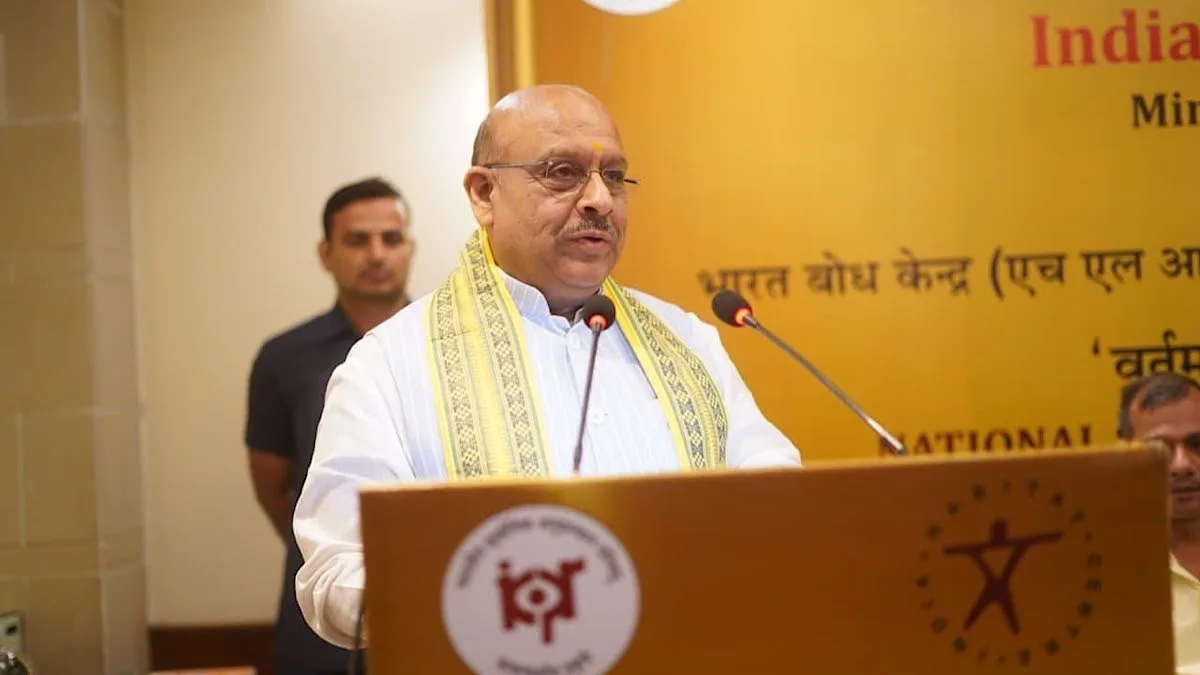
Delhi Assembly Speaker Vijender Gupta on Saturday said that democracy is strengthened when debate is guided by dignity, logic and facts, adding that “Shastrarth” is not about defeating an opponent, but discovering the truth.
Addressing the inaugural session of the two-day national seminar on “Vartaman Samay Mein Shastrarth” as the Chief Guest on Saturday, Gupta emphasised that the revival of India’s ancient tradition of “Shastrarth” is not merely a philosophical imperative, but a social and democratic necessity in contemporary times.
Advertisement
The seminar has been organised by the Indian Council of Philosophical Research (ICPR) in collaboration with Bharat Bodh Kendra. Addressing scholars, academicians and distinguished guests, Gupta described Shastrarth as the very soul of India’s knowledge tradition.
Referring to the dialogues of the Upanishads and the historic debate between Adi Shankaracharya and Mandana Mishra, he said that Indian civilisation has always accorded the highest place to reasoned dialogue, intellectual inquiry and the pursuit of truth.
He observed that in the Indian tradition, truth was never imposed, but tested through logic and debate, giving rise to the timeless principle, “Vāde Vāde Jāyate Tattva Bodhah”—the realisation of truth emerges through discussion and deliberation.
Expressing concern over the contemporary discourse ecosystem, the Speaker remarked that while the present age is rich in information, it is increasingly witnessing a decline in patience, listening and meaningful dialogue.
He noted that social media has provided every individual with a platform to express opinions, but society must also cultivate the ability to listen to differing viewpoints.
Gupta stressed that constructive dialogue remains the cornerstone of a healthy democracy and a harmonious society.
Drawing parallels between Shastrarth and democratic institutions, Gupta stated that legislative debates represent a modern manifestation of the ancient tradition of intellectual discourse.
Throwing light on meaningful discussions, he noted that they generate intellectual churning that ultimately leads to better governance and informed decision-making.
Gupta underscored the distinction between Shastrarth and mere argumentation, observing that the objective of Shastrarth is the search for truth rather than the defeat or humiliation of an opponent.
He said that India’s civilisational ethos values openness, fairness and impartiality, while citing the role of Bharati, wife of Mandana Mishra, as the adjudicator in the debate between Adi Shankaracharya and Mandana Mishra.
He further highlighted that values such as self-discipline, sacrifice, compassion and dialogue have been central to Indian culture and continue to offer guidance in addressing contemporary challenges.
The Delhi Assembly Speaker emphasised that strengthening cultural roots and drawing inspiration from India’s intellectual heritage are essential for nurturing a confident and value-based society.