West Bengal: The only Hindu Homeland blended in secular India
The creation of West Bengal as a state and its inclusion in India is an amazing case study in the political history of India.
After years of debate and contention, 20 June is finally going to be observed as the birthday of West Bengal, thanks to the resolution of the newly formed government of the Bharatiya Janata Party.




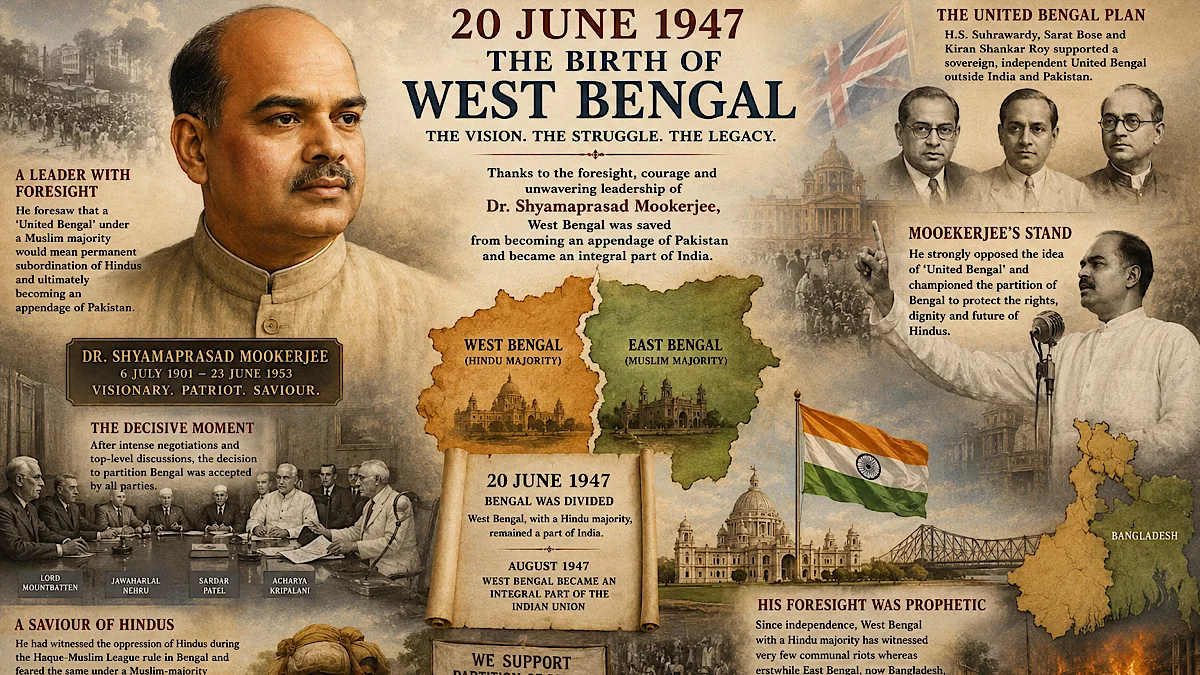
Photo:AI
After years of debate and contention, 20 June is finally going to be observed as the birthday of West Bengal, thanks to the resolution of the newly formed government of the Bharatiya Janata Party. The bifurcation of Bengal (the second and the decisive one after the first division in 1905) and creation of West Bengal owes its origin to the indefatigable leadership of Shyamaprasad Mookherjee who championed the idea of a ‘Hindu homeland’ within the Indian union.
A brief analysis of historical facts will clearly reveal Mookerjee’s contribution in this context. During 1946 and the early part of 1947 when Punjab was seething with communal clashes and intensified rioting causing an acute political crisis of governability that could not be salvaged without countenancing the League’s demand for Pakistan, in Bengal a section of the provincial leadership had taken a distinct stand in favour of “United Bengal”.
Advertisement
In fact, this movement was initiated by the then Bengal premier, Huseyn Shaheed Suhrawardy for a separate sovereign dominion outside India and Pakistan for which he demanded British support, with a gesture to join the British Commonwealth as a loyal member. Apparently, the idea was quite innovative and seemed sustainable for the twin reasons of economic viability of both parts of resource-rich Bengal and also for maintaining Hindu-Muslim solidarity. Some prominent Congress leaders of the day, particularly Sarat Bose (the elder brother of Subhas Bose) and Kiran Shankar Roy (the-then President of the Bengal Congress), strongly supported the idea of a sovereign Bengal.
Advertisement
met the Governor, Lord Mountbatten on 14 May 1947 to inform him about the ongoing discussions with Kiran Shankar Roy and Sarat Bose regarding the formation of a sovereign, democratic united Bengal. However, inside this camp there was a difference of views insofar as Sarat Bose was inclined towards an independent socialist Bengal while Suhrawardy preferred a pro-Western independent Bengal. On this issue, the Hindu Mahasabha leader, Shyamaprasad Mookherjee took a completely different stand.
From the very beginning he was sceptical about the idea of a “United Bengal” because with his foresight he could understand that it would amount to permanent political subordination of the Hindus to the Muslim majority. The proponents of a united Bengal argued that the western part of Bengal had a good industrial infrastructure and the eastern part was rich in raw materials and hence a united Bengal would become both agriculturally and industrially prosperous.
This argument did not appeal to those who opposed the scheme. The logic could neither convince Mookherjee nor the powerful trio of the Congress namely Nehru, Patel and Acharya Kripalani. On the other hand, the plan for a united Bengal was supported by Jinnah and his Muslim League. This made the Hindu Mahasabha leaders deeply disturbed as Mookherjee, in particular, was afraid of the demographical factors. While in the eastern part of Bengal there was a Muslim majority, in the western part there was a Hindu majority; but in united Bengal Muslims enjoyed an overwhelming majority.
So, in united Bengal Muslims would certainly dominate Hindus both numerically and politically as it happened during the Krishak Praja party-Muslim League coalition government. Moreover, a pertinent point arises here as to why did Jinnah support this move for a united Bengal? Jinnah who wanted East Bengal to be a part of his proposed Pakistan must have felt, Shyamaprasad feared, that a united sovereign Bengal under a Muslim majority would become an appendage of, and subsequently, a part of Pakistan.
Thus, the creation of a separate and independent Bengal would practically result in the whole of Bengal being gifted to Pakistan. For this reason, Mookherjee and the Hindu Mahasabha campaigned in favour of partitioning Bengal into a Muslim-majority state of East Bengal and a Hindu-majority state of West Bengal within India. After a series of negotiations and top-level discussions the decision to partition Bengal was accepted by all parties. This ultimately led to the division of Bengal on 20 June, 1947, and the newly born state of West Bengal became an integral part of the Indian union in August 1947.
This, in short, is the story of the birth of West Bengal and the role of Shyamaprasad Mookerjee in saving the western part of Bengal with a Hindu-majority from becoming an appendage or a part of Pakistan. Mookerjee had the experience of Muslim oppression of Hindus during the Haque-Muslim League coalition in Bengal and feared that similar oppression would be there in a Muslim-majority united Bengal.
He is therefore regarded by his followers as a saviour of Hindus. Mookerjee envisioned a “National Home” for Hindus, where they could find dignity and security after the 1947 Partition. That Mukherjee’s foresight was prophetic is proved by the fact that since independence, West Bengal with a Hindu majority experienced very few instances of communal riots whereas erstwhile Muslim-dominated East Bengal, now Bangladesh, has undergone far too many events of communal atrocities.
(The writers are, respectively, former Professor, Dept. of Political Science, Calcutta University, and Professor, Dept. of Political Science, Sidho-Kanho-Birsha University, Purulia)
Advertisement