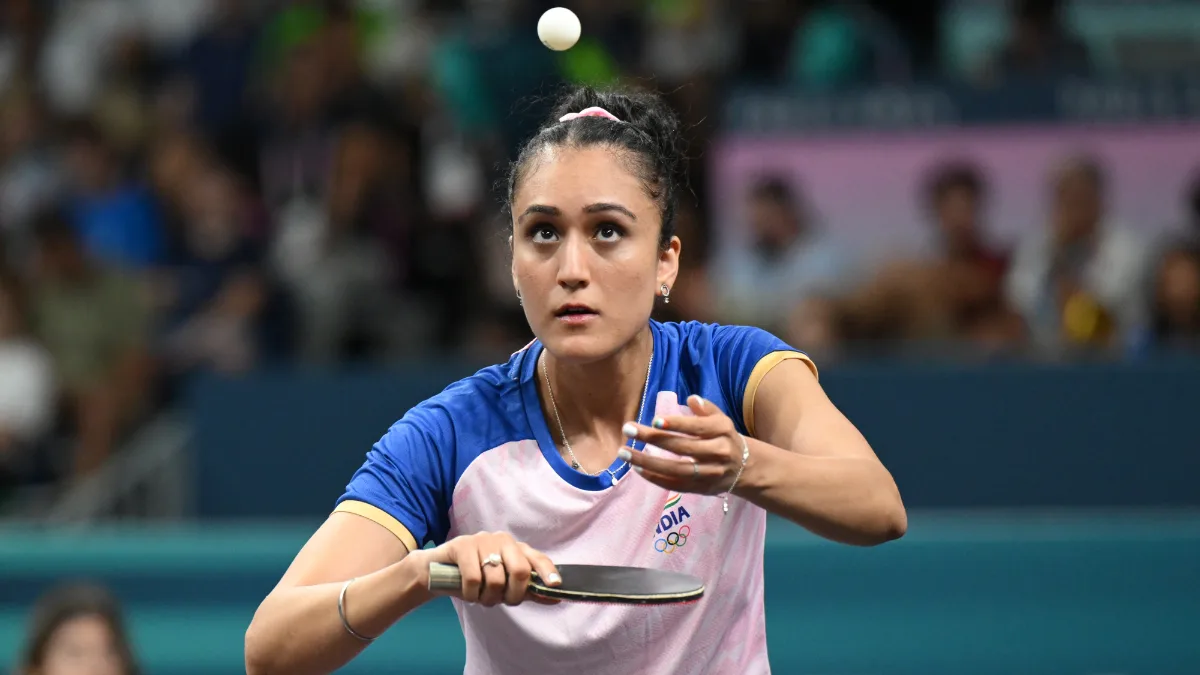
India’s star paddler Manika Batra has raised serious concerns over her exclusion from the country’s main table tennis squad for the Asian Games 2026, calling for greater transparency and accountability in the selection process after being named only among the reserves.
The Table Tennis Federation of India (TTFI) on Wednesday announced a 10-member men’s and women’s contingent for the Asian Games in Aichi-Nagoya, Japan, with Olympians Sreeja Akula and G Sathiyan set to lead the squads.
Advertisement
While Sreeja, Yashaswini Ghorpade, Diya Chitale, Sutirtha Mukherjee and Syndrela Das were selected in the women’s team, three-time Olympian Manika Batra was placed among the reserves alongside Swastika Ghosh.
The decision has sparked debate, considering Manika remains one of India’s most decorated table tennis players and is currently the second-highest-ranked Indian woman on the international circuit.
Why was Manika left out?
According to the selection policy, squad members were chosen using a formula that assigns 50 per cent weightage to national rankings, 40 per cent to world rankings and 10 per cent to the selection committee’s discretion.
Manika’s absence from several domestic competitions impacted her national ranking, ultimately affecting her overall selection score despite her international standing. As a result, she failed to secure a place in the final five-member women’s squad and was instead named as a reserve.
The 31-year-old, however, has questioned how the criteria were applied and has sought a detailed explanation from the federation.
Manika seeks intervention, demands clarity
In a statement posted on social media, Manika urged Sports Minister Dr. Mansukh Mandaviya and the Indian Olympic Association to examine the selection process.
“My exclusion from the Asian Games 2026 squad is deeply disheartening, not only because of the outcome, but because of the manner in which the selection criteria appear to have been interpreted and applied. No specific reason has been communicated to me.”
“I respectfully request the Hon’ble Sports Minister and the leadership of the Indian Olympic Association to kindly look into this matter to ensure that the process is transparent, consistent, and fair to all athletes,” she added.
Questions over selection criteria
Manika said the federation must clearly explain how the selection formula was applied in her case.
“I am seeking full clarity and accountability so that there is no ambiguity in how selection decisions are made at the highest level.”
“As per publicly reported information, the selection framework is understood to be based on a combination of world ranking, national ranking, and selection committee discretion. If this is indeed the case, then transparency requires that each component and its application be clearly explained to the athletes concerned.”
She further claimed that players with comparable ranking positions had been selected under special considerations in previous Asian Games cycles.
“I also note that during the previous Asian Games selection cycle, players who were outside similar ranking thresholds in both World Ranking and National Ranking were still included in the squad under special considerations and were given special privileges.”
“This makes it important that the present selection clearly explains how the same or similar principles have been applied or not applied in my case.”
World No. 51 is only marginally outside top 50
One of Manika’s key arguments centres around her current world ranking.
The Delhi paddler is presently ranked World No. 51, narrowly outside the top 50, and believes such a small difference should not outweigh years of international success.
“With respect to world ranking, I am currently World No. 51, having moved just outside the Top 50 very recently. The margin is extremely narrow, and I remain very close to that bracket.”
“I have not dropped to a distant range; rather, I am at a marginal difference where movement in either direction can occur within a single ranking cycle. In such a context, I find it difficult to understand how this alone becomes a decisive factor outweighing long-standing performance at the highest level.”
Manika also pointed to her performances against top international opponents this season, arguing that her current form warranted selection.
“In my case this season, I have been more consistent in performance and have recorded wins against strong international opponents, including U-19 youth champions from China and several other top Asian players. My current form reflects consistency at a high international level.”
She further defended her limited participation in domestic events, stating that international commitments often make it difficult for elite athletes to compete in every national tournament.
“With the increasing number of international tournaments and the demands of maintaining consistent performance at the highest global level, it is not always feasible to participate in every domestic event.”
The former Commonwealth Games champion stressed that the use of discretionary selection must be transparent and uniformly applied.
“A key concern remains the consistency of application of selection norms. If discretion forms even a small part of the process, then the manner in which it is applied must be transparent, uniform, and clearly recorded.”
“Any variation in its application naturally raises questions of fairness and equal treatment.”
Manika confirmed that she has formally sought a detailed explanation from the federation regarding her exclusion.
“I have formally sought a detailed explanation regarding my non-selection, including the complete basis of the decision, applicable norms, selection criteria, and the manner in which each factor was weighted in my case. I expect a clear, structured, and factual response supported by documented criteria.”
Table tennis competitions at the Asian Games 2026 will be held from September 20 to 28 in Japan. India have won three table tennis medals in Asian Games history, with Manika playing a key role in the country’s breakthrough successes in recent editions.
India’s Asian Games squad
Men: G Sathiyan, Harmeet Desai, Manav Thakkar, Manush Shah, Payas Jain.
Women: Sreeja Akula, Yashaswini Ghorpade, Diya Chitale, Sutirtha Mukherjee, Syndrela Das.
Reserves: Ankur Bhattacharjee, Ronit Bhanja (men); Swastika Ghosh, Manika Batra (women).