There Are moments in history when a nation’s progress stops being incremental and becomes directional. India is living through one such moment. For decades, the global conversation around India was framed on “potential”. I have always said, light-heartedly of course, that we have always been pregnant with potential, always in labour, but the delivery never in sight.
We were seen as a nation of scale: a large market, a youthful population, a vibrant democracy, and an entrepreneurial culture waiting to be fully unleashed. The promise was evident. What was less certain was the mechanism by which that promise would be converted into capability. That mechanism is now becoming clear. It is innovation. Not innovation as a slogan or an aspiration, but innovation as a national operating system. Innovation in India is alive, well, vibrant, and increasingly outward-looking and globally relevant. Today, the question is no longer whether India can participate meaningfully in the global economy.
Advertisement
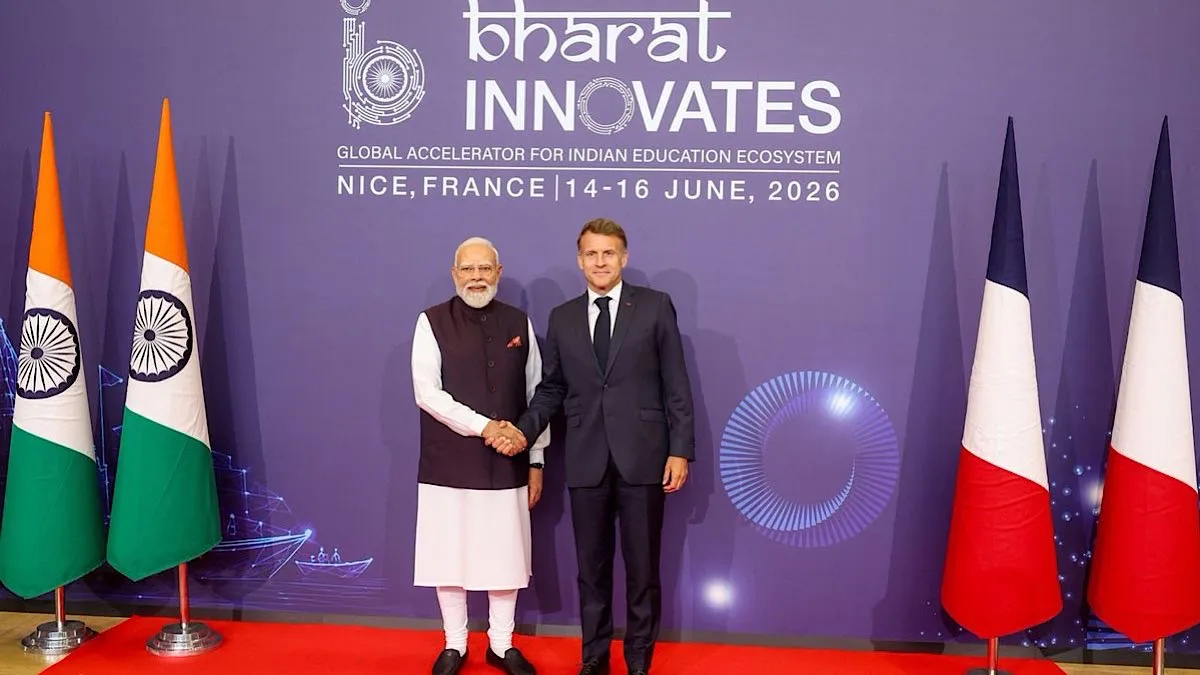
It is increasingly whether the world can afford to ignore India’s potential for creating a better world through its capacity to create democratized innovation. And it is precisely what Bharat Innovates, inaugurated in France under the leadership of Prime Minister Modi and President Macron, symbolises. At one level, it is a celebration of India’s innovation ecosystem. At another, it is something far more consequential: a recognition that India’s innovation journey is no longer simply a national story. It is becoming a global one. The last decade has been foundational for India.
Government-led initiatives such as Startup India, Digital India, Aadhaar, and UPI have built bold policy frameworks designed to encourage entrepreneurship, digitisation, and financial inclusion. Aadhaar today is the world’s largest biometric ID system, covering well over 1.4 billion people. UPI processes over 22 billion transactions every month, which is nearly 50 per cent of global real-time payments volume. Jan Dhan has brought over 560 million people into the banking system. These are not just scale numbers. They reflect growing trust in systems. This policy, however visionary, is only the beginning. Its true purpose is not to substitute enterprise but to unleash it.
India is now entering its next chapter – from policy-led frameworks to industry-driven execution. That is what makes Bharat Innovates, being organized by the Ministry of Education, Government of India, so significant. It is more than an event. It is a signal that India’s innovation economy is ready to engage the world not simply as a participant, but as a partner. By convening Indian innovators, global corporations, universities, and investors, Bharat Innovates does something critically important: it compresses the distance between invention and commercialisation, between capital and ideas, between local ingenuity and global relevance. That is how ecosystems accelerate.
The breadth of startups showcased in Bharat Innovates is impressive. Deep-tech, Artificial Intelligence, Semiconductors, Biotechnology, Food and Agriculture, Climate technologies, Advanced manufacturing, Mobility, Security, Space, to mention just a few. These are not the usual software or services sectors. These are frontier sectors that will shape tomorrow’s prosperity. The common thread running through them is that they are largely dedicated to affordability, inclusion and public good.
Each is transformative on its own. Taken together, they are multiplicative. India’s digital public infrastructure has become a global case study for the world. UPI demonstrated what happens when digital infrastructure is designed as a public good. Aadhaar showed what scale can look like when inclusion becomes a design principle. Systems like these are not merely technological achievements. They are demonstrations of a larger principle, that innovation should not merely create value, it should democratise value.
That is India’s distinctive edge: the ability to innovate not only for sophistication, but for affordability, accessibility, and scale. That is increasingly what the world needs. The next challenge is to apply that same philosophy to deeper industrial capability. No innovation ecosystem thrives on ideas alone. It thrive s on alignment and connections. The most successful innovation economies have mastered one formula: the seamless linkage between industry, innovators, and investors. I like to call this the Virtuous Triangle between Industry, which identifies real-world challenges, Innovators – who imagine and engineer solutions, and Investors – who provide patient capital and conviction. When these operate separately, progress is episodic.
When they operate together, progress compounds. India is now strengthening this triangle. Startups are no longer just app builders. As the line-up at this event shows, they are solving deep tech, climate tech, and industrial and agri-tech challenges. Our corporations are becoming co-creators of innovation, learning to collaborate with startups and other innovators, helping them to build scale. Investors are becoming more willing to back long-gestation technologies, not just quick wins. What makes me truly proud is that India’s innovation story has a distinctive character. It is innovation with a purpose. Our problems are real-world problems on a massive scale.
We build because millions still need access to health care, education, mobility, clean energy, finance, and opportunity. That forces us to innovate not only for excellence but for affordability, accessibility, and scale. India has long been known for jugaad – the ability to improvise under constraints. But, as I have been saying for over a decade now, the next phase requires a shift from jugaad to jhakaas – from improvisation to world-class innovation. Jugaad is a slang word that means to ‘make do’ with the resources you have. Constraint-driven innovation is not to be scorned, but I believe that we need to move decisively to innovation that is cutting-edge and globally disruptive.
The right slang term for that would be ‘jhakaas,’ which is often used colloquially to describe something that inspires awe. I believe that shift, from frugal ingenuity to globally competitive excellence, is now underway. In that sense, India’s innovation model may well be our greatest export. A blueprint for how democracies can grow sustainably and inclusively. Much has been written about India’s aspiration of becoming a Viksit Bharat by India@100 (2047). The phrase translates simply as “a developed India”. But its significance extends well beyond economics. It is not merely about GDP.
It is about capability – capability to invent, manufacture, solve at scale, always with a purpose. And ultimately, the capability to contribute meaningfully to global progress. At a time when many societies are wrestling with the tensions between technology and equity, India’s innovation journey offers an alternative possibility: that innovation can be both world-class and widely shared. That growth and inclusion can coexist. I am optimistic that one outcome of the Bharat Innovates event will be that the global question will shift: From: “Can India deliver?” To: “How can we partner with India’s future?”
(The writer is Chairman, Mahindra Group.)