Light follows darkness. After the 15-year long TMC era ~ most certainly a dark period in the socio-economic and political history of Bengal, people are now hoping for rejuvenation of a state that has fallen beyond the depth of anarchy and despair. They want to forget the nightmare and look for sunshine. “Keep your face always toward the sunshine ~ and shadows will fall behind you”, Walt Whitman had said.
Shadows, unfortunately, do not always disappear automatically, light has to be focused on them. In the TMC-free Bengal today, no one is talking about how to reintegrate the cross-bearers of the evil Syndicate Raj, the politically nurtured goonda force that kept the TMC flag flying during the last 15 years. Otherwise, the state’s future will remain insecure. Stories that are emerging now are increasingly pointing to the fact that the TMC was presiding over an elaborate machinery of extortion and intimidation of common people, and sabotage of the elections that prevented people either from casting their vote, or voting without fear.
Advertisement
The result of the Falta repoll clearly demonstrated how fear worked to their advantage. The structural nature of political violence and intimidation have been the subject of numerous articles and commentaries about how intensified cadre-based local control machinery was historically used by previous Left regimes to maintain themselves in power, a machinery that the TMC inherited and perfected.
During its earlier 34-years of rule, the CPI-M had built one of the most formidable party organizations in India through extensive grassroots networks that enabled land reforms, decentralized governance, and political mobilization and also enabled the party to maintain political control extending deep into villages, educational institutions, and trade unions. The TMC which inherited this apparatus adapted it most effectively to influence electoral outcomes, control access to government benefits and subsidies, and stifle political dissent through violence to create and reinforce fear. Local cadres ensured territorial control over specific villages or wards.
Musclemen dominated local economic hubs including fishponds (bheris) and rural market distribution lines, while the “syndicate” of politically supported goons ruled supreme over all material supply and construction, taking a cut for every brick laid anywhere. Residents who did not actively support the party faced economic boycotts or saw their trade licenses and livelihoods disrupted. During municipal and panchayat elections, musclemen physically prevented opposition candidates from filing papers, resulting in a high percentage of uncontested victories for the ruling party.
Political violence and post-poll killings became a recurring feature of electoral contests. Under the Left, party and the state had fused together to make Bengal a “party state”; under TMC, the party and the goondas together elevated it to an “Extortion state”. Institutions were subverted to serve the ruling dispensation, while goons operated with total immunity, secure in the knowledge that state machinery would always protect them, no matter what.
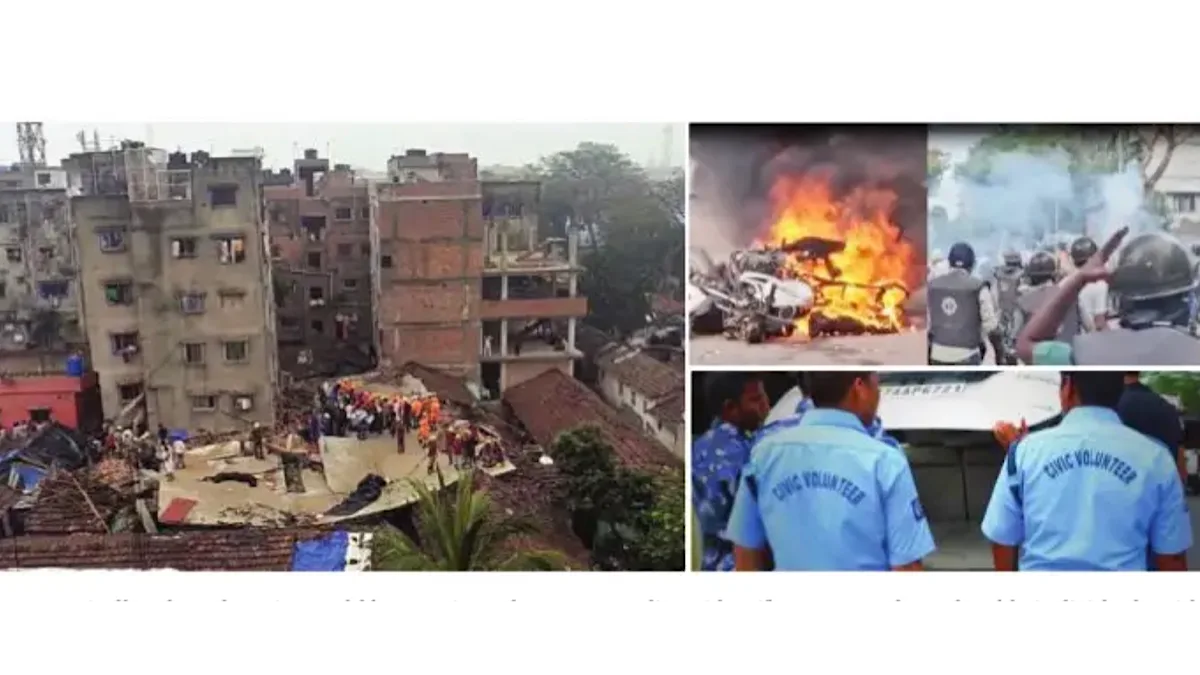
Economic opportunities became intertwined with political allegiance. One hopes that this Goonda Raj will never return to Bengal, to ensure that we must address the issue of rehabilitation of these misguided and directionless youth systematically who otherwise could be a serious drag on development. Their total strength is anybody’s guess, but it is by no means meagre. Over a lakh of them have been employed by the government as “Civic Volunteers” who were paid a monthly emolument of around Rs 12,000.
Lacking practically any employable skill, they were deployed to assist the police in various tasks like traffic management, providing assistance to the public at police stations, crowd control, delivering official communications and sometimes in disaster and emergency response, etc. But practically all they did was to extort money and carry out the Party’s orders. Thus, they became powerful and feared, and operated without any accountability at all. The government was spending a whopping Rs 1400 crore a year on this force which was practically controlled by the party, as was their recruitment. Many more were earning their livelihood through extortion.
Some of them may go to jail now for what they did during the TMC rule, but shall walk out free someday. Others may not have any employable skills to earn their living by independent and legal means. They are misguided and directionless, but youth nevertheless who possess energy and dynamism. They are products of a system that offered them no better alternative, and deserve to be brought into the mainstream by the new government through appropriate strategies, to provide them economic and employment alternatives. A state based on the rule of law needs regular policemen and not such volunteers.
Hence the government has no option but to terminate such volunteers and resort to regular recruitment which has been stalled in the state for a very long time. But simply terminating these workers without providing alternative livelihoods is no solution as it would drive them towards criminality and renewed political violence. Experiences from countries such as Colombia, Northern Ireland, and South Africa suggest that successful reintegration essentially requires three basic elements: A clear break from political patronage networks, social acceptance and rehabilitation and providing productive employment opportunities.
For redeploying them in government/ private sector, the first task will be to map their skills through a statewide skill audit to identify young and employable individuals with some basic education and semi-skilled workers with organisational, or logistical experience so that they be used as drivers or for providing security to buildings and commercial establishments. Some of them can also be employed in rural road construction under VB GRAM G, for canal and irrigation maintenance, river embankment strengthening, urban sanitation and waste management, and afforestation and environmental restoration, etc.
Some jobs may require training but not necessarily advanced educational qualifications, like in fisheries, poultry, dairy farming, food processing, etc. Villages often face labour shortages during certain agricultural seasons and the government may frame a suitable scheme to deploy these people in such activities. Growing cities also need manpower for parking management, municipal maintenance, solid waste management, urban greening projects, and there is scope for deployment in these areas also, under proper training and guidance.
There are several central government programmes that could potentially be used for reskilling like the Skill India Mission, the umbrella programme for vocational training and certification, Pradhan Mantri Kaushal Vikas Yojana, etc. and the state government may facilitate the youth to their advantage. Government may try to establish local community counselling centres to assist them in transitioning away from political violence and gang cultures into useful members of society, or train them through targeted technical programmes for formal jobs. Linking trainees with private-sector employers will be imperative for the success of such ventures.
They may be provided subsidized, low-interest micro-loans via schemes like Pradhan Mantri Mudra Yojana (PMMY) to start small businesses. There are many central/ centrally sponsored schemes and institutions like National Skill Development Corporation (NSDC) that provide short-term skill training and certification across multiple sectors and also work with training providers and industry partners to improve employability. Schemes like the Deen Dayal Upadhyaya Grameen Kaushalya Yojana focus on rural youth from low-income households, while the National Urban Livelihoods Mission supports skill development and self-employment among urban residents.
Only through such sustained efforts can the dependence on political patronage be transformed into marketable skills and productive employment. The government may also engage community leaders, civil society groups, educational institutions, etc. to offer them constructive social avenues for growth.
West Bengal is a dismal place today for industry, manufacturing or construction, but once these activities hopefully pick up and the formal sector starts reviving, the government may partner with private manufacturing, logistics, and construction firms to absorb local workers into formal, regulated employment. Civic volunteers may be trained, with a stipend if needed, for specific jobs which a rising economy will demand, though they must not be employed with the government any more. The bottom line is clear ~ a new Bengal cannot afford to leave its youth lost to their uncertain fates.
(The writers are, respectively, former Director General, CAG of India, and former Executive Director, NTPC)