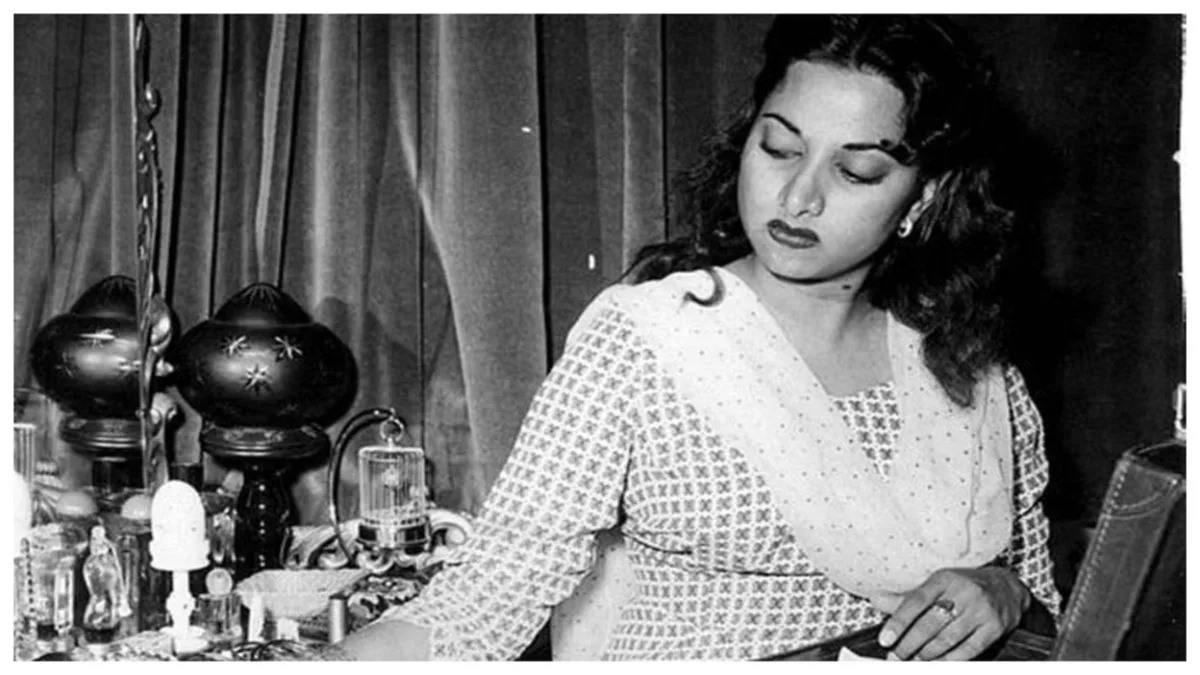
June 15 marks the birth anniversary of Suraiya Jamal Sheikh. She was born on June 15, 1929, and went on to become one of the most celebrated actresses in the history of Indian cinema. Most Gen Z audiences know Bollywood through Instagram reels and Netflix releases. Suraiya predates all of that by decades. But that is exactly why she matters. In a career spanning from 1936 to 1964, she acted in over 70 films and sang 338 songs. She did not lip-sync to someone else’s voice. She sang every song herself.
There was a time in the late 1940s and early 1950s when Suraiya was the highest-paid actress in Hindi cinema. She was paid more than her male co-stars. That is a fact. In an industry built on male dominance, she sat at the very top of the pay scale. Her fans did not just watch her films. They followed her everywhere.
Advertisement
Here are the films that define her legacy and deserve a proper watch today.
Anmol Ghadi (1946)
Anmol Ghadi was directed by Mehboob Khan and featured Surendra, Noor Jehan, Suraiya in the lead roles. The plot follows childhood sweethearts Chander and Laila who are separated when Laila’s family moves to Bombay. Years later, Chander follows and discovers Laila is already engaged to his friend Prakash. Laila’s friend Basanti, played by Suraiya, develops feelings for Chander, which leads into a tragic love triangle.
The film became the highest-grossing film at the Indian box office in 1946. The music was composed by Naushad, and the soundtrack was a national craze. The film also featured Mohammed Rafi’s first notable song, “Tera Khilauna Toota Balak.” Suraiya was not even the top-billed star in this one. She played a supporting role. But she still managed to own every frame she appeared in.
For Gen Z, this film is a lesson in how stories about love, loyalty, and loss do not need CGI or background scores dripping with synths. Raw emotion and good music do the job just fine.
Dard (1947)
Dard was described as Suraiya’s first big hit, and the film turned her into a popular singing star almost overnight. The film was a Muslim social romantic drama involving a love triangle, with two women both in love with a doctor. The music director was Naushad, and the lyricist was Shakeel Badayuni, who had just arrived in Bombay in 1946.
The film dealt with sacrifice. Suraiya’s character gives up her love for someone else’s happiness. It sounds like a tired trope today, but the way she played it was anything but. The songs from Dard continue to remain popular to this day, which says everything about the quality of work that went into them. If you want to understand where Hindi film music found its emotional vocabulary, this is a good place to start.
Pyar Ki Jeet (1948)
Pyar Ki Jeet was the third highest-grossing Indian film of 1948. It starred Suraiya opposite Rehman, with music composed by Husnlal Bhagatram.
The impact of this film went far beyond the box office. When Pyar Ki Jeet was released, it caused large crowds to gather outside Suraiya’s house that had to be controlled by posting an inspector and four constables. That is not a PR stunt. That is a superstar. Songs like “Tere Nainon Ne Chori Kiya” and “O Door Jaanewale” were hummed across the country. The film showed Suraiya at the height of her powers as both an actress and a singer, and it announced to everyone that she was the biggest female star in Hindi cinema.
Badi Behen (1949)
In Badi Behen, Suraiya played a protective older sister. The film paired her again with actor Rehman. At the premiere of Badi Behen, there was a very large crowd outside the cinema hall and the police had to baton-charge when Suraiya arrived. People pulled at her clothes, so after that, she stopped going to the premieres of her films.
Let that image sink in. A film premiere in 1949 that required a lathi charge. Songs from this film like “Woh Paas Rahe Ya Door Rahe” and “Bigdi Bananewale” entered everyday life. With Pyar Ki Jeet, Badi Behen, and Dillagi, she became the highest-paid female star of her time.
Dillagi (1949)
This film is perhaps the most interesting recommendation on this list for Gen Z, purely because of its source material. The plot of Dillagi was adapted from the 1939 William Wyler film of Wuthering Heights. Suraiya starred opposite Shyam. The story was a romantic tragedy and became commercially successful, being the fourth highest-grossing film of the year.
Deepa Gahlot included the film in her book 50 Films That Deserve a New Audience. That alone should be enough reason to track it down. Naushad composed the music, and “Tu Mera Chand, Main Teri Chandni” from this film became one of the most iconic songs of Suraiya’s career. The film is proof that Bollywood was in conversation with world cinema long before anyone thought to give it credit for it.
Mirza Ghalib (1954)
This is the one. If you watch only one film from this list, make it Mirza Ghalib.
Directed by Sohrab Modi, the film stars Bharat Bhushan as Ghalib and Suraiya as his tawaif lover, Moti Begum. The story was written by Saadat Hasan Manto, and music was composed by Ghulam Mohammed.
The film won the President’s Gold Medal for the All India Best Feature Film and the President’s Silver Medal for Best Feature Film in Hindi at the 2nd National Film Awards.
Prime Minister Jawaharlal Nehru praised Suraiya’s performance by saying, “Tumne Mirza Ghalib ki rooh ko zinda kar diya,” which translates to “You have brought the soul of Mirza Ghalib back to life.” Two sitting Prime Ministers of India praised her work in this film. That is not a small thing.
The music features the immortal ghazals and nazms of Ghalib, sung by Suraiya and Talat Mahmood and composed by Ghulam Mohammed. Suraiya did not just recite the words. She felt them. Her performance as Moti Begum is considered the finest of her entire career. For anyone who has ever read a single line of Ghalib and felt something, this film is essential.
Why now?
Suraiya quit acting at the age of 34. In 1996, she received the Screen Lifetime Achievement Award for her work in Indian cinema. She never married. Despite ruling the Hindi film industry and having a massive fanbase, Suraiya quit acting and left the world of glam at 34.
She was a woman who earned the most in a male-dominated industry, who sang her own songs without formal training, and who walked away on her own terms. During her most famous years, people called her Malika-e-Husn, meaning the queen of beauty, and Malika-e-Adakari, meaning the queen of acting.
Both titles were earned. Go watch the films.