For generations, Indian society has perfected a contradiction. It has revered mothers as selfless nurturers, praised wives as the anchors of the household and celebrated sacrifice as an essential feminine virtue. Yet when it came to economics and the law, the labour that sustained families was often dismissed as “non-earning” and therefore unworthy of serious recognition.
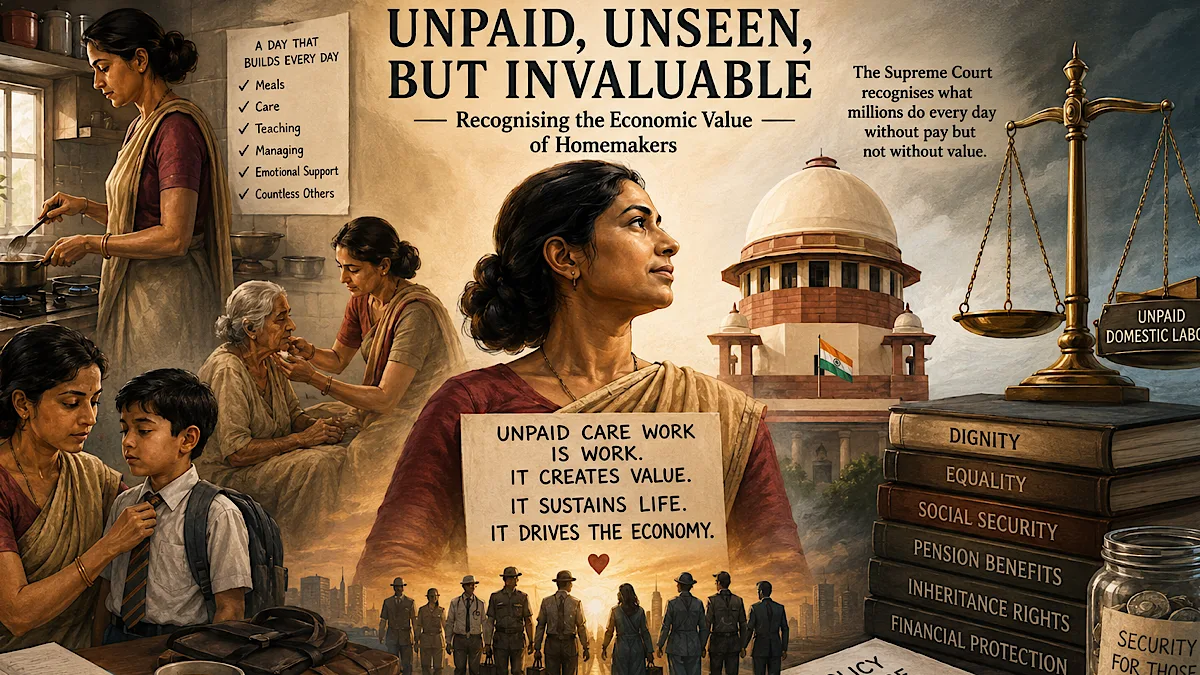
That contradiction is finally being confronted. The significance of the evolving judicial approach towards homemakers lies not in sentiment but in economics. It acknowledges an uncomfortable truth: unpaid care work is work. It creates value, supports productivity and forms the invisible foundation upon which the formal economy rests. Every working day begins with labour that rarely appears in statistics. Meals are prepared before office-goers leave for work. Children are prepared for school.
Advertisement
Elderly relatives are cared for. Household crises are managed. Emotional support is provided during moments of stress and uncertainty. These activities do not generate salaries, invoices or tax returns. Yet they make it possible for millions of people to participate in paid employment and contribute to economic growth. Conventional measures such as Gross Domestic Product have failed to account for this reality. Feminist economists across the world have argued that by excluding unpaid domestic and caregiving labour, societies underestimate both women’s contribution and the true cost of sustaining life.
The economy recognises the wage paid to a domestic worker but not identical work performed within one’s own home. The distinction may suit accounting systems, but it does not reflect reality. Recognising the economic value of domestic labour is therefore not an exercise in generosity. It is an attempt to correct an institutional blind spot. It challenges the notion that worth can only be measured through market participation.
More importantly, it strengthens the idea that dignity should not depend solely on the possession of a payslip. However, recognition alone will not transform the lives of homemakers. Courts can influence social attitudes, but they cannot substitute for public policy. Questions relating to social security, pension benefits, inheritance rights and financial protection for those who spend decades performing unpaid care work require legislative attention. Equally important is ensuring that caregiving itself does not remain an obligation imposed on women.
A more equal society values care while also sharing its burdens. Ideas shape institutions, and institutions shape culture. The immediate trigger for this debate is a recent Supreme Court ruling arising out of a motor accident compensation case. In recognising the economic contribution of a deceased homemaker, the court moved beyond treating homemakers as “non-earning” dependents and sought to assign a realistic value to unpaid domestic labour. In doing so, it sent a powerful message about what societies choose to value ~ and what they choose to ignore. India’s homes have always generated wealth of a different kind: raising children, caring for the vulnerable and sustaining those who drive the economy. Recognising that truth is not an act of charity. It is an overdue act of honesty.