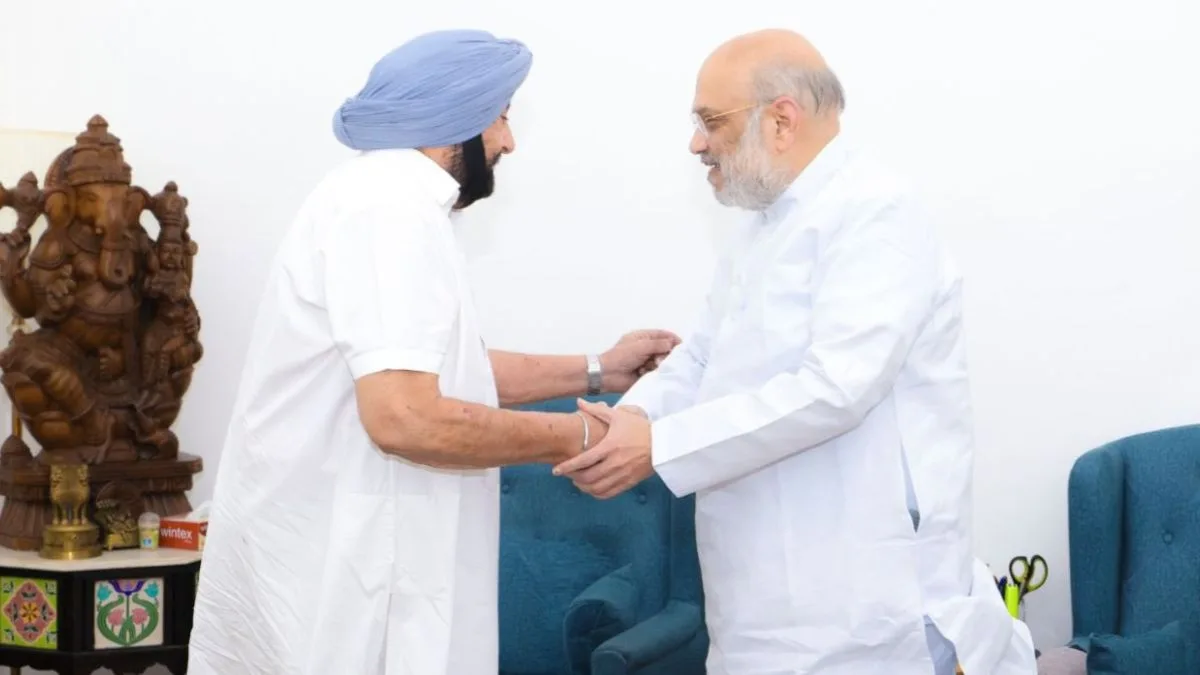
When former Punjab Chief Minister Capt Amarinder Singh walked into New Delhi this week to meet Union Home Minister Amit Shah and J.P. Nadda, the official statements were brief and predictable. Punjab-related issues were discussed, both sides said.
But in politics, the timing of a meeting often matters more than the contents of a press release.
Advertisement
Capt Amarinder Singh’s meetings with the BJP’s top leadership came at a moment when the Punjab unit of the party is witnessing unusual turbulence following the appointment of Kewal Singh Dhillon as state president. The development has sparked a larger conversation within political circles, not merely about organisational appointments, but about who really matters in the Punjab BJP and whether the party is struggling to balance old influence with new ambitions.
Unlike many senior leaders who prefer private negotiations, Amarinder Singh publicly questioned the appointment of Kewal Singh Dhillon.
The former chief minister made it clear that he was neither consulted nor convinced. More significantly, he questioned whether Dhillon could deliver what the BJP expects in Punjab ahead of the 2027 Assembly elections.
Those remarks carried weight because they came from a politician who has spent over six decades in Punjab politics, served twice as chief minister, led the Congress to a sweeping victory in 2017, and still commands influence among sections of Punjab’s traditional political class.
Within the BJP, many leaders may occupy organisational positions, but very few possess Amarinder Singh’s administrative experience, political network, and understanding of Punjab’s electoral sociology.
That is why his criticism could not be dismissed as routine dissent. The political significance of Amarinder Singh’s meetings lies in a simple question. If his concerns were insignificant, would the BJP’s top leadership have moved so quickly to engage with him?
For many leaders, securing a meeting with Amit Shah or J.P. Nadda can take months. Amarinder Singh publicly criticises a major organisational decision and soon finds himself discussing Punjab politics with the party’s highest leadership.
The message is unmistakable. Even at 84, Amarinder Singh remains a leader whom Delhi cannot afford to ignore.
The BJP understands that while electoral victories may increasingly depend on younger faces and new social coalitions, political credibility in Punjab still carries value. Capt Amarinder Singh represents a bridge between traditional Congress-era politics and the BJP’s ambitions in the state.
The appointment of Kewal Singh Dhillon was intended to give the BJP a stronger rural Sikh face. Dhillon, who joined the BJP after leaving the Congress, brings his own political experience and influence, particularly in parts of Malwa. However, his elevation has not received universal acceptance within the party.
Many BJP leaders privately believe that the appointment bypassed several long-serving leaders who had spent years building the organisation when the party had limited political space in Punjab.
The resignation of senior BJP leader and former IAS officer Jagmohan Raju from the post of state general secretary has only intensified such discussions.
Although Raju cited personal and public-interest commitments, the timing of his resignation has inevitably fuelled speculation about growing dissatisfaction within sections of the party.
The BJP may officially deny any crisis, but the sequence of events has ensured that questions continue to be asked.
Interestingly, while Amarinder Singh skipped the event where Kewal Singh Dhillon formally assumed charge as Punjab BJP president, Patiala MP Preneet Kaur attended the function.
Political observers interpreted her presence as a carefully calibrated message. The family was unhappy, but not rebellious.
For the BJP leadership, Preneet Kaur remains an important political asset. Her electoral victory from Patiala in 2024 demonstrated that the Amarinder-Preneet political network still retains relevance despite the Congress-BJP realignment that transformed Punjab politics over the past few years.
In many ways, Preneet Kaur serves as the BJP’s strongest reminder that the Amarinder brand has not completely faded from Punjab’s political landscape.
Adding further intrigue to the situation were Amarinder Singh’s recent comments regarding Rahul Gandhi. In a candid observation, Amarinder revealed that Rahul Gandhi had personally called him after the death of a close family member and expressed condolences. He also noted that no senior BJP leader had contacted him during that difficult period.
The remark was striking because it came from a leader who left Congress after a bitter political separation. While Amarinder Singh did not suggest any political realignment, his comments triggered fresh speculation in Punjab’s political circles.
For many observers, the statement was less about Rahul Gandhi and more about Amarinder Singh signalling his disappointment with sections of the BJP leadership.
Another important dimension of Punjab BJP politics involves Union Minister Ravneet Singh Bittu. The BJP sees Bittu as one of its most recognisable Punjabi faces and a leader capable of attracting urban and youth voters. However, his emergence has also changed internal equations.
With Sunil Jakhar, Kewal Singh Dhillon, Ravneet Bittu, Preneet Kaur, and Amarinder Singh all occupying significant political space, the BJP now faces a challenge it did not have a few years ago. Managing multiple influential leaders with different political backgrounds and support bases.
Unlike states where the BJP has a clearly established leadership hierarchy, Punjab remains a work in progress. Most of the party’s prominent Sikh faces are relatively recent entrants from the Congress or other political formations. Integrating these leaders while maintaining organisational cohesion is proving more difficult than anticipated.
Even though the immediate debate revolves around Dhillon and Amarinder Singh, the shadow of former Punjab BJP president Sunil Jakhar continues to loom large.
Jakhar had worked to expand the BJP’s acceptability beyond its traditional urban Hindu base and was viewed by many as a consensus-building figure.
Amarinder Singh, himself, publicly questioned whether there was any need to replace leaders like Jakhar. That comment reflected a broader concern among some BJP leaders that organisational continuity may have been sacrificed for political experimentation.
As Punjab moves closer to the 2027 Assembly elections, the BJP faces a delicate balancing act. It needs Kewal Singh Dhillon to succeed because he represents the party’s future strategy. It needs Ravneet Bittu because he offers electoral visibility. It values Preneet Kaur because she remains electorally relevant. And it cannot afford to alienate Capt Amarinder Singh because he still carries political stature unmatched by most leaders in the state unit.
The meetings between Amarinder Singh, Amit Shah, and J.P. Nadda suggest that Delhi understands this reality.
For now, there is no indication that Amarinder Singh is preparing to leave the BJP. Equally, there is no sign that he intends to stop speaking his mind. And perhaps that is the biggest takeaway from the week’s developments.
Punjab BJP may be changing, new leaders may be rising, and new strategies may be taking shape, but one message from Delhi is clear: when Capt Amarinder Singh speaks, the party still listens.