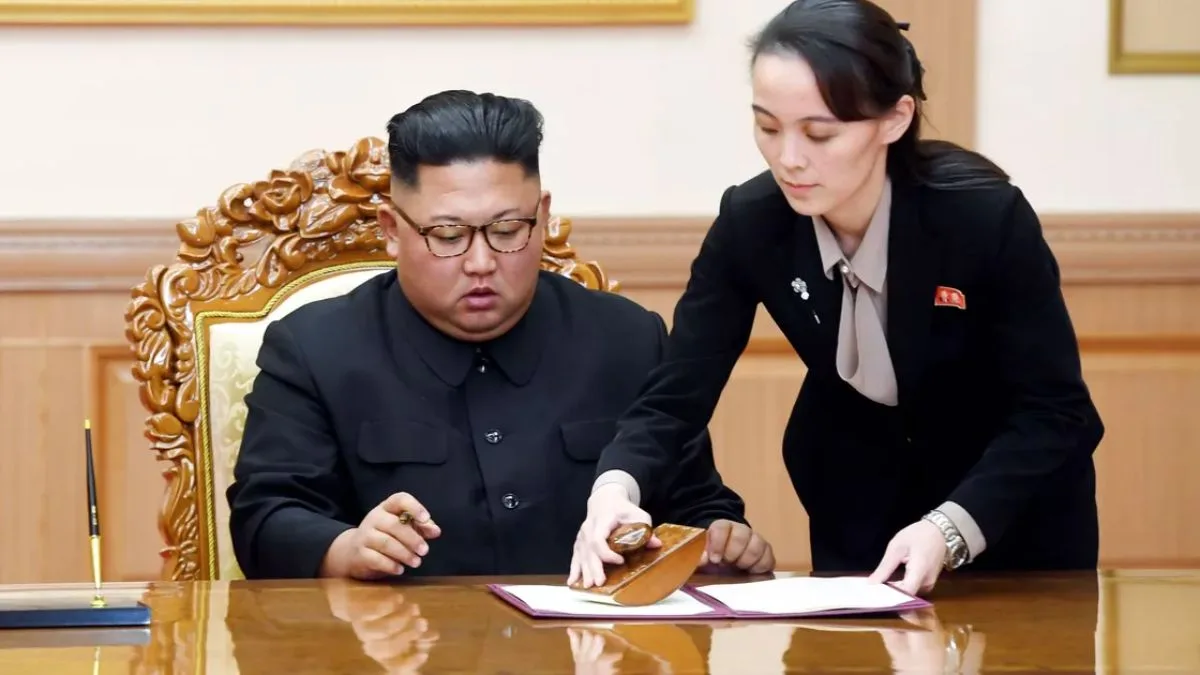
Kim Yo Jong, the sister of North Korean leader Kim Jong Un, declared that North Korea’s status as a nuclear power is “absolutely non-negotiable.” The statement was carried by North Korea’s official Korean Central News Agency (KCNA) on Thursday.
“Our status as a nuclear power is absolutely non-negotiable. We will not tolerate any threats,” she said.
Advertisement
Kim Yo Jong also said that US claims that Chinese President Xi Jinping and US President Donald Trump confirmed a goal to denuclearise North Korea during a May summit were “false,” adding that Pyongyang “has the most accurate information” regarding those claims.
She further stated that “the policy of continuously strengthening self-defensive nuclear war deterrence, as declared by the head of state, is an irreversible and final conclusion that must be executed unconditionally.”
Timing of the statement
The statement was issued on the eve of Chinese President Xi Jinping’s scheduled visit to Pyongyang, his first to the country in nearly seven years. China remains North Korea’s only formal treaty ally.
Xi is set to meet Kim Jong Un and exchange views on bilateral relations and issues of common concern, China’s foreign ministry confirmed.
The announcement of Xi’s trip came a day after North Korea unveiled a new facility to produce the material for nuclear bombs, which is believed to be a uranium enrichment plant, though North Korea has not confirmed that.
Who is Kim Yo Jong?
Kim Yo Jong was born on 26 September 1987 in Pyongyang. As of February 2026, she is the Director of the General Affairs Department of the Workers’ Party of Korea, a high-level appointment made during the first plenary meeting of the 9th Central Committee. Since March 2026, she has also served as an alternate member of the Politburo of the Workers’ Party of Korea.
She is one of the most powerful figures in North Korea and plays key role in shaping the country’s messaging and foreign policy.
The new nuclear facility
North Korea unveiled a new facility to produce nuclear bomb fuels earlier this week. During his visit to the plant, Kim Jong Un announced plans to bolster the country’s nuclear forces “at an exponential rate.”
The official Korean Central News Agency said the facility used “more sophisticated technology” but did not provide further details, including where it is located or when it began operations. State media photos showed what appeared to be a large centrifuge hall, indicating the plant is likely used to enrich weapons-grade uranium.
South Korea’s Joint Chiefs of Staff assessed the site as a uranium enrichment plant and confirmed they were closely coordinating with the United States to monitor North Korean nuclear activities. KCNA photos showed Kim walking through narrow aisles lined with dense rows of silver tubes and pipes, in what appeared to be a centrifuge hall.
This is the third time North Korea has publicly disclosed a uranium enrichment site. In 2010, it showed one at its main Yongbyon nuclear complex to visiting American scholars. In 2024, it released photos of another covert uranium enrichment plant, which experts believe was at its Kangson complex.
Ankit Panda, an expert with the Carnegie Endowment for International Peace, said: “Based on a preliminary analysis, it appears that this facility is likely the newly added Yongbyon enrichment facility. It appears to have two levels and represents a substantial expansion of enrichment capability. North Korea’s ongoing nuclear expansion does not have a near-term end in sight.”
Missile production orders
Kim Jong Un also visited a major munitions factory and ordered the country’s missile production capacity to be increased 2.5 times over the next five years, according to South Korea’s Yonhap News Agency, citing North Korea’s state newspaper, the Rodong Sinmun.
In a separate statement earlier this year, Kim Jong Un called for developing new weapons systems to bolster his nuclear-armed military, including intercontinental ballistic missiles that could be launched from underwater and an expanded arsenal of tactical nuclear weapons, such as artillery and short-range missiles, targeting South Korea.
North Korea’s nuclear policy history
In 2023, North Korea formally enshrined its nuclear power status in its constitution, codifying a policy first announced by Kim Jong Un a year earlier.
North Korea has long insisted on its right to nuclear weapons and ballistic missile programmes, even though both are forbidden under the terms of UN Security Council sanctions.
US President Donald Trump and Kim Jong Un met three times during Trump’s first term, but their diplomacy quickly collapsed over disagreements about ending US-led sanctions in return for North Korea taking steps to wind down its nuclear and missile programmes.
North Korea’s goals for nuclear weapons expansion are enshrined in its constitution. Kim Yo Jong has previously insisted that any external discussions of denuclearization constitute “the most hostile act” and amount to a denial of her country’s sovereignty.
China’s position
China remains Pyongyang’s most important political and economic partner, despite Beijing’s previous support for multiple United Nations Security Council sanctions targeting North Korea. In recent years, however, China’s approach toward North Korea’s nuclear ambitions has appeared to soften, as tensions between Beijing and Western countries have intensified.
Experts say Kim wants international recognition as a nuclear state so he can demand the lifting of sanctions. They say Kim would ultimately push for arms reduction talks with the US to win concessions in return for a partial surrender of his country’s nuclear capability.
Kim has been focusing on expanding his nuclear arsenal since his high-stakes diplomacy with Trump collapsed in 2019. North Korea’s alignment with Russia has also grown, with Kim sending troops and conventional weapons to support the war in Ukraine.
Warhead estimates
North Korea is believed to possess dozens of nuclear warheads alongside an increasingly sophisticated ballistic missile programme. Independent verification of these figures remains impossible, as North Korea does not permit international inspectors inside its borders. The International Atomic Energy Agency expelled its inspectors from North Korea in 2009 and has had no access since.