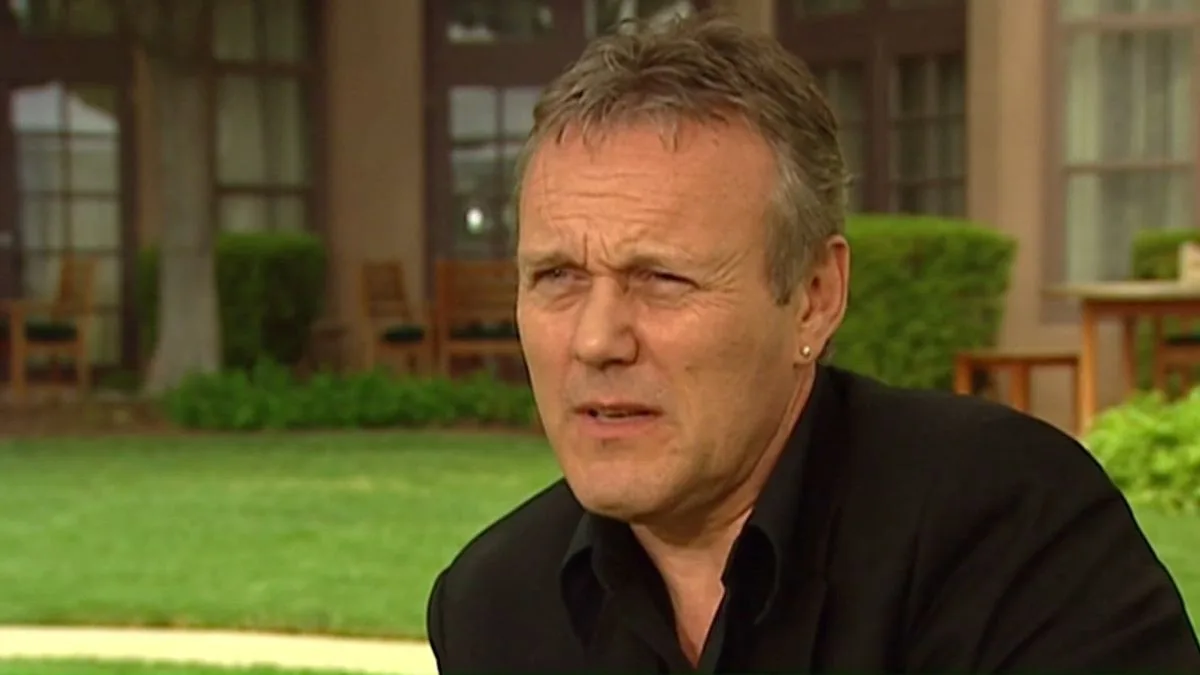
Anthony Stewart Head is no more. He was 72. His daughters Emily and Daisy confirmed in a statement to the BBC that he passed away peacefully from complications due to pneumonia, surrounded by his family. The news sent a wave of grief through television audiences on both sides of the Atlantic. Head had been, for many, a constant and reassuring presence on screen since the 1980s. He was funny, dignified, versatile, and genuinely talented in ways that often went underappreciated.
Origins and early life
Head was born Anthony Stewart Head on 20 February 1954 in Camden Town, north London. His father, Seafield Laurence Stewart Murray Head, was a documentary filmmaker and co-founder of Verity Films. His mother was the actress Helen Shingler. The family had theatre and storytelling in its bones. His older brother Murray Head became an actor and singer, best remembered for the hit single “One Night in Bangkok.” Anthony attended Sunbury Grammar School before training at the London Academy of Music and Dramatic Art, where he developed the theatrical discipline that would define his work for decades.
Advertisement
He cut his teeth in musical theatre. His first professional role was in the production of ‘Godspell’. He went on to play the title role in ‘Joseph and the Amazing Technicolor Dreamcoat’, and both he and his brother Murray separately played the role of Freddie Trumper in the musical ‘Chess’ at the Prince Edward Theatre in London. Murray was in the original 1986 cast; Anthony took the same role in the final 1989 run. The symmetry said something about the family’s deep theatrical roots.
The coffee ads that made him famous
Before Giles, before Merlin, before any of it, there were the coffee commercials. In 1987, Head was cast alongside actress Sharon Maughan in a campaign for Nescafé Gold Blend. What followed was unlike anything British advertising had produced. Across twelve serialised instalments running from 1987 to 1993, the two characters played out a slow-burning romance over cups of coffee. The ads were structured like soap opera cliffhangers. Audiences genuinely waited to find out what would happen next. The campaign hit the front pages, was spoofed by sketch comedians, and spawned a bestselling novel.
It made Head a household name. He later referred to the campaign with mixed feelings, calling it “the advert” in tones that suggested affectionate exasperation. But its cultural reach was real. It demonstrated something important about his appeal: he projected warmth and intelligence without strain. He was the kind of face you trusted. That quality would serve him throughout his career.
The West End and stage work
Alongside his television work, Head built a serious stage reputation. He played Frank N. Furter in the West End revival of ‘The Rocky Horror Show’ at London’s Piccadilly Theatre in 1990 and 1991, reprising the role in 1995 and a 2006 tribute production. He also played Captain Hook in ‘Peter Pan’ at the Savoy Theatre in 2003. His baritone singing voice gave him range and texture on stage that many screen actors simply cannot replicate. He recorded a solo album, ‘Music for Elevators’, in 2002, and contributed backing vocals to Chris de Burgh’s 1982 album ‘The Getaway’.
The stage work matters because it explains something about his screen performances. Head never came across as an actor who had learned television mannerisms. He carried weight and presence. Every character he played had a history behind the eyes.
Rupert Giles and the ‘Buffy’ years
In 1997, Head was cast as Rupert Giles in ‘Buffy the Vampire Slayer’. What could have been a thankless supporting role became something genuinely memorable. Giles was the Watcher: the scholarly, tea-drinking, cardigan-wearing British guardian assigned to train the Slayer. Head played him across all seven seasons of the show, appearing in 121 episodes. He also lent his voice to two ‘Buffy’ video games, the four-minute animated series pilot, and the 2023 podcast ‘Slayers: A Buffyverse Story’.
The role worked because Head never played Giles as a simple authority figure. He found the humour and the heartbreak in equal measure. When the show demanded it, he showed Giles’s dangerous past as a reckless young man known as “Ripper.” When it demanded grief, he delivered it quietly and convincingly. The relationship between Giles and Buffy, played by Sarah Michelle Gellar, became the emotional backbone of the series. It was a father-daughter dynamic built from mutual respect rather than biology, and it resonated with audiences who had never expected to care so much about a librarian.
In a 2008 BBC interview, Head said he appreciated the fans who came up to him. He told them that actors were ordinary people who had caught a break, and asked them not to put performers on pedestals. The comment was characteristically grounded.
Little Britain, Merlin, and later television
After ‘Buffy’ wrapped, Head returned to Britain and continued working across a wide range of projects. From 2003 to 2006 he played the Prime Minister in the sketch comedy ‘Little Britain’, created by Matt Lucas and David Walliams. The Prime Minister sketches were built on absurdist excess, and Head played his role with absolute straight-faced commitment, which was precisely why they worked.
From 2008 to 2012 he appeared in the BBC fantasy series ‘Merlin’ as King Uther Pendragon, the rigid and often tyrannical father of Prince Arthur. It was a more severe performance than most of his work, and he carried the moral weight of the character with conviction. He also contributed to BBC Radio 4’s ‘Cabin Pressure’, playing Herc Shipwright, a role that made considerable use of his distinctive baritone voice.
His final major recurring television role was Rupert Mannion in ‘Ted Lasso’, the Apple TV+ comedy drama that became a global phenomenon. Mannion was the smug, obstructive former owner of AFC Richmond, a character who existed in pointed contrast to the show’s relentless optimism. Head played the antagonist role with visible relish. It added another dimension to a career already full of them.
Personal life
Head was partnered with the animal welfare advocate Sarah Fisher from 1982 until her death in December 2025. They lived near Bath, Somerset, and had two daughters together. Emily Head, born in 1988, became an actress, as did Daisy Head, born in 1991. Both confirmed their father’s death in the statement released on 5 June 2026. Their words described him as an extraordinary father whose work had touched an enormous number of lives. He had, they said, loved his job very much.
Career worth more than its highlights
It would be reductive to pin Head’s legacy entirely to Rupert Giles, though the role will likely define how most people remember him. What his full career actually shows is a performer who understood how to inhabit different registers without losing coherence. He could anchor a long-running fantasy drama, steal scenes in a sketch comedy, carry a stage musical, and voice animated characters with equal facility. He moved between genres without ever appearing to calculate the move.
Anthony Head also brought a kind of decency to the profession. He did not court controversy. He spoke about his work with honesty and without vanity. And, he remained recognisably the same person across forty years of public life.