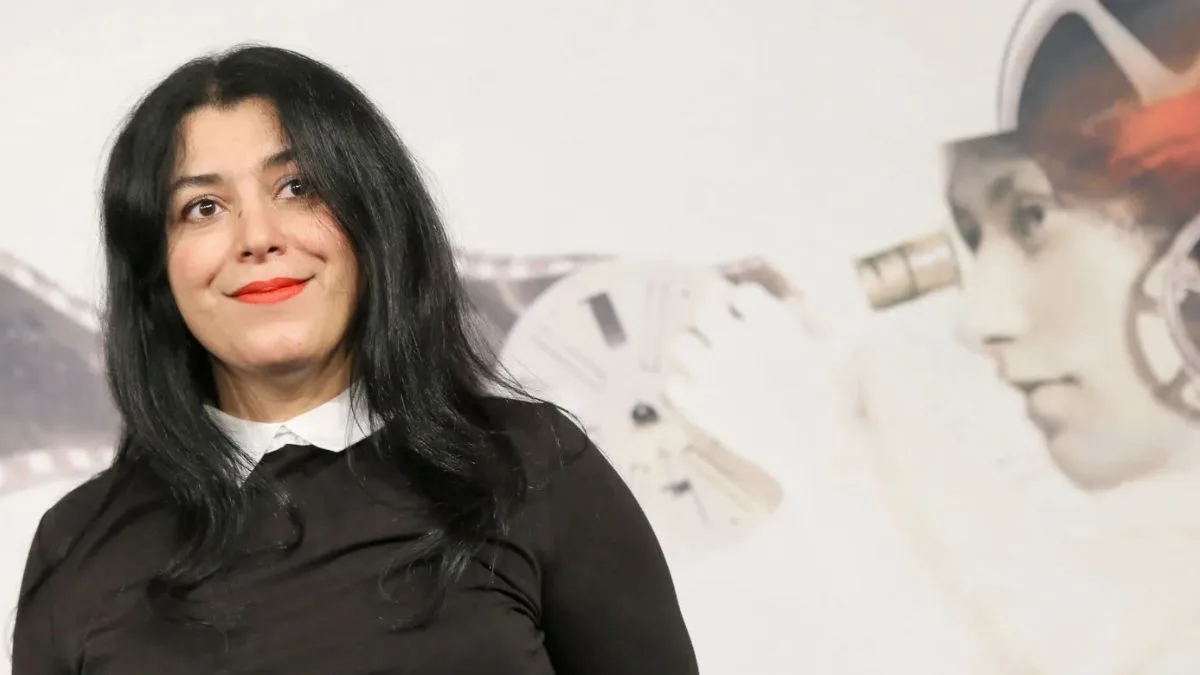
Marjane Satrapi, Iranian-French graphic novelist and filmmaker whose autobiographical work ‘Persepolis’ reshaped how the world understood Iran, died on June 4. She was 56. Her family released a statement saying she died of grief just over a year after the death of her husband and the love of her life, Swedish producer and screenwriter Mattias Ripa, who passed away on April 8, 2025. No further medical details were provided.
She was 56 years old. She was also, by any honest measure, one of the most consequential artists of her generation.
Advertisement
Childhood inside a revolution
Satrapi was born in Tehran in 1969. Her childhood was shadowed by polarization. She grew up in a communist-leaning household and studied abroad in Vienna and France as a young adult. The 1979 Iranian Revolution and its resulting theocratic regime indelibly altered her life.
She was 10 years old when Ayatollah Khomeini came to power. That timing mattered enormously. She was old enough to remember the Iran before the revolution. She was young enough to come of age entirely under its constraints. The combination gave her a double vision that would define her art.
After the revolution, her family’s Western way of life drew the attention of Iranian authorities. By 1984, her parents decided to send her to Austria to attend school. A failed relationship there exacerbated her sense of alienation and contributed to a downward spiral that left her homeless and using drugs. Satrapi returned to Tehran at age 19, studied art, and after a short-lived marriage, moved back to Europe in 1993. In France she earned a degree in art, and by the mid-1990s she was living permanently in Paris.
This biography is not just backstory. It is the raw material of everything she made.
‘Persepolis’ and the power of the graphic memoir
Published in four French volumes between 2000 and 2003, Satrapi’s autobiographical comic book became an international bestseller. It has since been translated into more than 20 languages.
The work chronicled her childhood in Iran during and after the 1979 revolution and her later experiences living abroad. It is widely credited with helping bring graphic memoirs into mainstream literary culture. Through a deeply personal story, Satrapi offered readers an accessible window into Iranian society and the challenges of exile.
The book’s visual language was deliberate. The stark black-and-white drawings, spare and almost childlike in style, created a kind of clarity that dense prose rarely achieves. Satrapi’s work mixed political defiance with dark humour and a stripped-down visual style, making her one of the best-known graphic novelists of her generation.
She understood something that many writers miss. Simplicity is not the absence of depth. It is another path to it.
When ‘Persepolis’ was first published by Pantheon two decades ago, Satrapi brought North America a child’s-eye view of revolution in the Middle East. She also changed the future of comics publishing. The phenomenon of ‘Persepolis’ and its conversion of general readers into a breakthrough bestselling audience opened the gates to today’s diverse graphic novel landscape.
Her influence on the medium is difficult to overstate. Publishers Weekly compared her to Art Spiegelman, the creator of ‘Maus’. That comparison was not flattery. It was accurate.
From page to screen
The semi-autobiographical novel was later turned into an animated film, which she helmed herself. It premiered at Cannes in 2007. Satrapi and her creative partner Vincent Paronnaud earned an Academy Award nomination for Best Animated Feature for their work on the film.
The film’s success raised an interesting question about Satrapi as an artist. Hollywood had come calling about the film rights to ‘Persepolis’ years earlier. She turned them down. Hollywood immediately came knocking to adapt the work, but Satrapi resisted the offers and bravely decided to direct her own film adaptation. That decision preserved the book’s tone, its politics, and its intimacy. A Hollywood version of ‘Persepolis’ would likely have been a very different film.
She went on to direct films including ‘Chicken with Plums’, ‘The Voices’, and ‘Radioactive’, about scientist Marie Sklodowska Curie. Her last film was the 2024 ‘Dear Paris’ (‘Paris Paradis’), a dark comedy set in the French capital where a flurry of charming characters confront death only to embrace life once again.
Her filmmaking was uneven. ‘Radioactive’ received mixed reviews. ‘The Voices’ divided critics. But across all of it, there was a consistent sensibility: a preference for moral complexity, a discomfort with easy sentiment, and a willingness to make work that did not try to please everyone.
Activist, dissident, inconvenient voice
Satrapi was never willing to be simply a writer. She spoke, acted, and refused.
She backed the “Woman, Life, Freedom” mass protests that followed the death of Mahsa Amini in police custody in 2022, and published a collection of graphic novel-style essays under the same title about the movement.
Her last book, ‘Woman, Life, Freedom’ (2024), is a collaborative anthology assembled in just five months, bringing together works of artists and academics on the death of Mahsa Amini and the protests that followed.
Last year she refused to accept France’s Légion d’Honneur, citing France’s “hypocrisy” in its diplomatic dealings with Iran. “I can’t ignore what I see as a hypocritical attitude toward Iran, which forged the other part of my identity,” Satrapi wrote in an open letter to France’s culture minister. She added that she could not accept the honor while Iranian dissidents struggled to obtain tourist visas to enter France, and the children of Iranian oligarchs moved freely between the two countries.
This refusal was characteristic. She had spent her career making it clear that she would not be a decorative dissident. She wanted institutional accountability, not institutional recognition.
What she left behind
After her husband’s death, Satrapi set up the Mattias and Marjane Ripa-Satrapi Cinema Foundation to provide support for foreign students who want to study filmmaking in Paris. Even in grief, she was thinking about who comes next.
Satrapi also designed a nine-metre wool triptych for the Paris 2024 Olympics, showing athletes competing around the Eiffel Tower. The range of her work, from comics to cinema to textile art, reflected an artist who never allowed herself to become defined by a single format.
The Élysée Palace announced her death, saying that her work “captivated a global audience.” The office of French President Emmanuel Macron stated that her passing marked the loss of a leading figure in French culture and an artist deeply committed to freedom, whose work carried a universal message and earned her immense international acclaim.
The Narges Foundation, an Iranian women’s human rights organization, described her as a fearless advocate for feminism and women’s rights who championed the struggles of Iranian women.
What made Satrapi’s work lasting was not that it explained Iran to Western readers. Plenty of journalists and academics have tried to do that. What she did was harder. Marjane made Western readers feel the specific weight of growing up inside a particular history, in a particular body, in a particular family. She made the political personal in the oldest and most demanding sense of that phrase.
Marjane did it in black and white. She did it with a clean line and a sharp wit. And, she did it without asking for permission.
She was 56 years old. The work is permanent.