Delhi: Massive fire guts exhibition goods warehouse in Chandan Hola
The incident triggered a firefighting operation with over 25 fire tenders pressed into service.
Every government that has ruled Delhi has ordered a magisterial inquiry after a major fire. Not one report has ever been placed in the public domain.




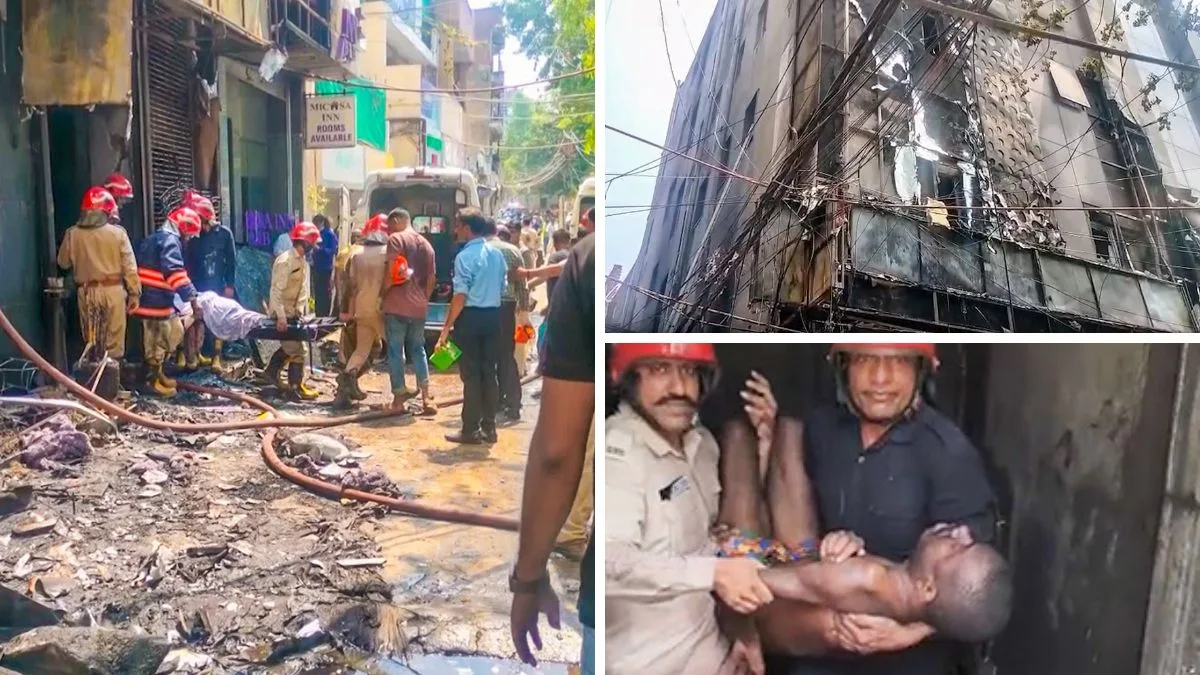
Firefighters, police personnel and rescue workers conduct operations at the site of a devastating fire in Malviya Nagar, South Delhi, on Wednesday. The incident claimed 21 lives and left several others injured. (Photo: IANS)
Hours after 21 people died in a hotel fire in south Delhi’s Malviya Nagar on Wednesday, Chief Minister Rekha Gupta ordered a magisterial inquiry.
After every major fire, loss of lives, magisterial probes are a familiar ritual.
Advertisement
A senior official is appointed. A deadline, usually 7-14 days, is fixed. Statements are recorded, site visits conducted, files assembled. And then, with a consistency that cuts across governments and parties, the report disappears into the system. No tabling. No public disclosure. No lessons, on record, ever learnt.
Advertisement
It started with Uphaar. On June 13, 1997, 59 people died inside a cinema in Green Park while watching Border, trapped by a transformer fire, locked emergency exits and an overcrowded balcony. The then Chief Minister Sahib Singh Verma’s government ordered a magisterial inquiry. A report was submitted on July 3, 1997, holding cinema management, the Delhi Vidyut Board, and the city fire service responsible.
The CBI eventually took over the criminal case. The Ansals were convicted and, after years of legal proceedings, released. The inquiry report, as a public document capable of informing policy, ceased to exist.
Twenty-two years later, on the morning of December 8, 2019, 43 people choked to death in a building in Anaj Mandi’s Rani Jhansi Road, sleeping through the night shift, locked inside an illegal factory.
The then Chief Minister Arvind Kejriwal arrived at the site and announced a magisterial inquiry. A district magistrate was appointed, recorded statements from witnesses and agencies. The criminal case moved through courts. The probe report fixing the culpability of officials was never made public.
In May 2022, fire tore through a four-storey building in Mundka, killing 27. The then Lt Governor Anil Baijal approved a magisterial inquiry to be completed within six weeks, with terms of reference including ascertaining the cause of the fire, fixing responsibility on the concerned departments and suggesting remedial measures to prevent recurrence. Kejriwal was still chief minister.
The six-week deadline came and went. The report did not surface.
In May 2024, seven newborns died in a fire at a neonatal hospital in Vivek Vihar. The government, in its final months under Kejriwal, directed the district magistrate of Shahdara to inquire into the tragedy and submit a report as expeditiously as possible. That report has not been made public either.
Now Malviya Nagar, 2026. A new government, a new chief minister, a new party in power. The same magisterial inquiry, ordered within 24 hours.
This is a systemic problem, running unbroken across administrations, Lt Governors, and municipal regimes.
Each fire exposes almost the same set of violations — no fire NOC, illegal floors, blocked exits, and overcrowding. Each inquiry presumably documents them. The documentation goes nowhere.
The magisterial inquiry, as practised in Delhi, has become a pressure-release valve. It signals seriousness without requiring accountability. It produces the appearance of a reckoning without delivering one.
What no family ever receives is a public accounting of what exactly failed, who allowed it and what changed as a result.
Delhi has been burning, off and on, for 29 years. The inquiry always comes. The report never does.
Advertisement