Women hail free bus rides in state buses starting Monday
Women commuters hailed the West Bengal government’s scheme of allowing women to travel free in state-run buses starting today.
What is the first impression that comes to mind when you think of Taiwan? Everybody thinks of Taiwan as an undisputed leader in the high-technology industry, especially the global semiconductor supply chain.




(Photo: ASHOK TUTEJA/SNS)
What is the first impression that comes to mind when you think of Taiwan? Everybody thinks of Taiwan as an undisputed leader in the high-technology industry, especially the global semiconductor supply chain. The other thing that comes to one’s mind is China’s evil design to annex the island. But few people in India are aware of the tourism potential of this beautiful island nation in the western Pacific Ocean.
It is truly an absolute paradise for tourists, especially honeymooners, offering a perfect blend of rich culture, futuristic cities, and breathtaking natural landscapes. The island boasts a world-renowned street food scene, easily accessible hot springs, and ancient temples, all while remaining highly affordable and one of the safest destinations in the world. The country is easy to navigate and the High-Speed Rail (HSR) makes travelling from the capital city of Taipei to the harbour-side southern city of Kaohsiung an exciting and memorable journey.
Advertisement
There is currently no direct connectivity between India and Taiwan, and the two countries are reportedly holding diplomatic talks about starting flights between them. But one can always travel to Taipei and Kaohsiung through other major travel hubs in the region like Bangkok, Hong Kong, Singapore or Kuala Lumpur. So if you are looking for an exciting holiday destination with your family and friends, don’t think twice. Book your ticket to Taiwan for a memorable journey to some of the world’s most exciting places. Here is a glimpse of some of the “must-see places and unforgettable adventures” in Taiwan.
Advertisement
Taipei: Taiwan’s vibrant historic capital has a disarming charm. It beautifully blends its deep 300 + year cultural roots with a modern metropolis. ‘’Taipei 101 Observatory’’, formerly the Taipei World Financial Center, is a landmark 508-meter (1,667 ft), 101-storey skyscraper in Taipei. Opened in 2004, it was the world’s first skyscraper to exceed half a kilometer in height. Known for its design resembling a bamboo stalk, it features a high-end mall, office space, and top-tier observation decks; the indoor observatory on the 89th floor gives a 360° view of the city.
Xiaoyoukeng & Yangmingshan Volcanic Area: It begins just 40 minutes from Taipei’s city centre and feels like another world entirely. Xiaoyoukeng is the park’s most dramatic volcanic feature: steaming fumaroles, sulphur vents, and a wide crater plateau that smells of the earth’s interior. In May, the hillsides erupt with hydrangeas in deep blue, purple, and pink a seasonal bloom that draws visitors from across Asia. The combination of active geology and floral spectacle in the shadow of a major capital is genuinely rare on this planet. Taiwanese glove puppetry (Budaixi) is a 400-year-old art form that has somehow evolved into a modern cult. Elaborate hand-carved wooden puppet heads, intricate costumes, and lightning-fast manipulation technique combine into performances that range from ancient epic to sci-fi fantasy.
Kaohsiung: As Taiwan’s commercial city, Kaohsiung is the second most popular place after Taipei. It has everything that a tourist looks forward to: from food to music to entertainment. Built along the harbour in 2021, the Kaohsiung Music Center is one of Asia’s most ambitious waterfront cultural projects. Its centrepiece, the Soundwave Tower, rises like a giant musical wave of interlocking steel panels—a genuinely iconic piece of architecture. On weekends, the surrounding plaza buzzes with a creative market showcasing local designers, artisans, and street food vendors. It captures the new Kaohsiung as confident, artistic, and looking outward to the sea. Kaohsiung’s Grand Harbour was once the industrial engine of Taiwan. Today, the Grand Harbour Bridge and its surrounding warehouses have been reimagined into cafes, bars, and public art spaces. Walking across the bridge at night with the city lights reflecting off the water is one of those quietly cinematic moments that doesn’t need a filter. This is the story of a port city that refused to be left behind.
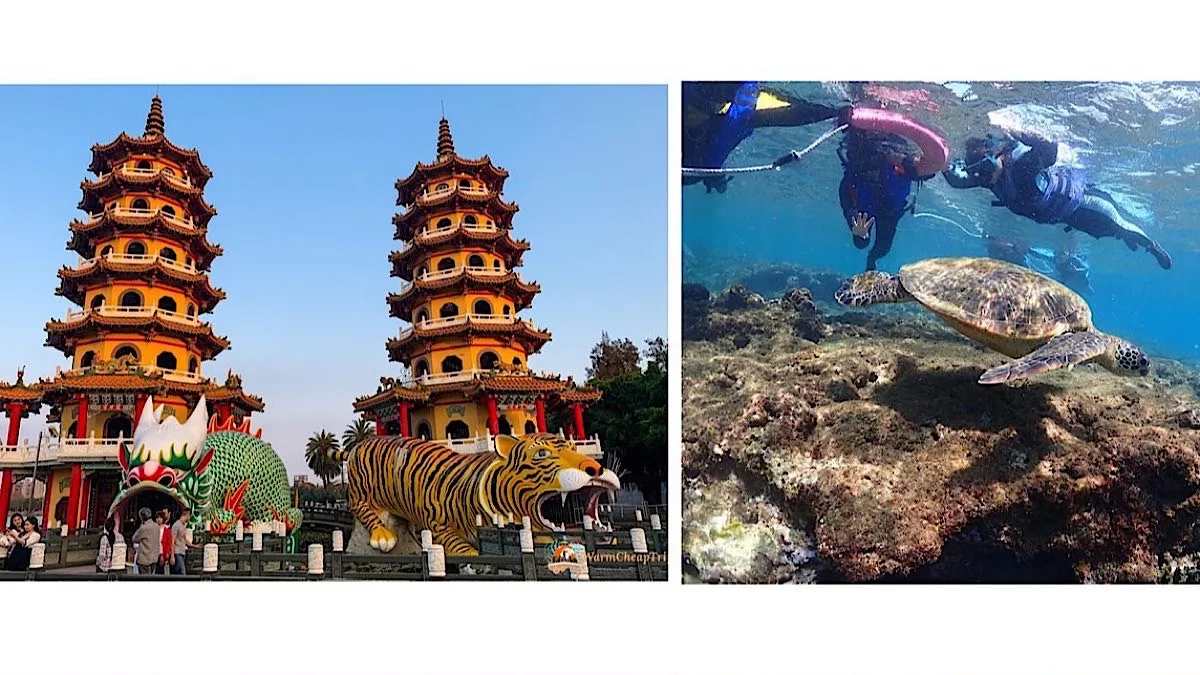
Lianchitan Scenic Area & Dragon Tiger Pagoda: Lianchitan-Lotus Pond is a shallow lake surrounded by temples, pavilions, and some of southern Taiwan’s most vivid folk-religion architecture. The Dragon and Tiger Pagoda is its crown jewel: visitors enter through the dragon’s open mouth and exit through the tiger’s, a ritual said to transform bad luck into good. Spring and Autumn Pavilions rise from the water on the backs of giant tortoises. It’s visually overwhelming and spiritually layered—a place where Taiwan’s folk beliefs feel completely alive.
Snorkeling with Sea Turtles & Glass Semi-Submarine: Xiaoliuqiu’s waters are home to one of the highest concentrations of wild green sea turtles in Asia. Unlike many turtle experiences elsewhere, this is entirely in their natural habitat—no captivity, no feeding, just turtles going about their lives as you glide alongside them. The glass semi-submarine offers the same underwater world for those who prefer to stay dry. Either way, the clarity of the coral-filtered water and the density of marine life here is humbling. Overseas Chinese Fish Market is another landmark of Kaohsiung. It is a raw, unfiltered window into the island’s deep relationship with the ocean. Stalls overflow with grouper, squid, mantis shrimp, and seafood varieties most visitors have never encountered. The pace is fast, the smells are real, and the energy is pure. For anyone wanting to understand how Taiwan feeds itself, this market is essential: noisy, chaotic, and completely honest. Xiaoliuqiu (Little Ryukyu Island) is Taiwan’s only purely coral island and one of its best-kept secrets. Just a 30-minute ferry from the mainland, it operates at a completely different rhythm: slow, warm, and traffic-free. Dapeng Bay National Scenic Area is a sheltered lagoon on Taiwan’s southwestern coast that is calm, wide, and built for sailing. Surrounded by mangroves and connected to the Taiwan Strait, it is one of the island’s premier water sports destinations. Sailing across it in the late afternoon, with the mountains of Pingtung County in the distance, provides a new perspective on Taiwan that most visitors never find.
Yokai Village: Nestled in the mountains of central Taiwan, Yokai Village brings Japanese supernatural folklore to life in an immersive forest setting. Yokai spirits, demons, and shape-shifters from Japanese mythology have deep cultural resonance in Taiwan due to its 50-year Japanese colonial history. Lanterns, hand-crafted sculptures, and theatrical installations are woven among the trees. It is eerie, playful, and unexpectedly moving—a reminder of how deeply Japanese culture threads into Taiwanese identity.
Xitou Bamboo Forest: It is Taiwan’s most celebrated forest reserve, featuring thousands of towering Moso bamboo groves, Japanese cedar, and cypress trees at an altitude of 1,150 metres. The air is cool, misty, and noticeably different from the coast. May is the peak firefly season at Xitou, one of Asia’s most magical wildlife spectacles. As darkness settles over the bamboo forest, thousands of Lamprigera fireflies begin their silent light show among the trees. Taiwan has over 60 firefly species, and Xitou hosts some of the densest populations on the island . No phone camera does it justice which is precisely the point. It is one of those experiences that reminds you why you travel.
Taiwan Tea: Taiwan produces some of the world’s finest teas. Tea ceremonies in many places in Taiwan are not performances for tourists. It is a daily ritual that Taiwanese people genuinely practice. Learning to brew gongfu-style (small pot, short steeps, multiple rounds) fundamentally changes how you understand what tea can taste like. This experience is one of the most transferable things a traveller can take home from Taiwan.
Houfeng Bike Trail: The trail follows a decommissioned railway line along the Dajia River gorge—a 13-km ride through one of Taichung’s most scenic mountain valleys. Tunnel No. 9 is its centrepiece: a 1.3km former railway tunnel cut through solid rock, pitch dark, cool, and completely surreal when cycling through it. The Railway Winery, located at the trail’s end repurposes an old station into a craft wine and cider space. This is Taiwan’s railway heritage reimagined as a slow travel experience: unhurried, beautiful, and with surprisingly few tourists.
(The author is a journalist who was on a FAM tour of Taiwan)
Advertisement