RudraM-II passes crucial test as India sharpens indigenous strike capability
The successful RudraM-II trials validated multiple critical systems and highlighted collaboration between DRDO laboratories, the Indian Air Force and industry partners.
The armed forces would want the self-reliance push to lead to faster invocation cycles and higher scales of production.




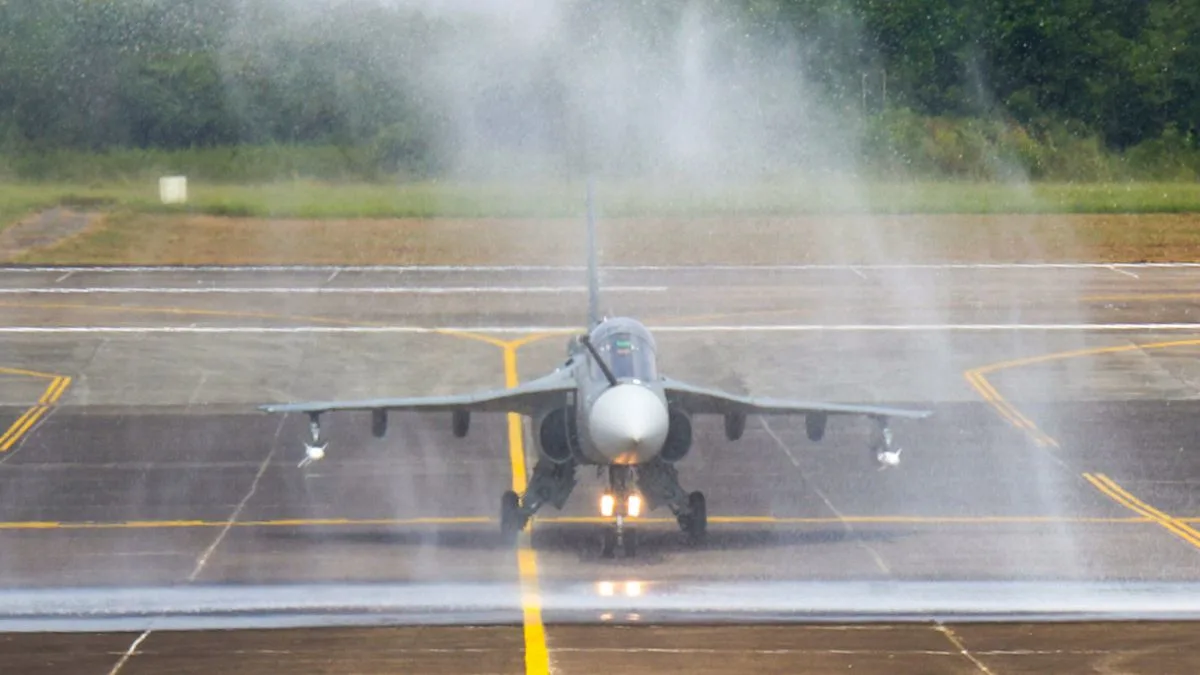
Image: IANS
At a recent event in Shirdi, Maharashtra, the Raksha Mantri Rajnath Singh said, “A nation that manufactures its own weaponry writes its own destiny.” He was inaugurating a defence manufacturing complex of a private sector company. On the same subject, in a recent interview on the, Secretary, Defence Production (MoD), Sanjeev Kumar described rapid strides that India has made toward achieving self-reliance (Atmanirbharta) in the defence sector.
Kumar went further to explain the nuances of self-reliance: “Self-reliance is not just about making products locally; it is about having the design capabilities to modify and adapt weapons to India’s specific needs.”
Advertisement
Speaking on the criticality of self-reliance, CDS Gen Chauhan, in a recent event said, “ …any country that innovates, speeds up production and whose armed forces adapt fast will have strategic advantage.” The CDS added that self-reliance in the defence sector is not just an economic objective but also a strategic necessity.
Advertisement
Seemingly coherent, these three articulations aptly sum up the strategic ambiguity and institutional misalignment on the subject of—self-reliance.
The armed forces would want the self-reliance push to lead to faster invocation cycles and higher scales of production. Inwardly, they are concerned about- capacity to adopt new and emerging tech and the urgent need to absorb changing nature of warfare. Military bureaucracy is busy responding to these changes by rewriting procurement processes and by redesigning command & organizational structures. Institutionally, in terms of self-reliance, they are more worried about- timely deliveries, scales of production and ready availability of weapons and equipment during phases of surge demand.
The Services want proven systems with high performance at the least cost in the least possible time. The origin of the equipment, IP rights, localization of content and up-skilling of domestic manpower are of lesser concern. The reluctant alignment with the self-reliance initiative is based on the assumption of assured delivery, of reasonably latest tech, at scale, during surge demand- which would allow them to function as intended, even in a high intensity combat situation under tech denial regime.
This framing, runs counter to the spirit of self- reliance, as seen by the industry. Domestic private defence industry would want to see scales of assured orders, predictability in QRs, funding, access to testing infrastructure, and above all a fair competition. DPSUs possess sufficient institutional heft and capital to deal with these challenges, however, suffer from institutional inertia, procedural inefficiencies and legacy mindsets. The political leadership is happy measuring degree of self- reliance by observing the percentage of local content. When imports become inescapable, transfer of technology (ToT) is presented as a magic bullet. DPSUs on the other hand find it difficult to absorb the ToT in full and instead prefer settling for ‘assembling’ rather than ‘manufacturing’.
Screwdrivergiri is the derisive term used in Indian defence circles to describe this practice. Taking a cue, the private defence industry has also started offering foreign weapon systems, calling them domestic by simply changing their names/nomenclature. Some prominent examples from recent times include:
• Vayu Astra is the Indianized version of the Israeli SkyStriker loitering munition. Originally Elbit systems of Israel.
• Agnikaa loitering munition is the Indian version of Harop , used for SEAD (Suppression of Enemy Air Defences). Originally IAI of Isreal.
• SuryAstra is the rechristened version of PULS (Precise & Universal Launching System – Multiple Rocket Launcher). Originally Elbit systems of Israel.
The civilian leadership in the MoD looks at this issue of self-reliance as a matter of projections and numbers. Take for example a recent PIB release. which stated that India’s indigenous defence production hit a record ₹1,27,434 crore in FY 2023-24, a 174% surge from ₹46,429 crore in 2014-15, fueled by Prime Minister Shri Narendra Modi’s Atmanirbharta policies. The press release went on to state that the country recorded its highest-ever defence production of ₹1.54 lakh crore in FY 2024-25, a testament to the strength of Aatmanirbhar Bharat in action. India is on track to achieve a target of ₹1.75 lakh crore in defence production in the current fiscal year, while it aims to reach ₹3 lakh crore in defence production by 2029, further establishing itself as a global defence manufacturing hub.
A cursory reading of this PIB note would lead one to believe that true Self-reliance in defence production has already arrived. The reality however, is slightly harsher. While we are producing more at home- we remain dependent on others for critical components. Most of our warships, armoured vehicles and fighter jets rely on imported engines for propulsion. The material used in our advanced seekers and sensors, including guidance kits for precision weapons are imported. Titanium alloys, composites, high-temperature superalloys, special steels- material essential for aircraft structures, missile casings, armour, and engine components- is imported. Even some basic equipment like ejection seats, air-to-air refuelling kits and brake parachutes are imported.
While the institutions are busy measuring and celebrating self-reliance in defence sector, the proverbial sand is shifting from under our feet. With the advent of AI, autonomous systems, drones and machines dominating the battlefield of the future; our dependence on imported items would increase rather than reduce. As on date, equipment such as AI accelerators, GPUs, TPUs, edge AI chips, GaN/GaAs RF chips, advanced nodes, high-energy-density Li-ion/Li-Po cells and Battery Management Systems (BMS), are all imported. India’s vulnerability will shift from traditional platforms—ships, tanks, fighter jets—to “invisible” foundational technologies—semiconductors, power systems, and sensors. ‘Compute capacity’ will be a key measure of military power in the near future.
For self-reliance to truly succeed, there is an urgent need to review ongoing projects, reassess priorities and realign organisational effort. It is neither possible, nor desirable to make everything at home. As Shri Sanjeev Kumar also conveyed in his interview- as long as we have assurance of availability- foreign sourcing should not be considered a critical dependency. However, we need to identify and create capacity at home to build and field critical technologies. The process must start by first providing a clear articulation of self-reliance.
Measuring Self-reliance
The framework for measuring degree of self- reliance should move away from measuring merely the degree of content localisation to degree of sovereign control over the product. Sovereign control itself can be measured at two levels- software (IP) and hardware (production capacity).
The degree to which, we can design, develop and prototype the product, on our own, would define the intellectual control or ownership of the process. Subsequent iterations of upgrades, modifications, integration of weapons and sensors identified by us, would also be included in this classification. For example- possession of source code would provide greater level of self-reliance viz possession of interface Control Document (ICD) or access to restricted application programming interfaces (APIs).
Our ability to produce/ manufacture the product to the desired specifications at the required scale would define our hardware prowess. The degree to which, we can achieve this capability, on our own, would determine our self-reliance.
Ideally, we should possess a very high degree of sovereignty in both spheres, however, in certain cases, control/ownership in one aspect would be good enough.
Let’s analyse the proposition using three examples:
The Integrated Air Command and Control System (IACCS) has been built by Bharat Electronics Limited (BEL). The IP is ours. We can upgrade, modify or integrate local sensors at will. We also possess the ability to integrate sensors built by Russians, Americans and Israelis on a homemade platform. The design architecture is completely domestic; although, it still relies on imported hardware to deliver performance. Without going into specifics, it can be stated that the system utilises certain high-end core networking switches and specialized servers, imported from global tech giants (like Cisco or HPE). The underlying microprocessors and high-speed FPGA (Field Programmable Gate Array) chips are almost exclusively imported from the US (Xilinx/Intel) or Taiwan. Despite these dependencies our sovereign control over the system is almost absolute. Also, should we choose to, we can export it to any country we like.
The BrahMos project is another good example of the gap between high indigenous content and full sovereign control. Developed as a 50.5:49.5 joint venture between DRDO and Russia’s NPO Mashinostroyeniya, the missile’s core IP—design, ramjet propulsion, and key subsystems—is jointly owned. This restricts India from unilaterally modifying critical technologies without Russian approval. However, there are no limits on production numbers or the platforms on which BrahMos can be integrated. It has been successfully deployed on Indian Naval ships, Army’s mobile launchers, and IAF fighters. Indigenous content has risen to over 65%, but design sovereignty remains shared. Exports would require approvals from Russia.
Upcoming LCA Mk1A ( tranche 2 comprising 97 aircraft) would have an indigenous content of over 64 %. We own the IP and the mythical ‘source code’. We would have the ability to modify and upgrade the system architecture as well as the ability to integrate locally sourced weapons and sensors. However, the aircraft would be 0% exportable without explicit clearance from foreign manufacturers. Besides the engine- which is made in the USA, we would require approvals from UK for ejection seat and in-flight refuelling kit; from Israel for HMDS; and from certain EU partners for actuators, sensors, LRUs and avionics items. Some of these items, could, in theory at least, be sourced from alternative countries, but there is no going around the engine.
To achieve higher degree of sovereign control, we need to start by revising our procurement policies. What we buy, is largely dependent on how we buy it.
New Age Procurement Policies For New Age Warfare
Warfare has changed dramatically in the recent years; the procurement policies must change too. General Valerii Zaluzhnyi (former Army Chief of Ukraine and current Ambassador to the UK) has spoken multiple times about the extremely rapid evolution of drone technology in the Russia-Ukraine war. The oft quoted reference is that software changes every few days and the hardware changes every few weeks. A procurement system that takes years (in best case scenario) is ill suited for modern warfare.
On the other side of the world, the war with Iran has forced Pentagon to take a hard look at its procurement policies. In a very reflective piece on the subject, Swarajya has made an argument that Pentagon is no longer buying the weapon, rather the capacity to mass produce the weapons. Quoting from the article, “Future wars may depend less on who has the best missile, and more on who can manufacture thousands of missiles, drones, motors, and spare parts fast enough once the war begins.” India must reflect on these developments. We can no longer remain hostage to a set of policies that were ill suited even for the warfare of yesterday.
Anduril Industries took its Fury autonomous fighter (officially the YFQ-44A) from a clean-sheet design to its first flight in just 556 days. Compare this to LCA program which started in 1983; or compare this to HAL CATS Warrior (India’s autonomous ‘loyal wingman’) CCA, which began in 2019. Anduril could deliver in record time, in part because Pentagon enabled them. The US DoD (now called DoW), created a fast-track acquisition process called MTA.
The Middle Tier of Acquisition (MTA), often referred to as Section 804, is a fast-track authority created by US Congress to bypass the “valley of death”- the years-long gap between an idea and a fielded product. It specifically targets projects that can be completed in under five years. USAF helped- by creating a new way to look at QRs. Instead of locking in every spec at the very start, the USAF decided on- learn by doing – adjusting the requirements based on prototype performance.
Our government should create a policy space that would allow Indian companies to replicate the Anduril model. A few suggestions for considerations are:
• Shift fully from “Make in India” (manufacturing/assembly) to “Design & Own in India”.
• Reduce timelines by streamlining SQRs/trials. Enable delegated powers for faster approvals.
• Introduce prototype-based competitive development. Instead of shortlisting product- shortlist vendors. Thereafter, fund all shortlisted prototypes- finally procure winners. This shares risk and accelerates tech maturation.
• Commit to multi-year, large-volume orders post-successful trials/prototypes. Single/small orders don’t justify heavy capex in modern tech (drones, electronics, propulsion, sensors).
• Private defence industry must be given tax incentives for- R&D expenses, design-linked work, and prototyping. They must be funded or at least given production subsidies to level the playing field vs. legacy DPSUs.
• Discourage Screwdrivergiri.
Conclusion
True self-reliance in defence is not merely a statistic of indigenous content or assembly lines- it is the sovereign ability to design, modify, produce, and sustain critical systems at speed and scale, even under technology-denial regimes. While impressive growth in domestic production deserves recognition, India must move beyond celebrating percentages and screwdrivergiri.
The future battlefield will be defined by compute power, autonomous systems, and rapid iteration, not just traditional platforms. By reorienting procurement towards “Design & Own in India,” embracing prototype-driven development, committing to multi-year orders, and prioritising intellectual property sovereignty over mere localisation, India can convert Atmanirbharta from a slogan into a genuine strategic advantage. The window is narrowing. The choice is clear: either build real sovereign capability now or risk remaining strategically vulnerable in the wars of tomorrow. India’s destiny, as the Raksha Mantri rightly said, will indeed be written by what it manufactures- but only if it truly owns the design and the technology behind it.
Advertisement