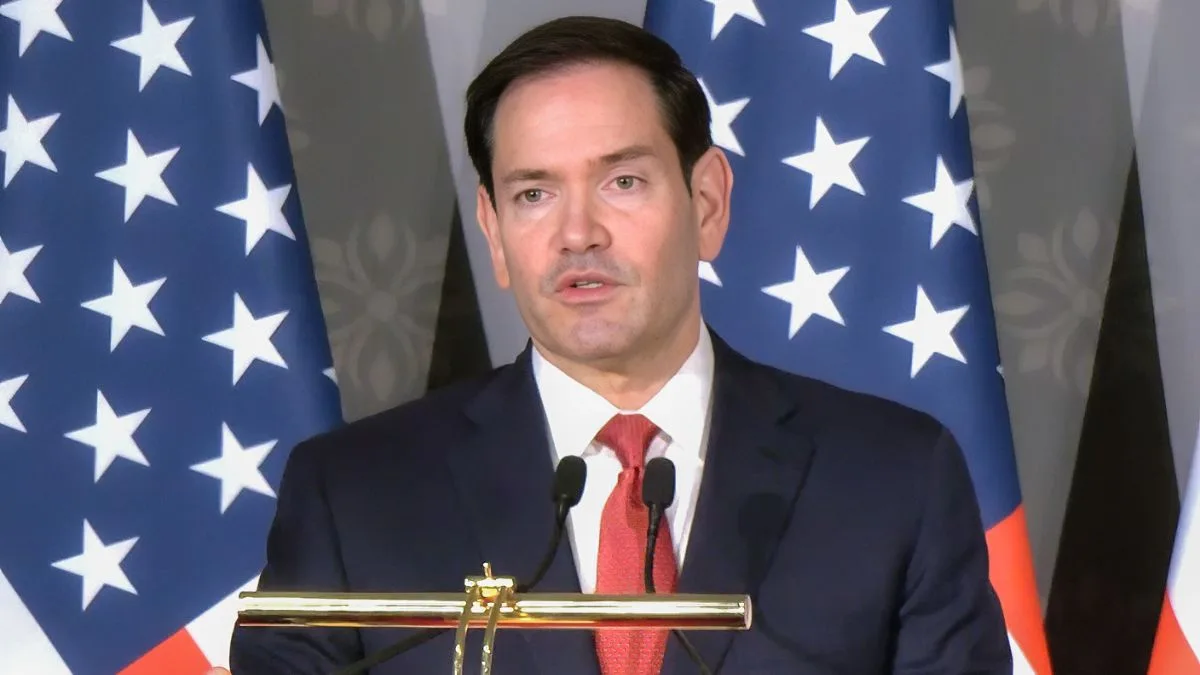
In a high-stakes diplomatic engagement overshadowed by global conflicts, trade friction, and shifting geopolitical equations, India and the United States on Sunday signalled a determined push to elevate their partnership into a more expansive and globally consequential alliance. External Affairs Minister S Jaishankar and US Secretary of State Marco Rubio announced accelerated efforts to finalise an interim bilateral trade agreement while reaffirming strategic coordination across energy, security, defence, and the Indo-Pacific.
The delegation-level talks at Hyderabad House in New Delhi — Rubio’s first official visit to India as Secretary of State — took place at a sensitive moment in India-US ties, with both sides attempting to move beyond recent tariff-related tensions and inject fresh momentum into what they repeatedly described as a “comprehensive global strategic partnership.”
Advertisement
Leading the diplomatic messaging after the talks, Jaishankar revealed that negotiations for an interim trade agreement had entered an intensive phase, with delegations from both countries moving rapidly to finalise the text ahead of looming tariff deadlines.
“India and the United States are pushing for an early interim trade agreement as a step towards a comprehensive bilateral trade pact,” Jaishankar said at the joint press interaction, noting that an Indian team had recently concluded discussions in Washington while an American delegation was expected in India shortly to carry negotiations forward.
The urgency surrounding the trade negotiations comes against the backdrop of economic strains triggered by US tariff measures on several Indian exports during President Donald Trump’s administration, a development that had raised concerns over whether strategic cooperation between the two democracies was losing momentum. Rubio, however, firmly rejected suggestions of any drift in the relationship.
“This is not about restoring or reinvigorating,” Rubio said during the joint press interaction. “This is about continuing to build on what is already a very solid and strong strategic partnership — one of the most important ones that we have, and one of the most important ones in the world.”
Calling India one of America’s “most important strategic partners,” Rubio argued that the relationship between Washington and New Delhi had evolved far beyond regional calculations and now carried significant global implications.
“The United States and India aren’t just allies, we’re strategic allies,” Rubio said. “Our cooperation is not simply limited to this region. It extends into other parts of the world, including opportunities in the Western Hemisphere.”
Jaishankar echoed the sentiment, describing the relationship as “deep” and “broad-based,” driven by converging interests on multiple global issues.
“In plain language, it means we have very deep and broad-based cooperation — and a relationship that impacts and influences other regions and the world,” he said. “These are complicated times, but as strong partners, I am very confident we will have open and productive discussions.”
The talks also placed heavy emphasis on energy security and civil nuclear cooperation, areas increasingly central to India’s long-term economic ambitions and energy transition goals. Jaishankar said both countries were strategically aligned on ensuring affordable and accessible energy for India’s population of 1.4 billion people.
“Secretary Rubio and I welcomed recent cooperation between India and the United States in the energy sector,” he said, adding that discussions also covered expanding collaboration in civil nuclear energy.
Referring to India’s recently enacted SHANTI Act, Jaishankar said the passage of the law had “opened up new possibilities” in the nuclear domain and expressed hope that both sides would realise the untapped potential of cooperation in the sector.
Another major issue raised during the discussions was the growing concern over difficulties faced by legitimate Indian travellers in obtaining US visas. Jaishankar stressed that while India remained committed to cooperating with Washington on combating illegal migration, legal mobility and people-to-people exchanges should not suffer.
“We cooperate strongly on illegal migration issues, but legal mobility should not face adverse impacts,” he said.
Rubio acknowledged the concerns and described the current challenges as part of a transitional phase in America’s immigration and visa systems.
“The United States is modernising its system, and whenever that happens, there is naturally a period of transition and friction,” Rubio said, while assuring that efforts were underway to improve efficiency.
The two leaders also reviewed major international flashpoints, including the continuing war in Ukraine, the escalating crisis in West Asia, and growing security concerns in the Indo-Pacific. Jaishankar said the discussions covered developments in “West Asia, the Indian subcontinent, and East Asia,” while reiterating India’s position in favour of “unimpeded maritime commerce.”
Both sides also reaffirmed a policy of “zero tolerance for terrorism,” underlining increasing convergence on regional security concerns.
Rubio’s India visit carries additional strategic weight because it directly precedes the Quad Foreign Ministers’ Meeting in New Delhi, where the US, India, Japan, and Australia are expected to sharpen coordination on Indo-Pacific security, resilient supply chains, and emerging technologies amid China’s expanding regional influence.
Before arriving in Delhi, Rubio visited Kolkata and paid respects at the Mother House of the Missionaries of Charity, founded by Mother Teresa.
The optics and messaging emerging from Hyderabad House made it clear that despite periodic economic disagreements, both India and the United States view the relationship as indispensable to their wider strategic ambitions.
With trade negotiations intensifying, energy cooperation expanding, and security coordination deepening across multiple theatres, Sunday’s talks suggested that New Delhi and Washington are now attempting to transform a robust bilateral partnership into a far more ambitious global compact.