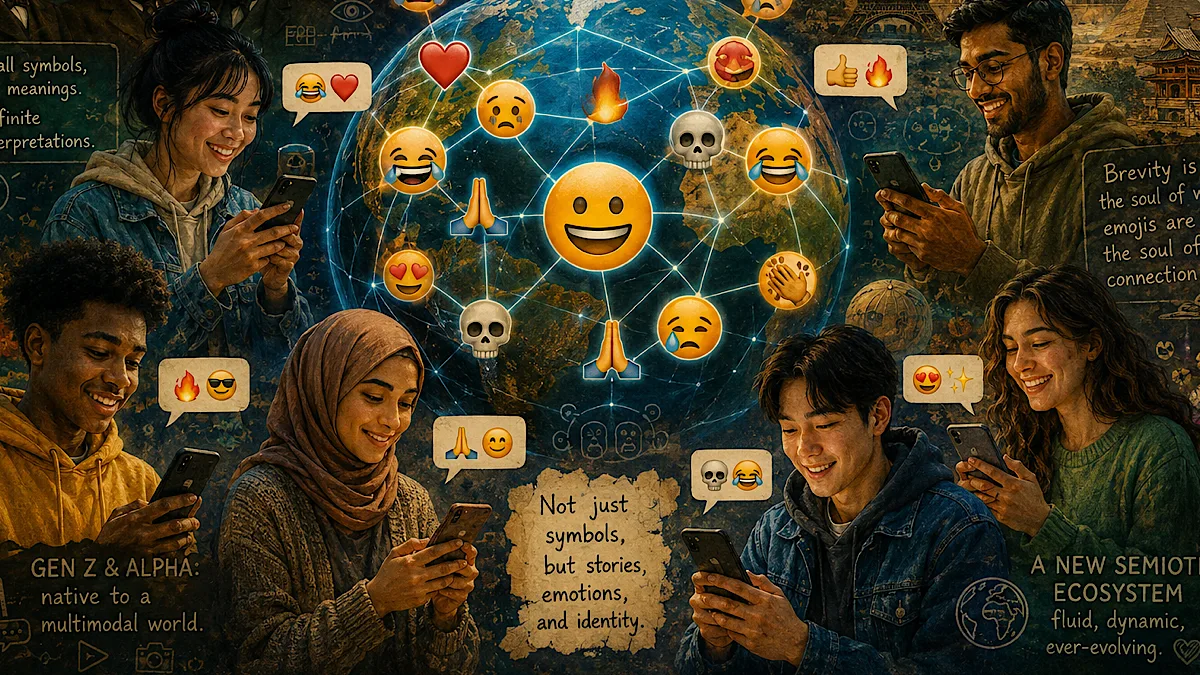
Brevity is the soul of wit.” In the compressed, high-velocity circuits of twenty-first-century communication, Shakespeare’s aphorism acquires an unexpected contemporaneity. The digital age prioritizes concision, immediacy, and effective precision; meaning must be transmitted swiftly, often within the spatial constraints of a screen and the temporal impatience of its user. It is within this communicative economy that emojis have emerged as a potent semiotic instrument, distilling complex emotions, tonal inflections, and social cues into compact visual signs.
What begins as an aesthetic supplement to text gradually reveals itself as a transformative linguistic phenomenon: a system that not only abbreviates expression but reconfigures it. As these pictographic symbols permeate everyday discourse, they begin to function as more than mere embellishments; they constitute a parallel communicative code that operates across linguistic frontiers. In a world historically stratified by language barriers and cultural particularities, emojis introduce a shared visual lexicon that attenuates difference and facilitates instant recognition.
Advertisement
Their rising ubiquity among digitally native generations signals a shift from language as a strictly verbal construct to a hybridized, multimodal practice. In this evolving landscape, brevity is no longer merely the “soul of wit,” but also becomes the architecture of understanding, and emojis its most eloquent articulation. In the ever-accelerating circuitry of contemporary communication, language, which was once anchored in the fixity of script and speech, has undergone a striking metamorphosis. Among the most compelling manifestations of this transformation is the proliferation of emojis: those deceptively simple pictographic glyphs that now punctuate, supplement, and at times supplant verbal discourse.
Advertisement
What might initially appear as whimsical embellishments of digital expression has, upon closer scrutiny, evolved into a complex, transnational semiotic system which is arguably the closest approximation to a twenty-first-century lingua franca. The notion of a lingua franca traditionally evokes images of trade languages, pidgins, or imperial impositions, such as Latin in medieval Europe, French in diplomatic corridors, and English in the age of globalization. Yet emojis represent a radically different paradigm: a bottom-up, user-driven, technologically mediated mode of communication that transcends phonetic and syntactic barriers.
Unlike natural languages, emojis are not bound to phonology or grammar in any conventional sense; instead, they operate within the domain of visual semiotics, where meaning is negotiated through cultural inference, contextual cues, and shared digital literacy. The foundational insights of semiotics, particularly those articulated by Ferdinand de Saussure and Charles Sanders Peirce, help us to apprehend the significance of emojis as a global communicative apparatus with greater clarity. Saussure’s dyadic model, comprising the signifier (the form of a sign) and the signified (the concept it represents), is particularly instructive.
Emojis function as signifiers that are iconically suggestive rather than arbitrarily assigned; a smiling face emoji “ ” resembles the emotion it denotes, thereby re ducing the arbitrariness that characterizes linguistic signs. However, this apparent transparency is deceptive. The interpretive elasticity of emojis reveals that their signifieds are far from stable; a single emoji can oscillate between sincerity and irony, affection and sarcasm, depending on pragmatic context. Peirce’s triadic framework, which distinguishes between icons, indices, and symbols, further enriches this analysis. Emojis often operate simultaneously across these categories. The flame emoji “ ” may iconically represent fire, indexically suggest intensity or attractiveness, and symbolically denote approval or trendiness.
This polyvalence underscores the semiotic density of emojis, rendering them far more than ornamental adjuncts to text. It is, however, in the work of Umberto Eco that one finds a particularly resonant theoretical lens through which to examine the emoji phenomenon. Eco’s conception of semiotics as a field concerned with “everything that can be taken as a sign” invites us to consider emojis not merely as signs, but also as participants in a broader cultural code. For Eco, meaning is never inherent; it is pro duce d through interpretive cooperation between sender and receiver, mediated by shared codes and conventions. Emojis exemplify this process with remarkable clarity.
Their intelligibility depends upon a tacit agreement among users regarding their semantic range, an agreement that is constantly renegotiated within digital communities. Eco’s notion of the “open work” is equally pertinent. Emojis, like open texts, are inherently indeterminate, inviting multiple interpretations rather than prescribing a singular meaning. The skull emoji “ ”, for instance, has undergone a semantic shift within Gen Z vernacular, where it signifies not death but extreme amusement (“I’m dead” as a hyperbolic expression of laughter). This semantic drift illustrates Eco’s argument that signs are perpetually subject to reinterpretation within evolving cultural contexts.
The emergence of emojis as a quasi-universal language is inextricably linked to the communicative practices of Generation Z and Generation Alpha, cohorts that have been immersed in digital ecosystems from an early age. For these generations, communication is not merely textual but multimodal, integrating images, GIFs, memes, and emojis into a fluid semiotic repertoire. Emojis function as affective accelerators, enabling users to convey tone, nuance, and emotional subtext that might otherwise be flattened in text-based communication. This is particularly significant in an era where digital interaction often lacks the paralinguistic cues, such as intonation, facial expression, and gesture, that enrich face-to-face communication.
Emojis serve as compensatory mechanisms, reintroducing affective depth into ostensibly impersonal media. A simple message such as “fine” can oscillate between contentment, resignation, or irritation; the addition of an emoji can disambiguate or, intriguingly, further complicate its meaning. Moreover, emojis have engendered a form of linguistic economy that aligns with the rapid tempo of digital life. In a communicative landscape characterized by brevity and immediacy, emojis condense complex contemplative states into compact visual units. This economy, however, does not entail a diminution of expressive capacity; rather, it signals a shift towards a more efficient semiotic system, where meaning is conveyed through a synthesis of visual and textual elements.
Yet the proposition of emojis as a universal lingua franca warrants critical scrutiny. While their visual nature ostensibly transcends linguistic boundaries, their interpretation is far from culturally neutral. Emojis are embedded within specific socio-cultural matrices, and their meanings can vary significantly across contexts. The folded hands emoji “ ”, for instance, may signify prayer in some cultures, gratitude or greeting in others, and even a high-five in certain digital subcultures. This polysemy complicates the notion of universality, suggesting that emojis function less as a monolithic language and more as a flexible, context-dependent code.
Furthermore, the standardization of emojis through platforms such as the Unicode Consortium introduces questions of power and representation. Which symbols are included and which are excluded? Whose cultural expressions are legalized within this global semiotic system? The gradual diversification of emojis, such as incorporating varied skin tones, gender identities, and cultural artifacts, reflects an ongoing negotiation over inclusivity, yet it also underscores the inherently political dimensions of seemingly innocuous symbols. For Gen Z and Gen Alpha, emojis are not merely communicative tools but integral components of identity formation and social interaction. They facilitate a form of digital intimacy, enabling users to craft nuanced personae and navigate complex social dynamics.
The strategic deployment of emojis, whether to soften criticism, signal irony, or establish rapport, constitutes a sophisticated form of pragmatic competence. In this sense, fluency in emoji usage has become a marker of digital literacy, analogous to linguistic proficiency in traditional languages. At the same time, the ubiquity of emojis raises concerns about the potential erosion of linguistic complexity. Critics argue that the increasing reliance on pictographic communication may attenuate the richness of verbal expression, fostering a culture of superficiality.
Such apprehensions, however, echo historical anxieties surrounding earlier communicative innovations, spanning from the advent of writing to the rise of print culture. As with these precedents, it is more plausible that emojis will coexist with, rather than supplant, traditional language, enriching the communicative repertoire rather than impoverishing it. Indeed, the interplay between text and emoji often yields a form of hybrid discourse that is both economical and expressive. This hybridity aligns with Mikhail Bakhtin’s concept of heteroglossia, wherein multiple voices and registers coexist within a single communicative act. Emojis, in this context, function as an additional register, one that operates alongside and in dialogue with verbal language.
Moreover, emojis are increasingly eroding the rigidity of cultural and linguistic demarcations by instituting a shared, visually intelligible layer of communication that operates parallel to, and often independent of, verbal language. Unlike alphabetic systems, which are tethered to specific phonetic and grammatical structures, emojis function through iconicity and affect, enabling users from disparate linguistic backgrounds to converge upon approximate meanings without requiring translation in the conventional sense. A laughing face, a broken heart, or a flame transcends the need for lexical equivalence; it is apprehended almost instantaneously across cultures, thereby compressing communicative distance.
This phenomenon produces what may be termed a flattening of semiotic borders. While historically, language has served as both a bridge and a barrier, facilitating intra-community cohesion while impeding inter-community exchange, emojis dilute this exclusivity. They enable a Hindi speaker, a Japanese user, and a Spanish texter to participate in a shared expressive economy, even if their verbal messages remain mutually unintelligible. In this sense, emojis operate as a form of para-linguistic mediation, smoothing over linguistic discontinuities and fostering a rudimentary but effective universality. Additionally, emojis subtly recalibrate cultural specificity by encouraging convergence in emotional expression.
While cultures differ in how emotions are articulated, with some privileging restraint and others exuberance, emoji usage standardizes these expressions into recognizable visual codes. A smiling face or a teary emoji becomes a globally legible shorthand for affect, thereby attenuating culturally specific modes of emotional articulation. This does not erase cultural difference entirely, but it does overlay it with a common semiotic interface that prioritizes immediacy over nuance. However, this blurring is neither absolute nor unproblematic.
Emojis often carry culturally inflected meanings that can lead to misinterpretation; yet even these divergences contribute to a dynamic process of global semiotic negotiation. Users gradually acclimatize to alternative readings, and meanings stabilize through repeated transnational usage. In effect, emojis do not eliminate cultural and linguistic distinctions so much as render them more permeable, transforming rigid boundaries into zones of fluid exchange. What emerges, therefore, is not a homogenized global culture, but a layered communicative ecology in which emojis function as a connective tissue, diminishing the friction of difference while preserving the plurality of human expression. Conclusively, the ascent of emojis as a global communicative medium represents a paradigmatic shift in the semiotics of everyday interaction.
It is becoming quite certain that today emojis are rising as a fully-fledged lingua franca, and their capacity to traverse linguistic boundaries to facilitate cross-cultural communication is undeniable. Through the lens of semiotic theory, particularly the insights of Saussure, Peirce, and Eco, emojis emerge not as trivial embellishments but as complex, dynamic signs that encapsulate the evolving nature of human expression. As digital natives continue to recalibrate the parameters of communication, emojis will likely assume an increasingly central role in the global semiotic landscape.
They are, in many respects, the hieroglyphs of our time: concise, evocative, and perpetually open to interpretation. In their smiling faces and cryptic symbols, one discerns not the impoverishment of language, but its inexhaustible capacity for reinvention. The writer is an undergraduate scholar of English Literature, who weaves storytelling, poetry and culturally attuned featured writing into evocative reflections on contemporary trends and the fragile poetics of the environment.
Advertisement