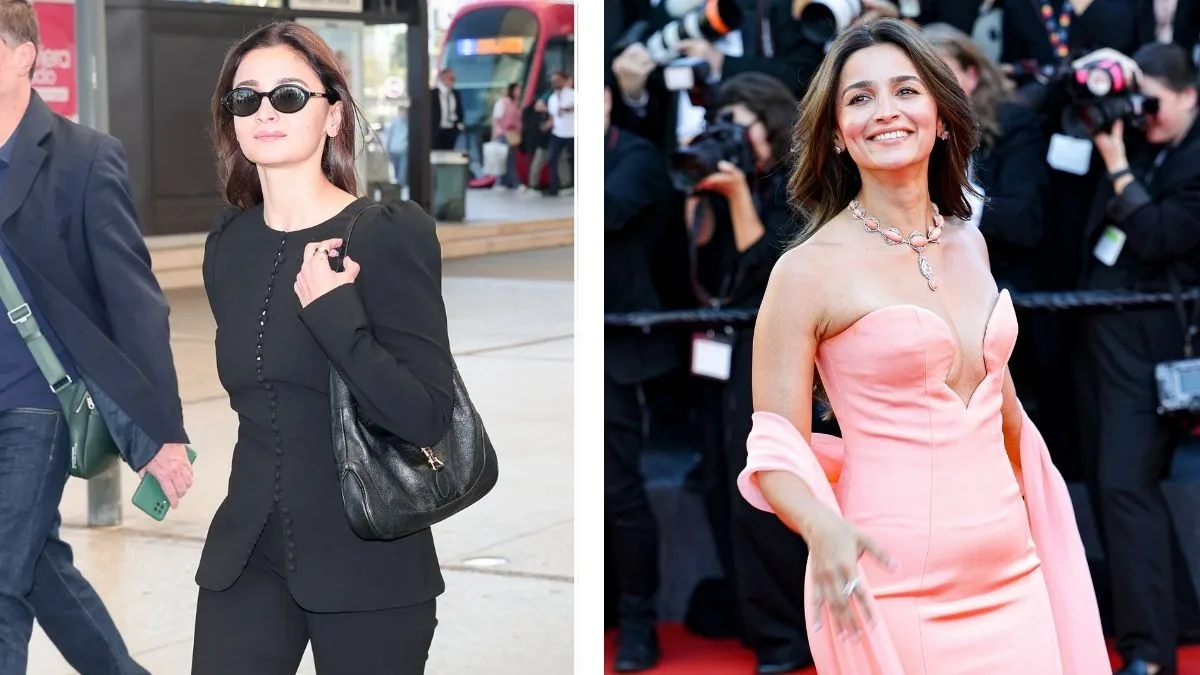
For about a decade, the airport was fashion’s most surprising runway. Celebrities stepped off planes in coordinated outfits, with paparazzi waiting on cue. It felt spontaneous. It was not. Now, that era is collapsing, and the film festival red carpet has taken its place as the most powerful fashion arena on earth.
The airport look was always a performance
Let’s start with what the airport look actually was. It was not casual dressing caught off guard. It was a calculated press strategy dressed up as a candid moment.
Advertisement
Brands like Gucci and Bottega Veneta actively leaned into this. In 2023, Gucci enlisted Kendall Jenner and Bad Bunny for airport-themed campaign. The imagery had a deliberately unpolished aesthetic of monogrammed bags, casual strides through departures. But it was a fully produced shoot. Bottega Veneta’s “Readymade” campaign with A$AP Rocky and Kendall Jenner replicated the same paparazzi-style visual language, staging grocery runs and dog walks to mimic candid celebrity life. That campaign generated $2.8 million in Media Impact Value within 48 hours, according to social analytics firm LaunchMetrics.
The irony is obvious. The moment brands started manufacturing “candid” airport dressing into polished campaigns, the real airport moment lost its edge. You cannot sell authenticity and have it too.
Saturation killed the terminal
By 2024, the volume of celebrity airport content had become overwhelming. Publications competed to photograph every arrival at JFK, LAX, and Heathrow. Stylists dressed clients specifically for departures. The result was a content category so overstuffed it lost meaning.
Industry observers had already flagged the problem. Predictions circulating before 2024 noted that celebrities would likely move away from “overhyped paparazzi shots” in search of more credible form of visibility. Market agreed. Engagement data from social platforms showed quite declining interaction rates across influencer and celebrity content formats. Rival IQ’s 2025 Social Media Industry Benchmark Report confirmed that all-industry median engagement fell year-on-year, with influencer categories among the most affected.
When everything is a look, nothing is.
Film festivals filled the vacuum
While airport fashion quietly lost its grip, film festivals, led by Cannes, became the most economically and culturally significant fashion stages in the world.
The numbers make this impossible to argue with. The 2025 Cannes Film Festival generated a record $1.1 billion in Media Impact Value across its twelve-day run, according to LaunchMetrics. To put that in perspective, this figure outperformed the combined visibility generated by New York, London, Milan, and Paris Fashion Weeks during the same window.
Fashion at film festivals operates under a fundamentally different logic than airport style. At an airport, a celebrity is passing through. At Cannes, they are representing a film, a studio, a personal brand, and often a luxury house simultaneously in front of an international press corps. The stakes are incomparably higher.
Brand performance at Cannes in 2025 reflected this. Chopard earned $27.7 million in MIV across more than 4,500 placements. Dior followed with $25.9 million. In 2024, Chopard had earned $32.3 million through its festival association alone. These are not figures generated by a celebrity stepping out of a terminal in a trench coat.
The dress code controversy made it matter more
Fashion thrives on conflict. In 2025, Cannes delivered exactly that.
For the first time in the festival’s history, organisers introduced an explicit nudity ban on the red carpet. “Voluminous outfits” with large trains were also restricted. The announcement landed just hours before the festival opened.
The response was immediate and divided. Halle Berry confirmed she had to abandon an original look by designer Gaurav Gupta because the train was too long, saying publicly, “I’m not going to break the rules.” Others ignored the directive entirely. Heidi Klum and Wan QianHui arrived in gowns with cascading trains on the opening night.
Critically, the controversy did not diminish Cannes as a fashion event. It amplified it. The dress code debate spread across media channels, drove social engagement, and made every outfit a statement; compliance or defiance both became editorial positions. What the airport look never could generate, Cannes produced effortlessly: friction, consequence, and a cultural conversation.
The brand logic has shifted
The shift is not only about aesthetics. It is about where luxury brands now choose to spend their visibility budgets.
According to a Launchmetrics analysis, brands are moving away from influencer-heavy strategies focused on reach alone toward “cultural actor” positioning; aligning with moments that already carry prestige and audience investment. A film festival, which exists independently of fashion, provides that context. An airport does not.
As Launchmetrics framed it, festival presence gives brands “permission to hold price, permission to extend into new categories, permission to attract a certain type of creative talent.” This is a sophisticated articulation of something the fashion industry has historically understood intuitively: association with cultural authority reinforces commercial power.
The airport look, by contrast, offers no such permission. It is purely promotional. Audiences have learned to read it as such.
The critical problem with this shift
It would be naive to treat the film festival’s fashion dominance as an uncomplicated improvement. Several tensions are worth naming.
First, saturation is already emerging. The same LaunchMetrics data that celebrated Cannes’s record MIV also flagged that the festival is “becoming more saturated.” When every brand rushes to the same event, the red carpet risks suffering the same fate as the airport terminal: too much content, diminishing differentiation.
Second, the film festival model is deeply exclusionary. The airport look, however staged, at least pretended to be democratic, anyone flying could aspire to it. The Cannes red carpet is a closed system. Access requires industry invitation, couture-level budgets, and established brand partnerships. The fashion conversations it generates are genuinely global; the access is anything but.
Third, there is a growing tension between cinema and fashion at these events. Critics, including filmmakers themselves, have noted that fashion coverage increasingly overwhelms film coverage at festivals. When the dress code sparks more headlines than the Palme d’Or competition, something has tilted. Cannes is, structurally, a film event. Fashion’s colonisation of it is a commercial success for brands and a category challenge for cinema.
What comes next
The airport era was always borrowed time. It depended on a particular ecosystem of paparazzi culture, tabloid media appetite, and celebrity cooperation, all of which are unstable variables. As social media engagement declined and audiences grew more cynical about staged candid moments, the format lost its credibility faster than brands could adapt.
Film festivals are not immune to the same forces. The Venice Film Festival red carpet in 2025 also generated strong fashion coverage. The pattern is extending beyond Cannes. More festivals, more brands, more coverage, more saturation; the cycle is already beginning again.
What this moment actually reveals is not that film festival fashion is categorically superior. It is that fashion’s centre of gravity has moved from the illusion of the everyday to the spectacle of the extraordinary. Audiences no longer want to see a celebrity looking great at baggage claim. They want the full theatrical event: the stairs, the lights, the gown, the defiance of a dress code.
The airport was a stage trying to look like a corridor. The film festival red carpet is simply honest about what it is.