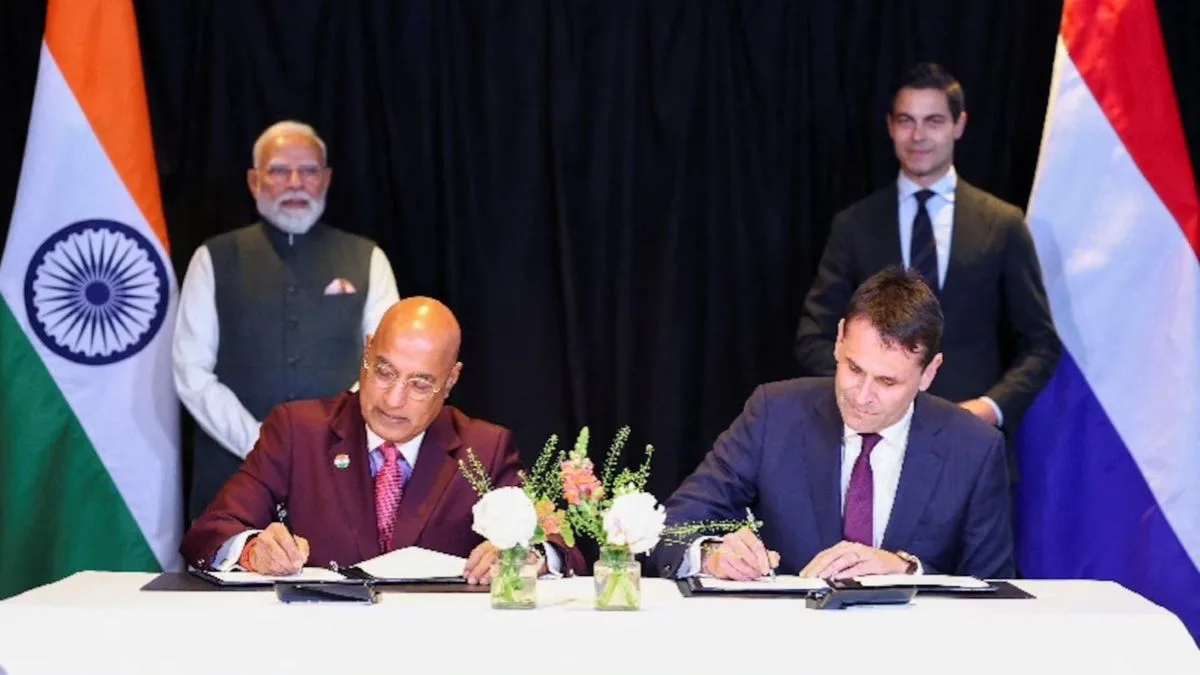
While much of the attention around Prime Minister Narendra Modi’s recent five-nation diplomatic tour focused on optics, speeches and geopolitical messaging, one meeting in the Netherlands may eventually stand out as the most consequential of them all.
PM Modi’s engagement with ASML leadership did not dominate prime time debates or social media chatter. Yet in strategic and technological terms, it may turn out to be one of the most important long-term gains India has secured in recent years.
Advertisement
India’s understanding with ASML is far bigger than a routine technology collaboration. It represents a quiet but significant entry into the most tightly guarded segment of the global semiconductor ecosystem.
For decades, semiconductor power has shaped economic strength, military capability and technological leadership across the world. Countries that control chip manufacturing ecosystems influence everything from artificial intelligence and quantum computing to defence systems and next-generation communications.
At the centre of this global architecture sits ASML.
The Dutch company is the only manufacturer in the world capable of producing the extreme ultraviolet lithography systems required for advanced semiconductor manufacturing. Without ASML’s machines, cutting-edge chips simply cannot be produced.
That is precisely why this development matters.
Why the ASML engagement is strategically significant
Deep engagement with ASML is not easily available. Even technologically advanced countries struggle to build trusted access around this ecosystem because semiconductor supply chains are now deeply linked to geopolitics, strategic trust and national security calculations.
India securing an understanding with ASML sends a powerful message to global technology players that the country is no longer being viewed merely as a consumer market or back office destination. It is increasingly being recognised as a serious long-term manufacturing and semiconductor partner.
The significance extends far beyond symbolism.
The partnership strengthens India’s broader ambition to develop a complete semiconductor ecosystem spanning chip fabrication, packaging, research, design and advanced electronics manufacturing.
It also improves India’s attractiveness for global investors and chipmakers looking to diversify supply chains at a time when the world is trying to reduce excessive dependence on limited manufacturing geographies.
Equally important, it opens doors for Indian engineers, researchers and domestic component suppliers to gradually integrate into one of the world’s most advanced technology value chains.
The development also aligns closely with the Centre’s semiconductor mission and manufacturing push under Prime Minister Modi, which has aggressively positioned technology sovereignty and trusted electronics production as national priorities.
Semiconductors are no longer just an economic sector. They have become instruments of strategic power.
In that context, India’s growing engagement with a company as critical as ASML signals something much larger. It reflects increasing global confidence in India’s technological ambitions, policy direction and geopolitical reliability.
The meeting may not have generated the loudest headlines during PM Modi’s foreign tour. But years from now, it could well be remembered as one of the moments when India quietly moved closer to the front ranks of the global technology order.