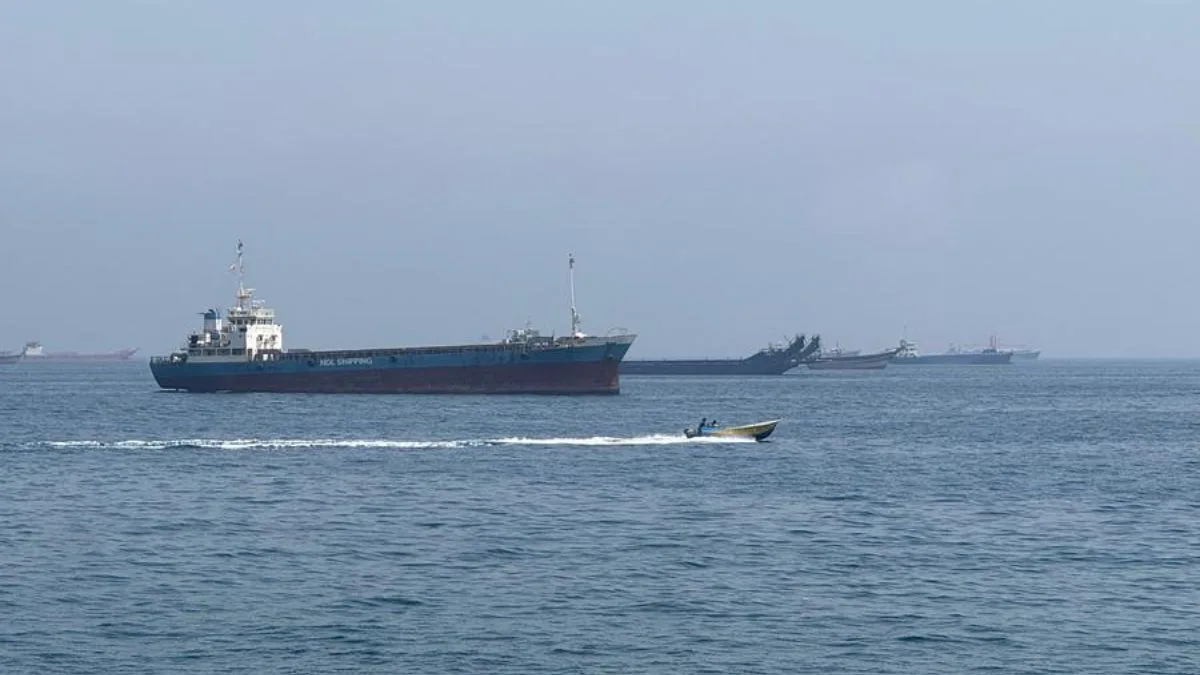
On 19 February, as India celebrated the legacy of Chhatrapati Shivaji Maharaj, a wooden sailing vessel named INSV Kaundinya was completing a remarkable voyage across the Arabian Sea to Oman. Built using the ancient Tankai technique i.e. stitched planks and coconut coir, not a single nail, the ship carried on board the economist and EAC-PM member Sanjeev Sanyal. It was a journey connecting India’s maritime past to its blue-water present. And what a present it is.
At Visakhapatnam, the International Fleet Review, Exercise MILAN, and the Indian Ocean Naval Symposium brought together over 70 nations, a scale unprecedented in India’s maritime history. But India’s ocean ambitions extend well beyond naval strength. 95 per cent of our trade by volume moves by sea. The Maritime India Vision 2030 targets Rs 3.5 lakh crore in investment across ports, shipping, and waterways. Port capacity has nearly doubled in a decade. Four landmark maritime reform bills replaced colonial-era legislation in 2025. A Rs 25,000 crore Maritime Development Fund and a Rs 69,725 crore shipbuilding package are on the table.
Advertisement
India’s coastline is no longer a boundary; it is the launchpad for the next phase of economic growth. One question, that refuses to go away: How do we sustain a trillion-dollar trade corridor without energy independence? India imports 88 per cent of its crude oil which is a bill north of $130 billion a year. By 2035, that dependence is projected to cross 90 per cent. Heavy fuel oil, the viscous sludge from crude refining, powers 95 per cent of global shipping. Every Indian vessel that sails on imported fuel is a floating reminder of this vulnerability. And the clock is ticking.
The International Maritime Organisation’s Net-Zero Framework, effective January 2028, will impose the world’s first carbon pricing on shipping – $100 per tonne of CO� for moderate non-compliance, $380 for the worst offenders. The global frontrunners are green ammonia and e-methanol that come with a staggering price tag, two to three times that of conventional fuel. For a nation aspiring to be the world’s third-largest economy, draining foreign exchange on imported green molecules is replacing one dependency with another. That is not Aatmanirbharta. The answer is not in our deserts or our research labs.
It is in our garbage. Urban India generates between 1.3-1.5 lakh metric tonnes of municipal solid waste every day which amounts to roughly 50 million tonnes a year, forecast to jump to 125 million tonnes by 2031. Half of this is biodegradable organic waste. Our port cities are among the worst affected: Mumbai produces 11,000 tonnes a day, Chennai 6,000, Visakhapatnam and Mangaluru thousands more. Despite the Swachh Bharat Mission, only a quarter is scientifically treated. The rest festers in landfills. Ghazipur’s 65-meter dumpsite in Delhi catches fire with grim regularity.
These are surely civic embarrassments, but they are also untapped fuel reserves. A ship engine does not care whether its fuel began as crude oil in the Persian Gulf or as kitchen waste in Dharavi. It needs carbon-andhydrogen-rich molecules in liquid form. Municipal waste is precisely that. Through gasification – heating waste in a low-oxygen environment, it becomes syngas, which is catalytically converted into green methanol, a clean-burning fuel that existing ship engines can use with minor modifications. Alternatively, the organic fraction can undergo anaerobic digestion to produce compressed biogas. This is not speculative technology.
Edmonton, Canada ran the world’s first commercial waste-to-methanol plant for eight years – processing 100,000 tonnes of municipal waste annually, producing ISCC-certified bio-methanol. Spain’s Repsol is investing €800 million in Ecoplanta, which will convert 400,000 tonnes of waste into 240,000 tonnes of methanol by 2029. China accounts for 90 per cent of renewable methanol capacity currently under construction. Denmark’s Kassø e-methanol plant went operational in 2025. Is India doing something on these lines? We have a 25-tonne-per-day pilot at Tuticorin and an MoU at Kandla. The economics, ironically, favours us more than anyone. Green hydrogen needs electrolysers costing Rs 3-5 crore per megawatt. Green ammonia trades at Rs 60,000-1,00,000 per tonne.
Waste-based methanol benefits from a feedstock that is not just free, it comes with payment attached. Cities pay tipping fees of Rs 1,700-4,200 per tonne to dispose of garbage. This negative feedstock cost means green methanol from waste can be produced at Rs 34,000-50,000 per tonne that is competitive with conventional heavy fuel oil, roughly half the price of its green rivals. Lifecycle emissions drop up to 90 per cent. Add carbon credits under India’s PAT scheme, and the numbers improve further. Maersk has ordered 25 methanol-powered container ships but cannot find enough green fuel to fill them. Over 450 methanol-capable vessels are on order globally.
The demand exists. India, which handles 1.65 billion tonnes of port cargo annually, should be supplying it. So, what is stopping us? Two things. First, source segregation. Waste-to-energy works only with assure d inp ut of segregate d biodegradable waste – a minimum 150-200 tonnes per day. Without it, plants run below capacity and die. Indore has cracked this: 100 per cent source segregation, 630 tonnes of biodegradable waste processed daily, a self-sustaining financial model funded through user charges and property taxes. A 100-TPD bio-methanation plant costs roughly $5.7 million and breaks even in six years. The model works. It needs replication, not reinvention.
Second, nobody has stitched the ecosystem together. Municipalities handle waste. Port authorities handle fuel. Energy companies handle production. These three sit in different ministries, different budgets, different incentive structures. The PPP model is straightforward: municipalities deliver segregated waste; energy companies gasify it into methanol near port premises; port authorities anchor demand through long-term offtake contracts with coastal shipping lines, port craft operators, and the Navy. The policy architecture exists now with the Maritime Amrit Kaal Vision 2047, Harit Sagar green port guidelines, the Maritime Development Fund.
What is missing is one state or one port authority willing to be the first mover in this direction. Here is a concrete proposal: commission a 200-TPD waste-tomethanol demonstration plant at Paradip, Tuticorin, or Kandla – modelled on Edmonton, scaled for Indian waste characteristics, co-located with the existing Green Hydrogen Hub infrastructure. Capital cost: under �50 crore. Timeline: 24 months. Output: enough methanol to fuel every tug and pilot vessel in the port, with surplus for coastal shipping. If Indore can fix segregation for a city of 35 lakh, a port city can fix it for a catchment zone. India achieved 50 per cent non-fossil energy five years early.
It crossed 100 GW of solar before anyone expected. When this country decides to move, it actually moves. The waste-to-fuel opportunity is no different – except here, India would not just meet a target but offer a replicable model for every coastal developing nation drowning in the same twin crises of imported fuel and unmanaged waste. The Indian Ocean is the only ocean named after a country. If India is to be truly Aatmanirbhar at sea by 2047, it must fuel the ships that sail these waters with its own resources – starting with the garbage it currently tries to wish away.
(The writers are, respectively, Project Manager and Digital Advisor, GIZ India. The views are personal.)