Artemis II crew splashes down after Moon mission; Trump says ‘next step, Mars’
After a record-breaking journey beyond the Moon, Artemis II’s safe return strengthens NASA’s deep space roadmap and puts fresh focus on future Mars ambitions.
Chandrayaan-3’s successful Moon south pole landing has earned India one of the world’s most prestigious astronautics honours at a major conference in Washington DC.




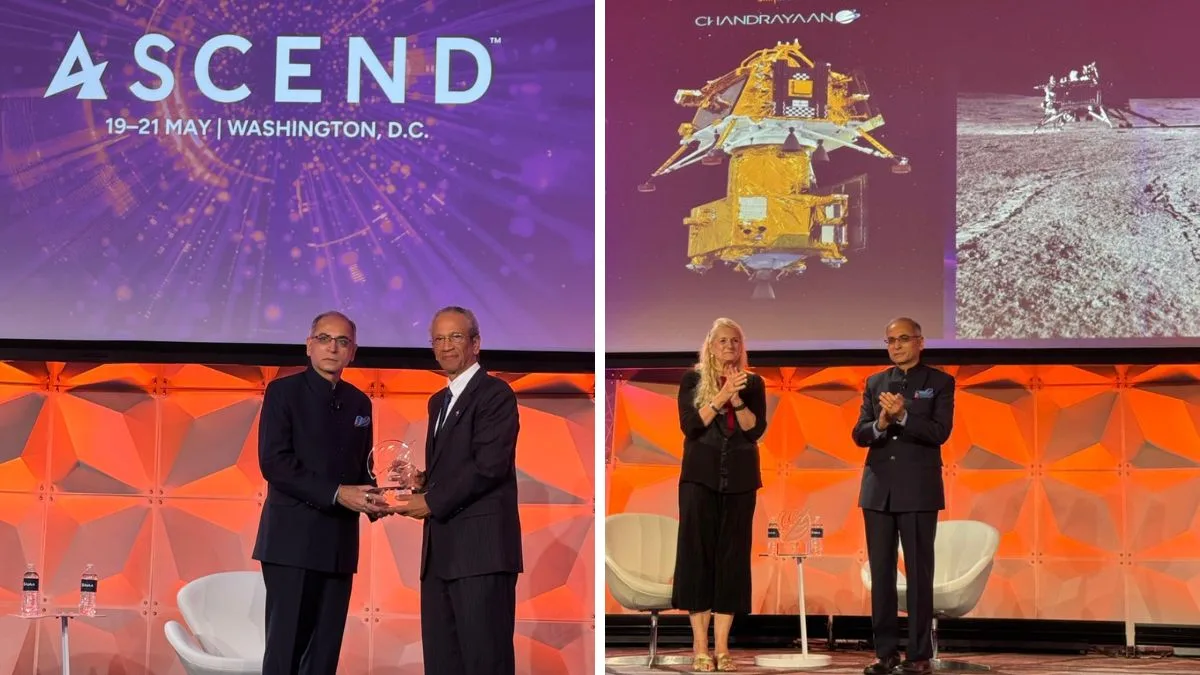
India’s Ambassador to the US, Vinay Kwatra, accepts the 2026 Goddard Astronautics Award on behalf of ISRO for the Chandrayaan-3 mission during the ASCEND 2026 conference in Washington DC. | ANI
India’s Chandrayaan-3 mission has been awarded the prestigious 2026 Goddard Astronautics Award by the American Institute of Aeronautics and Astronautics (AIAA), marking another major global recognition for the country’s historic Moon mission.
The award was presented in Washington, DC, on May 21 during the AIAA ASCEND 2026 Conference, where India’s Ambassador to the United States, Vinay Kwatra, accepted the honour on behalf of the Indian Space Research Organisation (ISRO).
Advertisement
Chandrayaan-3 had scripted history on August 23, 2023, when it became the first spacecraft to achieve a soft landing near the Moon’s south pole. The region has long attracted scientific interest because of its difficult terrain and the possibility of water ice and other resources that could support future lunar missions.
Advertisement
The mission is widely seen as a turning point in India’s space programme, not only for the successful landing but also for the scientific findings it generated from a region that had never previously been explored at the lunar surface level.
According to details shared at the event, Chandrayaan-3 provided important data that could aid future human missions to the Moon. The mission also confirmed the presence of several key chemical elements in the lunar south polar soil, strengthening prospects for future resource utilisation and manufacturing operations on the Moon.
During his address at the conference, Ambassador Vinay Kwatra spoke about Prime Minister Narendra Modi’s Space Vision 2047 and India’s long-term plans in deep space exploration and human spaceflight.
He also underlined the rapid growth of India’s commercial space sector and called for deeper cooperation between India and the United States in the field of space technology and research.
Kwatra stressed the importance of stronger partnerships involving governments, industries and research institutions from both countries as India expands its role in the global space ecosystem.
The Goddard Astronautics Award is considered the highest recognition presented by the AIAA for outstanding achievements in astronautics.
The award commemorates Robert H Goddard, widely regarded as one of the pioneers of modern rocketry. Goddard’s early liquid rocket experiments laid the foundation for advances in space exploration and astronautics.
The award took its present form in 1975 after the institute broadened its selection criteria beyond propulsion and energy conversion technologies.
Advertisement