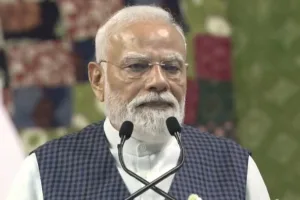
When Prime Minister Narendra Modi handed Italian PM Giorgia Meloni a packet of Melody toffees during his Rome visit, the clip went viral. Meloni held up the packet and called it a “very, very good toffee.” For anyone who grew up in India between the 1980s and 2000s, the moment carried a weight far beyond a polite diplomatic exchange. Melody was not just a candy. It was a childhood, a question, and an inside joke that a billion people shared.
This is the story of how that toffee got there.
Advertisement
The house that built it: Parle Products
To understand Melody, you first need to understand Parle.
Parle Products Private Limited was founded in 1929 by Chauhan family of Vile Parle, Mumbai. Today it is an Indian multinational food corporation that makes biscuits and confectionery products with revenue of ₹17,223 crore in FY23. The company began as a small sweet shop. Parle started as small confectionery factory producing sweets and toffees. Over time, it diversified into biscuits, snacks, other food products.
The Chauhan family later split the original Parle into three separate businesses. The original Parle company was divided into Parle Products, led by Vijay, Sharad, and Raj Chauhan’ owners of brands including Parle-G, Melody, Mango Bite, Poppins, and Kismi Toffee Bar along with Parle Agro and Parle Bisleri. Melody stayed with the Products branch, the one rooted most deeply in the confectionery tradition.
By the time the 1980s arrived, Parle was already a trusted name in Indian kitchens. That trust gave it the credibility to take a risk on a new kind of product.
Idea behind the toffee
Parle launched Melody in the early 1980s, around 1983, at a time when India’s confectionery market was still evolving. Chocolate was considered aspirational and often expensive, while dominant category consisted of simpler candies and toffees.
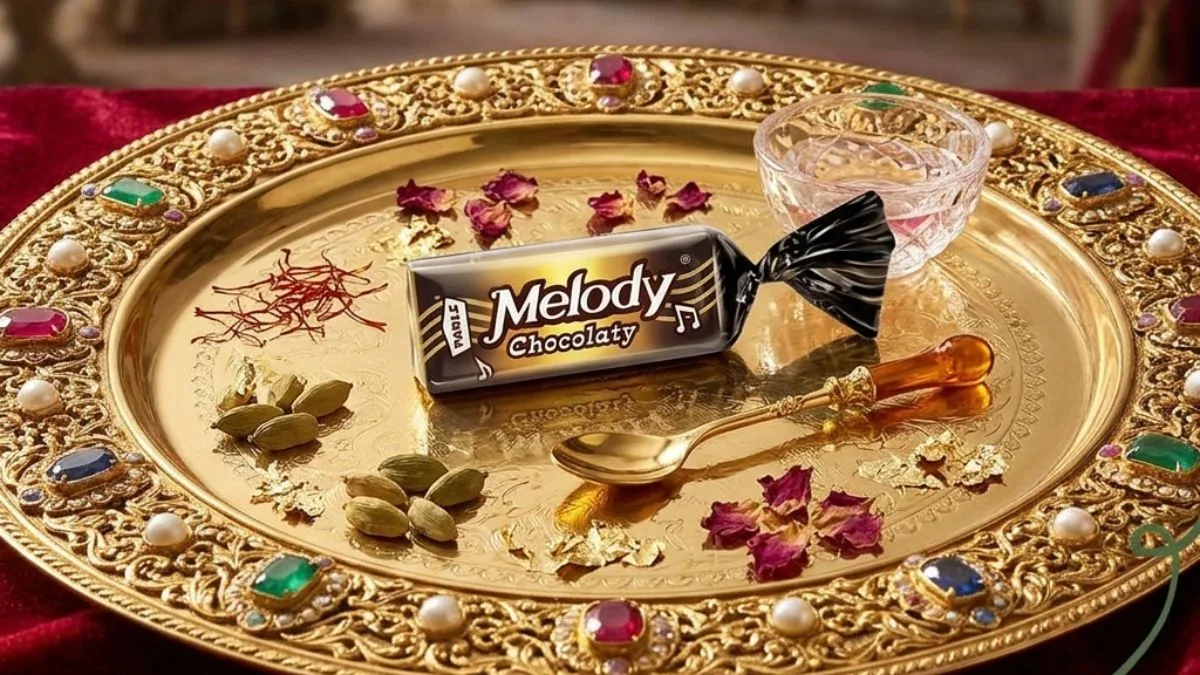
Timing mattered. India in 1983 was not a country where chocolate was freely accessible. Full chocolate bar was out of reach for most school children. Children craved chocolate bars but they were not affordable. That is when Parle introduced Melody, dual-core sweet: a soft caramel exterior with rich liquid chocolate centre, priced at just one rupee.
The product itself was engineered around that insight. Melody entered the market as hybrid product, caramel-coated toffee with a chocolate filling inside. What made it visually distinct from its rivals was that the chocolate core was visible from the side of the candy. You could see it before you tasted it. That visual was a quiet sales pitch in itself.
The competition problem
Parle entered a market that was already contested.
When Melody was introduced, segment of chocolate-filled toffees was already gaining traction, led by multinational brands such as Cadbury’s Eclairs. Cadbury had both deeper pockets and stronger shelf presence. Going up against it head-on would have been a losing game.
Tough competition came from Cadbury (now Mondelez) with its Eclairs, toffee with oozy chocolate filling. Eclairs had literally created new space and dominant position for itself in this sub-category. Parle’s Melody was structurally similar. Challenge was not making a better product. Challenge was making people see it differently.
Parle carved out a differentiated identity for Melody. This positioning allowed Melody to coexist alongside larger global brands while maintaining strong appeal in India’s price-sensitive market.
The answer to that challenge came not from the product but from an advertising agency’s reception area.
Campaign that changed everything
When Parle first set out to market Melody, confectionery space was fiercely crowded. Cadbury’s Eclairs had already carved out a dominant position. Parle needed way to make Melody stand out without directly taking on the competition. The task fell to Everest, the advertising agency brought on to handle the brand.
Creative head Haresh Moorjani and copywriter Sulekha Bajpai took on the brief, with the goal of highlighting Melody’s generous chocolate filling without making explicit comparisons to rivals. The breakthrough came in an unlikely moment. Bajpai was refining her lines in Parle’s reception area, waiting to present the concept, when the idea crystallised. Line she landed on was deceptively simple: “Melody ke andar itni chocolate kaise bhari batao?” and the now-iconic reply: “Melody khao, khud jaan jao.” A jingle sealed it. “Melody hai chocolatey, Melody hai chocolatey.”
Creative strategy behind the campaign was deliberately unconventional. The idea was to show the kind of people that children admired or aspired to be, like a magician, asking question about Melody and having a child give the reply. The question was never answered. That was the point.
Instead of positioning its candy as a “better chocolate,” Melody chose different route. It refused to explain itself. The brand turned its biggest selling point into mystery. This was a marketing gamble that paid off spectacularly.
Forty years of the same question
For entire generation growing up in the 80s, 90s, and early 2000s, one question echoed everywhere: “Melody itni chocolaty kyun hai?” The response would be: “Melody khao, khud jaan jao.” It became a national puzzle. This campaign made Melody a hit in the market and is perhaps one of the smartest marketing campaigns India has ever seen.
The ads evolved over time while keeping the core idea intact. Then came the 2016 thief ad, where a burglar breaking into a house gets distracted by Melody and wakes the homeowner just to ask the famous question: “Melody itni chocolaty kyun hai?” The format was refreshed but the question remained the same. New audiences found it just as funny as their parents had.
From the kirana counter to pop culture
Melody’s reach was never limited to the TV screen. It lived in the physical world of Indian retail in a way few brands managed.
Walk into almost any old-school kirana shop in India, and the scene is familiar: glass jars lined up on the counter, filled with individually wrapped candies in bright colours. Melody has occupied a spot in those jars for decades, its caramel exterior and visible chocolate filling making it one of the more distinctive options on the shelf.
For children across income groups, the kirana counter was the point of contact. At one rupee, Melody sat comfortably within the pocket money economy that governed Indian childhood purchases. That price point was not accidental. It was the entire strategy.
The brand eventually crossed from advertising into entertainment. A reference to the Melody tagline even made its way into the 2019 film Chhichhore, starring Sushant Singh Rajput, a film set largely in an engineering hostel in the 1990s. The inclusion was not product placement. It was a cultural shorthand.
Why it lasted
The product solved a real problem: it made chocolate accessible at a time when chocolate was not accessible. The price point held for decades, making it resistant to economic shifts that wiped out competitors. The advertising was built on a single, durable insight about human curiosity. And the distribution network that Parle had built over fifty years meant that Melody was always within arm’s reach of its consumer.
The question it asked in 1983 was never answered. That was always the plan. And four decades on, the question is still being asked, this time, by an Italian prime minister in Rome.
So, Meloni ji, Melody khao, khud jaan jao.