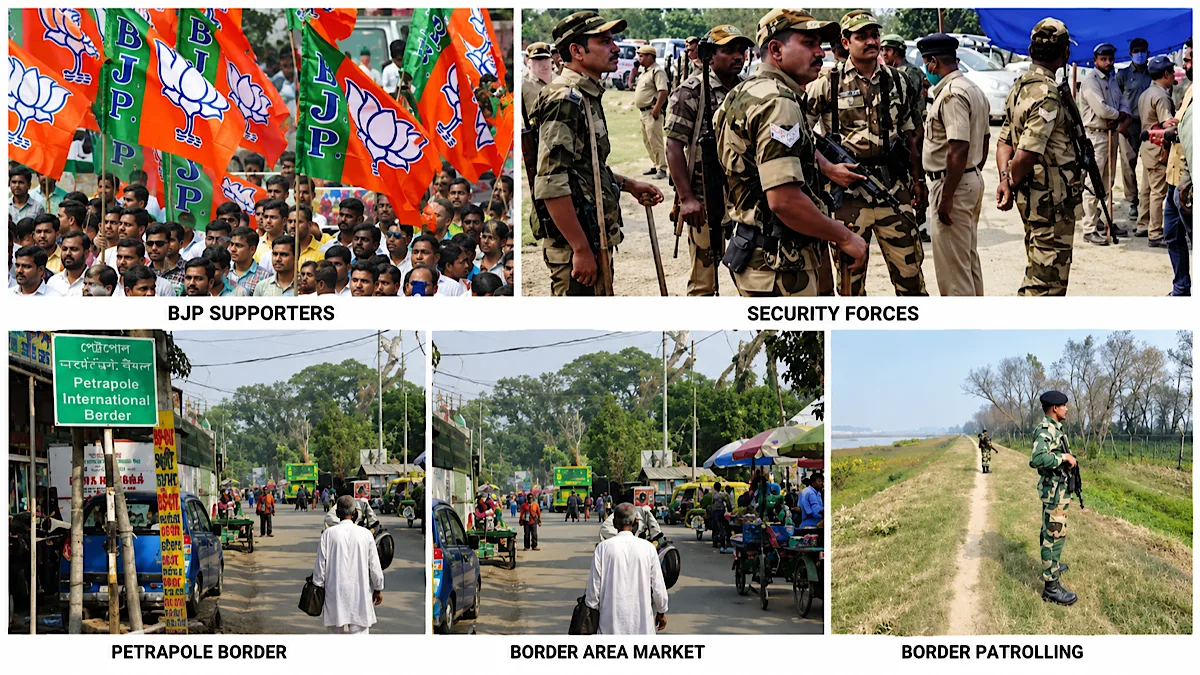
The massive electoral mandate of the BJP stands in stark contrast to an almost broken and dysfunctional state that it inherits. Lawful governance structures stand dismantled, with bureaucratic behaviour conditioned by unquestioning allegiance to the governing party. Deep institutional decay, substitution of policy by patronage, a near collapse of administrative machinery, and social discourses manipulated to preserve a self-serving status-quo define a failing state decayed almost beyond repairs, at least in the short term. To revive it from the abyss of despair it has sunk into would be no easy task for any government, and people should not expect miracles.
The historic mandate has imposed a daunting responsibility to reverse this descent which will demand far more than mere resolve ~ it must revive a dysfunctional administration, restore the rule of law by neutralising entrenched criminalised political networks that have flourished under overt state protection, and rebuild institutional credibility from scratch. It must also revive investor confidence, fix a broken and intensely politicised educational eco-system and lay the foundations for economic renewal, modernise industry, agriculture, and infrastructure to generate employment.
Advertisement
It would be more than a Herculean task to achieve all these and a pragmatic policy for the government would be to identify and carefully plan its tasks in the short, medium and the long term to ultimately transform the state into an engine of growth and rejuvenation. It is important that the government must resist the temptation to dissipate its energies in ideological triumphalism or by confrontationist paralysis. Of course, those who have abused power and plundered the state during the last 15 years must face the full force of law, but governance should not be consumed by vindictiveness ~ it came with the promise of Badlao, not Badla.
A feasible roadmap could be short-term stabilisation, medium-term institutional and economic restructuring, and long-term civilizational and developmental transformation. In the short term, the government must restore law and order, stabilise finances, reduce corruption, and reassure citizens that governance will be impartial and accountable. In the medium term, it must undertake structural reforms in industry, agriculture, education, healthcare, and urban governance. Long term goals should be to restore Bengal’s civilisational and intellectual and economic vitality so that it can again earn the respect of India. Electoral legitimacy does not automatically confer moral legitimacy which comes only through fairness and transparency.
The immediate challenge would be to restore administrative neutrality and supremacy of law. Public confidence and trust have been eroded completely through the culture of political patronage, limitless corruption, cadre influence, and partisan functioning of administration. When political allegiance defines administrative competence and determines career advancement, bureaucracy becomes a willing collaborator in the institutional decimation. It is doubtful whether the same bureaucracy can now reinvent itself to help the government deliver, and getting a few officers with experience and integrity on deputation from outside the state for some time at least may not be a bad idea. Depoliticising the police administration and strict non-interference in their transfers should be another top priority.
Building institutional safeguards to prevent one partisan ecosystem replacing another and to prevent the goons of TMC infiltrating the new apparatus would be another priority, as would be to end the obnoxious cut-money culture and the syndicate mafiosi that thrived so luxuriantly under the previous regime and stifled all economic activities ~ guardrails should be erected to see that it never again comes back. The political violence which has characterised West Bengal’s electoral politics throughout also must see its end. Another important consideration from the perspective of national security is to strengthen border security and prevent illegal infiltration by fulfilling the promise of land allocation for fencing within 45 days.
Equally important is to ensure the safety and security of women, not only at the workplace but everywhere, through effective policing and special women-only police battalions. The TMC government has not placed the CAG reports before the legislature since 2021, this would be an immediate task for the new government. Simultaneously, the government must fix the public finances of the state and ensure fiscal stabilisation by focusing on debt. Given the enormous electoral handouts that it has promised to women and others, this would be difficult, especially in view of the heavy debt burden carried by the state, which now amounts to 36 per cent of its GSDP and carries an interest burden of around Rs 45,000 crore annually.
The government must therefore rationalise expenditure, improve tax compliance through digitisation and undertake a complete overhaul of all its running schemes the way Uttarakhand and some other states have done. Schemes which are not delivering must be closed regardless of sunk costs, and others merged for better synergy; that way resource utilisation can be optimised. Welfare cannot be an open-ended tap that drains the treasury, continuity of welfare must be balanced with fiscal prudence. Technology must be employed to prevent the same set of people from getting multiple benefits from multiple schemes, and delivery must be redesigned to minimise if not eliminate leakages and redundancies. Creating unified beneficiary databases and linking welfare to measurable developmental outcomes might help.
The new administration must also launch a comprehensive audit of welfare schemes, and redesign recruitment processes, infrastructure projects, and local government finances. To limit corruption, it must completely digitise all government procurement through transparent tendering systems, establish independent vigilance mechanisms and protection for whistleblowers, devise and publicise departmental performance metrics and incorporate quality parameters for public services in the citizens’ charters. A credible anti-corruption drive may substantially improve confidence of investors and citizens alike and improve trust between citizens and the government.
Trust is the pixel of governance and corruption erodes trust, hence controlling corruption must be an overarching goal spanning the entire administrative architecture. Another major task in the short term would be to depoliticise the state’s educational institutions which are now in an advanced state of decay. Institutions and universities that once attracted talent from all over India are now hotbeds of politics where all senior positions are filled by politics of patronage, with standards and integrity falling to abysmal depths.
Students no longer dream of studying at once hallowed but now decaying state universities. To reverse the tide of talents fleeing a state devoid of opportunities, the entire educational ecosystem should be sanitised from politics and standards and integrity of appointments restored, but the crux would be economic revival. The government must start working for the economy to generate growth and employment, which is the biggest challenge before it. Once a leading industrialised state of India, West Bengal has been systematically deindustrialised ~ first by the Left Front Government which drove industries away, and by the TMC which did precious little to attract them. Capital flight, labour militancy, land acquisition controversies, and policy uncertainty destroyed whatever little industrial confidence was left.
It would again be a Herculean task for the BJP to position itself as a pro-industry, pro-investment, and pro-infrastructure government. It would require much more than investor summits ~ the elements of a revival strategy would be a predictable regulatory framework, faster land clearance mechanisms, credible labour dispute resolution systems, and reliable and cheaper power and logistics infrastructure. Bengal’s geography can be utilised to transform the state into an economic gateway to Southeast Asia and to develop it into a logistics hub for the Bay of Bengal region as well as a centre for cross-border trade. With Assam emerging as a large semiconductor hub, the strategic location of West Bengal as India’s gateway to Northeast India and South-East Asia provides enormous untapped potential under regional connectivity frameworks.
The long-term vision should be to transform it into a knowledge economy linking eastern India with global markets through deep port modernisation, multimodal transport corridors, creating high-quality urban infrastructure and through international investment partnerships. Many fixes would be required for that, beginning with reversing the migration of talent and capital, rebuilding social cohesion, building institutional maturity and cultural confidence. The long-term future of West Bengal depends not merely on economic growth, but on civilizational renewal and sustainable development.
The future will ultimately depend on whether it can move beyond cycles of ideological confrontation towards a developmental consensus grounded in institutional competence and social harmony. Bengal now stands at a crossroads between continued stagnation and a possible renaissance. The choices made in the coming years will determine whether it can once again emerge as one of India’s foremost centres of economic prosperity, artistic creativity, and intellectual vitality.
(The writer is a former Director General from the CAG of India and currently a Visiting Professor at IIM, Calcutta)