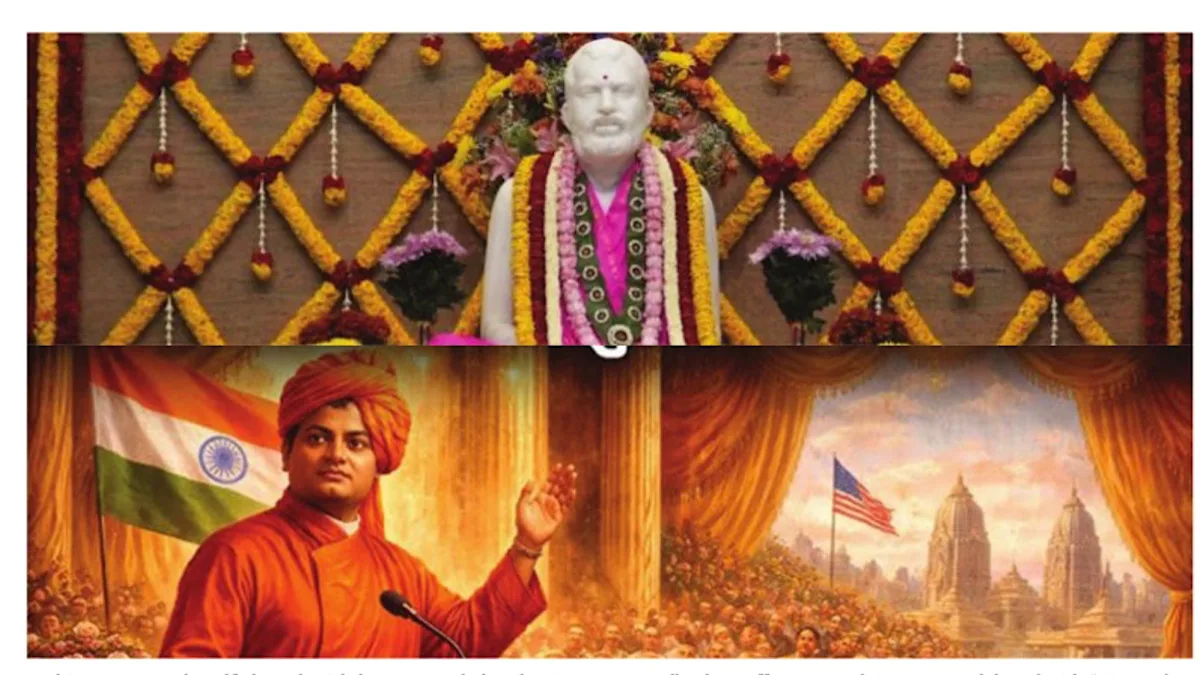
Sri Ramakrishna’s knowledge of God (Brahma-Jnana) covered the essences of all other faiths as well, for he tasted Him in them too. He found the Same God in every faith and in every being. He proclaimed his ultimate spiritual finding to the world in a word that suited the material man and upheld the truth of a “God in man” equality of mankind, like the ancient Hindu seers. It was the tenor of his message, by which he wished to knit humanity in a family and bind man in brotherhood.
Sri Ramakrishna chose Narendranath (Swami Vivekananda) as the instrument to carry his message and teaching forward. Narendranath was a teenage product of modernity. He left Hinduism and became its bitter critic. He was supple, sharp, argumentative, and skeptical, but pure at heart and a stickler for truth ~ just the one Sri Ramakrishna required. He was like a restive horse to be brought to heel, harnessed and trained ~ which Sri Ramakrishna did successfully as his skillful Master, despite the fact that the task was quite arduous and challenging. There were moments when he was too restless for Samadhi and realization of God, which were tactfully utilized by his Master dexterously to transform and prepare him for his purpose.
Advertisement
Samadhi is a condition in which a spiritual aspirant experiences God and His bliss within himself, remaining shut out from the external world. It is the acme of realization, born out of his spiritual endeavor and productive of Eternal Liberation (Moksha) from all miseries. That was the reason why Narendranath had an unqualified fascination for it. Sri Ramakrishna taught him that to achieve such a thing for the sake of personal peace and joy was utterly selfish and said there was a still higher state of God-realization. He asked him sarcastically why God is there only if the eyes are closed and He isn’t there if they are open! Narendranath was able to fathom the import of this very important, cryptic comment which conformed to the cardinal precepts of the Hindu seers and the truth Hindus piously treasured in their bosoms for millennia as the epitome of their faith.
Although his struggle to arrive at that point from the position of a non-believer was difficult, he could succeed and had a direct perception of God in man. Consequently, he now said: “God is all there is.” and “The highest concept we have of God is man.” Also rolled out of his lips the words: “Thou art here, I see Thee, Thou art with me, I feel Thee.” Narendranath grew to be a Hindu monk by virtue of the tutelage of Sri Ramakrishna and adopted the monastic name Swami Vivekananda.
Beginning his work with a sacred sense of worship for man, according to his Master’s teaching, he distinctly declared: “My ideal indeed can be put into a few words and that is: to preach unto mankind their divinity and how to make it manifest in every movement of life.” His message to humanity at large was centered on this idea based on the Hindu age-old conviction of “God in man”. The theme of his speeches to people everywhere was, by and large, about the glory of man as sung by realized souls from time immemorial. He said man seems to be imperfect and weak but he is not so really; he suffers unduly because he is not aware that he is God in whom there is no dearth of perfection.
He said, “Infinite perfection is in every man, though un-manifested.” Rabindranath Tagore was quite excited about his teachings, especially about the message he sent across the world regarding the “divinity” of man. Praising him, he wrote: “Some time ago Vivekananda said that there was the power of Brahman in every man, that Narayana (i.e. God) wanted to have our service through the poor. This is what I call real gospel. This gospel showed the path of infinite freedom from man’s tiny egocentric self beyond the limits of all selfishness.” Swami Vivekananda wanted to make every Hindu proud of his spiritual heritage and remain fully conscious of his true identity in order to behave himself.
He shared his plan for its efficacy with his brother disciples, saying: “My whole ambition in life is to set in motion a machinery which will bring noble ideas to the door of everybody, and then let men and women settle their own fate. Let them know what our forefathers as well as other nations have thought on the most momentous questions of life. Let them see especially what others are doing now, and then decide.” He set that “machinery” in motion on the 1 May 1897 in the form of an organization called the Ramakrishna Mission. The Hindu masses have been neglected and oppressed for centuries. They have been kept poor and ignorant.
They have lost their sense of individuality due to relentless exploitation. Presently, they are more degraded because they are now captive tools to dirty politics. Resorting to their naive and credulous nature, a section of powerful politicians has stuffed their brains with a toxic variety of faith falsely branding it as Hinduism, which trains them to be ferociously communal in order to blindly support and fulfill its evil political purposes. The spiritual undercurrent of pure Hinduism intensely perpetuated on earth by Sri Ramakrishna and Swami Vivekananda ~ to integrate mankind in an intimate kinship ~ will soon cleanse their hearts and minds of the planted hatred, jealousy, avarice, greed, enmity, atrocity, discrimination, division, etc., ushering in a feeling of oneness amidst them.
The Master and the disciple have proved themselves as the real saviours of the modern period. It is therefore worth remembering what C. Rajagopalachari had said: “Swami Vivekananda saved Hinduism and saved India. But for him we would have lost our religion and would not have gained our freedom. We therefore owe everything to Swami Vivekananda.”
(The writer is associated with the Ramakrishna Mission Ashrama, Narendrapur)