Nandni Sharma opens up on early struggles, credits WPL for her rise
Long before she became one of India’s promising young fast bowlers, Nandni Sharma was a youngster frustrated by the lack of opportunities at her academy.
April holds layered significance for India, Bengal, and the world. For India, it marks a turning point in history: on 21 April 1526, in the First Battle of Panipat, Babur defeated Ibrahim Lodi, initiating foreign rule that continued under the British for nearly two centuries.




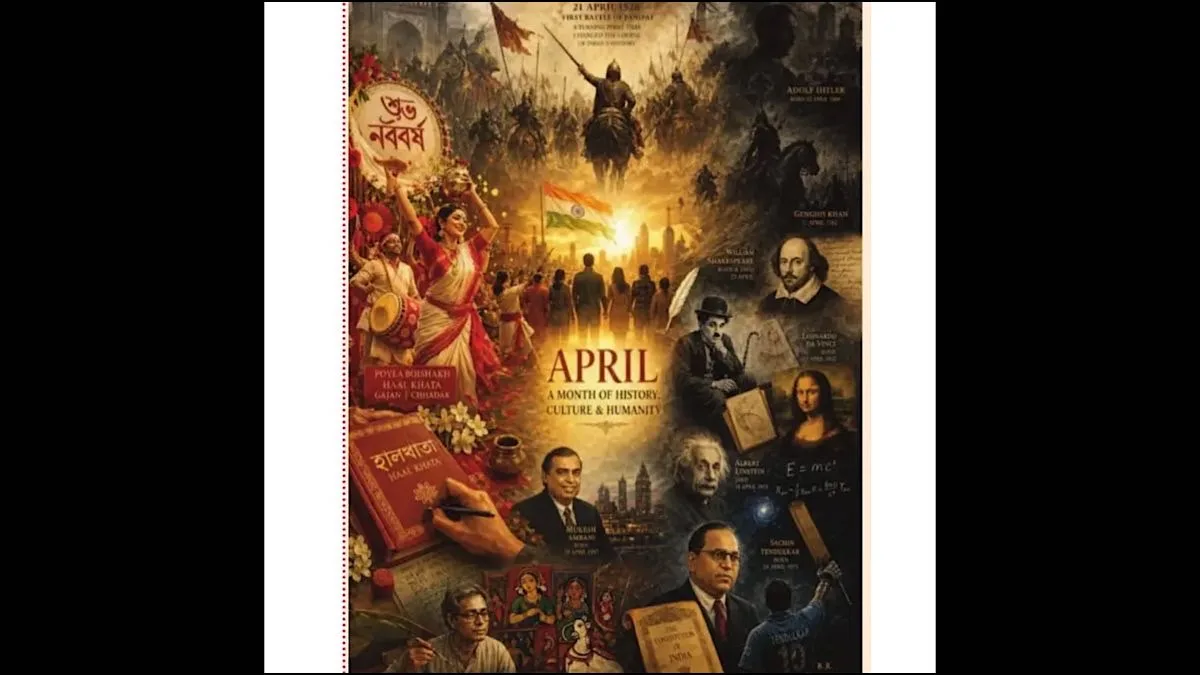
Photo:SNS
April holds layered significance for India, Bengal, and the world. For India, it marks a turning point in history: on 21 April 1526, in the First Battle of Panipat, Babur defeated Ibrahim Lodi, initiating foreign rule that continued under the British for nearly two centuries.
India’s eventual resurgence remains a source of pride. For Bengalis, April is culturally vibrant. Festivals like Shiber Gaajan, Chhadak, Poyla Boishakh, and Haal Khata define the month, though the latter has largely shifted from Poila Baishakh to Akshaya Tritiya. This year, April also hosted a major election, described as notably orderly compared to Bengal’s historically violent polls. Political activity dominated public discourse, making the state a hub of VIP attention.
Advertisement
Globally, April stands out for the birth and death of influential figures. William Shakespeare, born and died on 23 April, shaped literature with works like Hamlet and Macbeth. Charlie Chaplin, born 16 April 1889, revolutionized cinema through films such as Modern Times. Leonardo da Vinci, born 15 April 1452, left masterpieces like the Mona Lisa. Queen Elizabeth II, born 21 April 1926, had the longest reign in British history. Albert Einstein, who died on 18 April 1955, transformed science with relativity, while Arnold Sommerfeld, who died on 26 April 1951, mentored many Nobel laureates despite never winning one himself. In India, April marks the birth of key figures.
Advertisement
Jamini Roy (11 April 1887) elevated Bengali folk art. B. R. Ambedkar (14 April) shaped the Constitution and championed social justice. Mukesh Ambani (19 April)has influenced modern industry, and Sachin Tendulkar (24 April 1973) remains a sporting icon. Yet April also saw the birth of destructive figures like Adolf Hitler (20 April 1889), responsible for immense human loss, and Genghis Khan (c. April 1162), known for vast conquests.
Like Alfred Nobel whose invention brought both destruction and the Nobel Peace Prize April reflects duality. It embodies both brilliance and darkness, yet ultimately stands as a symbol of human creativity, resilience, and progress. April, therefore, becomes a mirror of humanity itself, where creation and destruction coexist. It reminds us that history is shaped by both visionaries and tyrants, by art and conflict, by renewal and loss. In recognising this contrast, we better understand our past and strengthen our resolve to shape a more humane future.
Advertisement