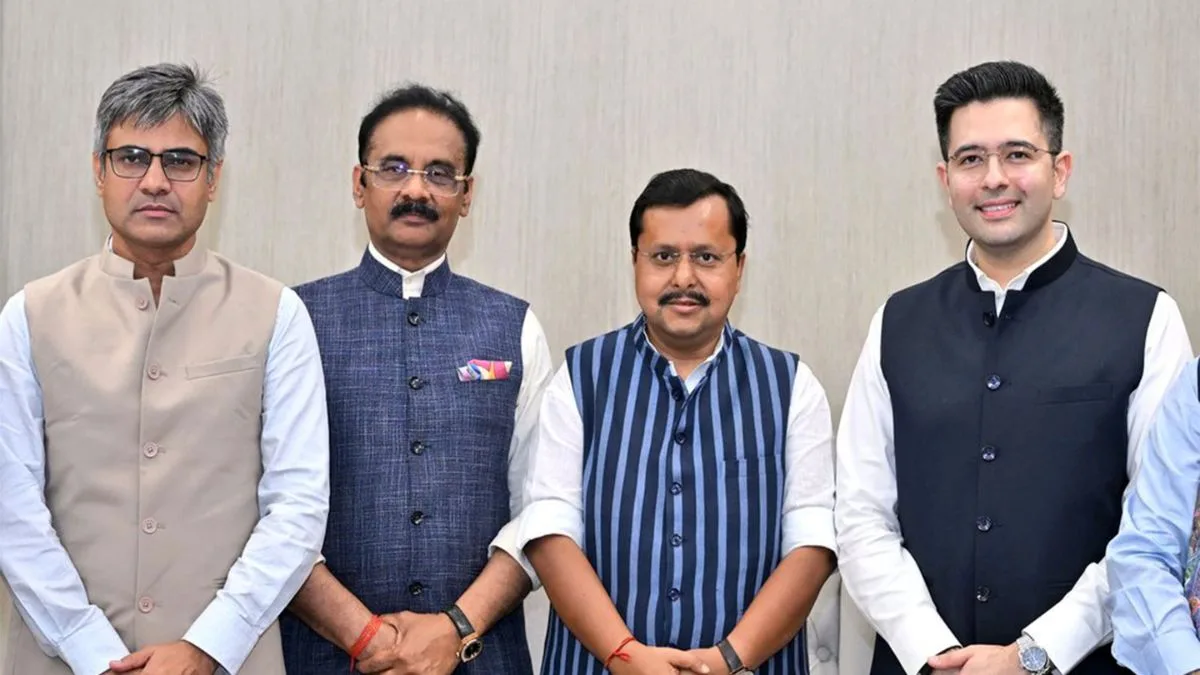
In a significant realignment in Parliament’s Upper House, seven rebel MPs from the Aam Aadmi Party (AAP) have formally joined the Bharatiya Janata Party (BJP), reshaping the numerical balance in the Rajya Sabha and strengthening the ruling coalition’s legislative position.
The updated party-wise position on the Rajya Sabha website on Monday reflected the induction, days after Raghav Chadha and six other MPs broke ranks with AAP and opted to merge with the BJP.
Advertisement
The development followed Chadha’s removal from the post of Deputy Leader in the Upper House last month, a move that had signalled deepening fissures within the party’s parliamentary wing.
Sources said the Rajya Sabha Chairman has accepted the merger of the seven MPs with the BJP, triggering an immediate shift in party strength. The BJP’s tally has now risen to 113 members in the 245-member House, up from 106, while AAP’s presence has shrunk sharply to just three MPs.
The broader National Democratic Alliance (NDA) has also gained from the switch, with its combined strength increasing from 141 to 148, including nominated members. The surge brings the ruling bloc closer to a commanding position in the Upper House, where numbers often dictate the fate of key legislation.
“This is a decisive moment in consolidating support for the government’s reform agenda in the Rajya Sabha,” a senior BJP leader said, adding that the party remains “optimistic about further gains as vacancies arise later this year.”
Over 30 seats are expected to fall vacant by the end of the year, and BJP strategists believe the party could secure at least five more seats, inching closer to the two-thirds majority mark of 163.
For the AAP, the development marks a steep setback in its national parliamentary representation. Party insiders, however, maintained that the departures were “not reflective of the organisation’s grassroots strength” and reiterated their focus on governance in the states where they are in power.
The reshaped House now presents a clearer picture of political alignments. The Indian National Congress holds 29 seats, followed by the All India Trinamool Congress with 13. Several regional parties, including the Rashtriya Janata Dal, Bharat Rashtra Samithi, and the Communist Party of India (Marxist), have three members each, underscoring the fragmented opposition landscape.
A cluster of smaller parties and regional outfits, ranging from the Jharkhand Mukti Morcha to the Telugu Desam Party and the Shiv Sena, hold two seats apiece, while a long tail of parties, including factions of the Shiv Sena, the Nationalist Congress Party, and others, are represented by a single MP each. The House also includes three Independents, one vacancy from Jharkhand, and seven nominated members.
With the BJP-led NDA tightening its numerical grip, the latest shift is expected to influence legislative negotiations and the passage of contentious bills, especially in a House where the government has historically relied on issue-based support from regional players.