Opposition alleges ‘saffronisation’ as Bihar renames, repaints 551 schools
A political controversy has erupted in Bihar over the colour scheme of 551 newly launched Model Schools inaugurated by Chief Minister Samrat Choudhary on Sunday.
The elevation of Samrat Choudhary as chief minister marks more than a routine change of guard in Bihar.




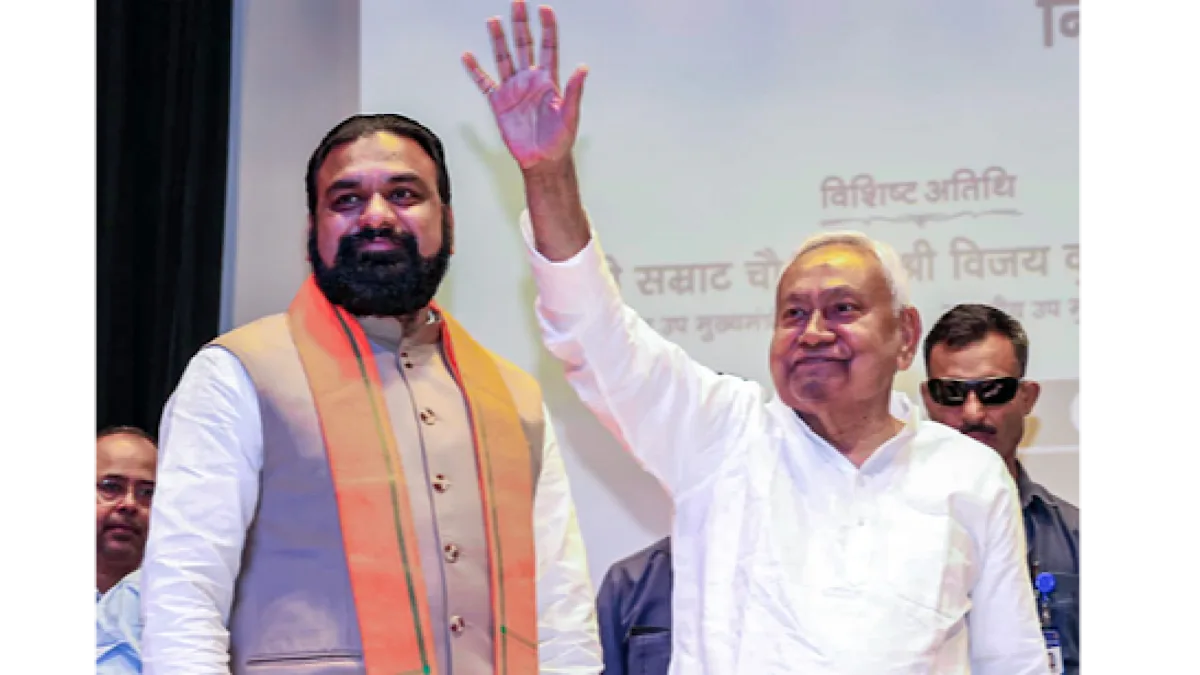
Photo:IANS
The elevation of Samrat Choudhary as chief minister marks more than a routine change of guard in Bihar. It signals the end of a political arrangement that revolved around the adaptability of one man, Nitish Kumar, and the beginning of a more structurally driven phase in the state’s politics. For nearly two decades, governance in Bihar was synonymous with Mr Nitish Kumar’s personal authority.
His tenure restored a semblance of order after the turbulent years associated with former chief minister Lalu Prasad Yadav, and reintroduced the idea that the state could be administered with a degree of predictability. Roads were built, electricity reached villages, and women became a visible political constituency through targeted welfare measures. These were not trivial achievements in a state long defined by administrative decay. Yet the durability of Mr Kumar’s rule came at a cost. His repeated shifts between alliances ~ most notably between the Bharatiya Janata Party and its rivals ~ gradually transformed governance into an exercise in political survival.
Advertisement
Stability was maintained, but direction became uncertain. Economic growth figures improved, but the underlying structure of the economy did not. Industrial investment remained scarce, and migration continued to function as Bihar’s most reliable employment programme. A deeper uncertainty shadows this transition. By moving beyond a coalition anchored in Mr Kumar, Bihar also risks losing the balancing mechanism that moderated extremes. A more centralised party-led model may deliver decisiveness, but it could just as easily narrow the state’s already fragile consensus politics.
Advertisement
This is the context in which Mr Choudhary assumes office. His appointment is being read as a historic breakthrough for the BJP, which has long struggled to translate electoral strength in Bihar into undisputed leadership. More significantly, it represents an attempt to recast the state’s political grammar – from a coalition anchored by a dominant regional figure to one led by a national party seeking deeper social penetration, particularly among Other Backward Classes. But the real test lies beyond symbolism. The political system Mr Choudhary inherits is still shaped by the logic of welfare distribution and administrative management. What it has not yet achieved is structural transformation.
Bihar’s persistent out-migration, weak educational outcomes, and limited industrial base are not failures of governance alone; they reflect the absence of a coherent economic strategy capable of retaining labour and attracting capital. This transition, therefore, is less about personalities and more about a shift in expectations.
Mr Kumar’s legacy will likely be judged as one of stabilisation ~ he made governance possible again. Mr Choudhary’s tenure will be judged on a different scale altogether: whether he can convert stability into opportunity. If that shift does not occur, Bihar risks remaining trapped in a political loop where governments change, but the economy, or the life of citizens, does not. The end of an era, in that sense, is meaningful only if it marks the beginning of a different trajectory.
Advertisement

![‘Beginning of accountability’: Sonam Wangchuk reveals 3 written assurances from Centre before ending fast [VIDEO]](https://www.thestatesman.com/wp-content/uploads/2026/07/Sonam-Wangchuk-1-1-300x200.webp)
![‘Beginning of accountability’: Sonam Wangchuk reveals 3 written assurances from Centre before ending fast [VIDEO]](https://www.thestatesman.com/wp-content/uploads/2026/07/Sonam-Wangchuk-1-1.webp)