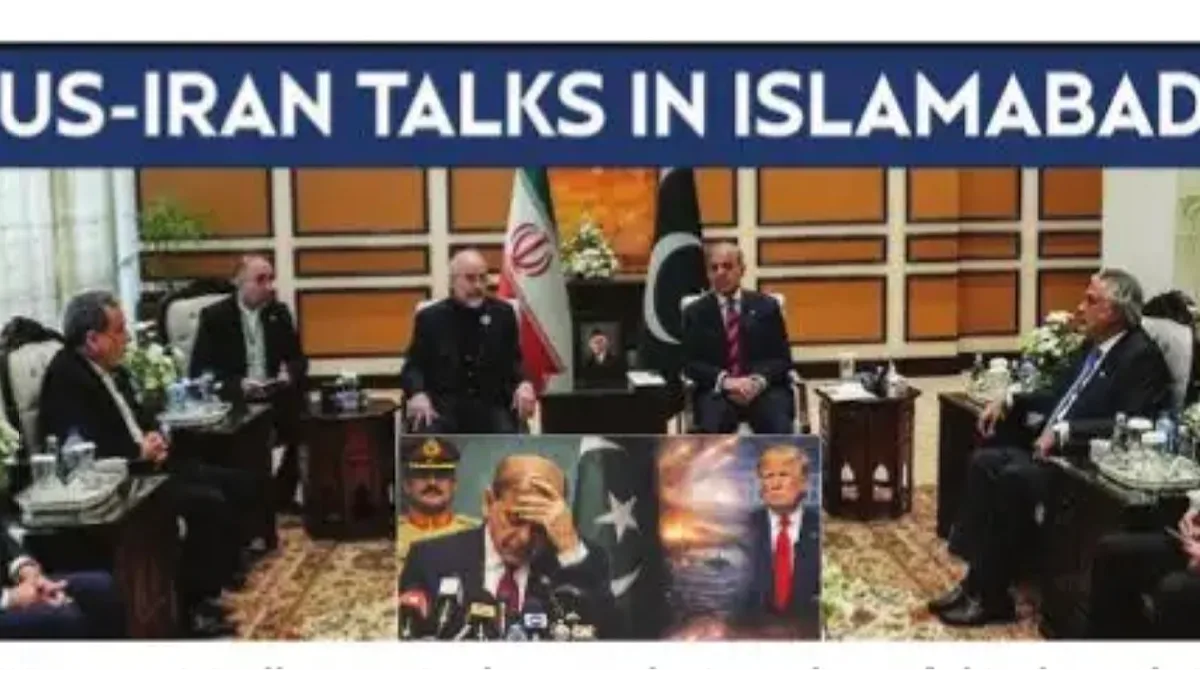
The collapse of the Islamabad talks between the United States and Iran has abruptly ended what many had hoped would serve as a pathway to de-escalation. Instead of easing tensions the failure of these negotiations has pushed the situation into a phase that is now marked by heightened uncertainty and strategic unease. What was once framed as a potential diplomatic breakthrough has now given way to growing concerns about the possibility of a direct confrontation intensifying further. This breakdown is already beginning to reverberate across the Muslim world placing governments under increasing pressure as they assess the risks of a broader conflict.
More importantly, the failure of these talks signals a weakening of diplomatic safeguards that previously acted as a buffer against open conflict. As these guardrails erode, the likelihood of instability spreading across political, economic, and ideological divides becomes far more pronounced. In that sense, the collapse of the Islamabad negotiations is not only redrawing the military frontlines but it is also quietly dismantling the long-held assumptions about unity among the Gulf countries on one hand while on the other it is exposing the fragile and transactional nature of Pakistan’s relationships with some of its closest Gulf allies.
Advertisement
What once appeared as a cohesive geopolitical bloc anchored in shared religious identity and economic interdependence is now revealing the deep fissures within competing national interests and a recalibration of alliances that is shaped less by ideology and more by hard edged strategic realism. At the heart of this unravelling lies the evolving crisis landscape stretching from the Persian Gulf to the Levant. The intensification of the regional tensions that is driven by proxy conflicts, maritime insecurity, and the recalibration of U.S. engagement in the region has forced members of the Gulf Cooperation Council (GCC) to respond not as a unified bloc, but as individual states pursuing divergent security doctrines.
While the GCC was originally conceived as a collective security framework in the aftermath of the Iranian Revolution, the present crisis has underscored how far that vision has drifted from reality. The divergence begins with differing threat perceptions. For countries like Saudi Arabia and the United Arab Emirates, the regional instability presents both a security challenge and an opportunity to assert individual strategic autonomy. Riyadh, still recalibrating after years of costly entanglement in Yemen, has adopted a more cautious and diplomatically layered approach by engaging in back-channel dialogue with Iran to de-escalate tensions.
Abu Dhabi, by contrast, has pursued a far more assertive and economically driven foreign policy that is embedded in expanding its influence through ports, logistics corridors, and strategic investments across the conflict prone regions. This divergence has been even more visible when contrasted with the positions of smaller GCC states such as Qatar and Oman. Qatar continues to leverage its diplomatic channels with a range of actors – this includes harbouring and actively engaging with the leadership of Islamist groups like Hamas and Iran thereby positioning itself as a mediator rather than a participant.
Oman, historically neutral, has maintained its role as a quiet interlocutor, carefully avoiding alignment with any aggressive regional posture. The result is a GCC that is no longer a unified strategic entity but a loose collection of states navigating the same storm with fundamentally different compasses. It is within this fractured geopolitical environment that Pakistan’s vulnerabilities have come sharply into focus. For decades, Pakistan has relied heavily on financial assistance from the Gulf states, particularly Saudi Arabia and the UAE, to stabilize its chronically fragile economy.
These relationships were often framed in terms of Islamic solidarity and strategic partnership, reinforced by Pakistan’s historical role in providing military support and security cooperation to the Gulf monarchies. However, the current crisis has exposed how conditional and transactional these ties have become. UAE’s reported demand for the immediate return of a $2 billion loan serves as a stark illustration of this shift. While financial flows from Gulf states to Pakistan have often been extended under flexible terms in the past, the immediacy of this demand signals a departure from that pattern.
It reflects not only the UAE’s own fiscal recalibrations amid the global economic uncertainty but also a broader reassessment of risk associated with Pakistan’s visible tilt towards Saudi Arabia and its sympathetic tone towards Iran thereby defining its geopolitical positioning. Abu Dhabi’s decision cannot be viewed merely through the lens of economic recalibration as it is equally rooted in the growing strategic unease over Pakistan’s shifting regional posture. Pakistan’s longstanding defence pact with Saudi Arabia when coupled with its noticeably softer diplomatic tone towards Iran has increasingly irked the United Arab Emirates.
For Abu Dhabi which sees itself as among the most directly exposed to Iranian aggression and regional volatility, this balancing act is viewed not as diplomatic pragmatism but as strategic ambiguity towards Abu Dhabi at a time that demands clarity. The perception that Islamabad has stopped short of offering unequivocal diplomatic backing has raised deeper concerns within the Emirati strategic circles about Pakistan’s reliability as a future partner. In this context the UAE’S demand of repayment of its longstanding loans is clear geopolitical signalling that reflects a broader reassessment of trust, alignment, and the long-term viability of the relationship between the two nations.
Moreover, the West Asian conflict has also intensified scrutiny over how the states allocate financial resources and manage external dependencies. As regional tensions threaten energy markets and trade routes, Gulf states are prioritizing domestic economic resilience and strategic investments over external financial commitments that yield limited strategic returns. In such a scenario, Pakistan’s reliance on short-term financial bailouts appears increasingly untenable. The strain in Pakistan-UAE relations also reflects a deeper geopolitical misalignment.
While the UAE has moved toward normalization agreements and pragmatic engagement with a broader range of actors including Israel, Pakistan remains constrained by its domestic political considerations and ideological positions that limit its diplomatic flexibility. This divergence has subtly eroded the strategic alignment that once underpinned their partnership. At the same time, Pakistan’s deepening strategic embrace of Turkey is being read in Gulf capitals not as diversification alone, but as a gradual dilution of alignment.
For decades, Pakistan’s value to Gulf monarchies rested on a clear strategic understanding that it was a dependable security partner that was politically aligned with their interests and willing to offer military and diplomatic backing when required. That clarity is now increasingly clouded. From the perspective of countries like Saudi Arabia and the United Arab Emirates, Pakistan’s growing proximity to Turkey introduces an ideological and geopolitical layer of discomfort. Ankara under its current leadership has positioned itself as a competing pole of influence within the Muslim world, often projecting a more assertive and at times adversarial posture towards the Gulf priorities.
This perception has tangible consequences. It erodes the confidence that once underpinned preferential financial support, security cooperation, and diplomatic backing. For Gulf states, the question is no longer whether Pakistan is an important partner, it undoubtedly remains one, but whether it is a consistent one. And in a region where alliances are increasingly transactional and risk-sensitive, consistency has become the currency of trust. Meanwhile, the fractures within the GCC are likely to persist as long as the underlying drivers of divergence remain unresolved. The absence of a unified threat perception coupled with varying economic priorities and differing foreign policy orientations makes collective action increasingly difficult.
In many ways the current moment represents a broader transition in the West Asian geopolitics. The era of bloc politics defined by rigid alliances is giving way to a more fluid landscape that is now characterized by issue-based partnerships and strategic hedging. States are no longer bound by ideological alignments but are instead navigating a complex web of relationships shaped by economic imperatives and security calculations. For Pakistan this evolving landscape demands a fundamental rethinking of its external engagement strategy.
Reliance on periodic financial assistance is no longer sustainable in a world where even long-standing partners are recalibrating their commitments. The episode with the UAE is not merely a financial dispute; it is a signal of a deeper shift in how relationships are getting defined and sustained in an increasingly transactional geopolitical order. As the West Asian conflict continues to reshape regional dynamics, the illusion of unity both within the GCC and in Pakistan’s external partnerships has been decisively shattered. What remains is a more fragmented, more competitive, and ultimately more unforgiving geopolitical environment where economic strength and strategic clarity will determine the durability of future alliances.
(The writer is an independent journalist and columnist)