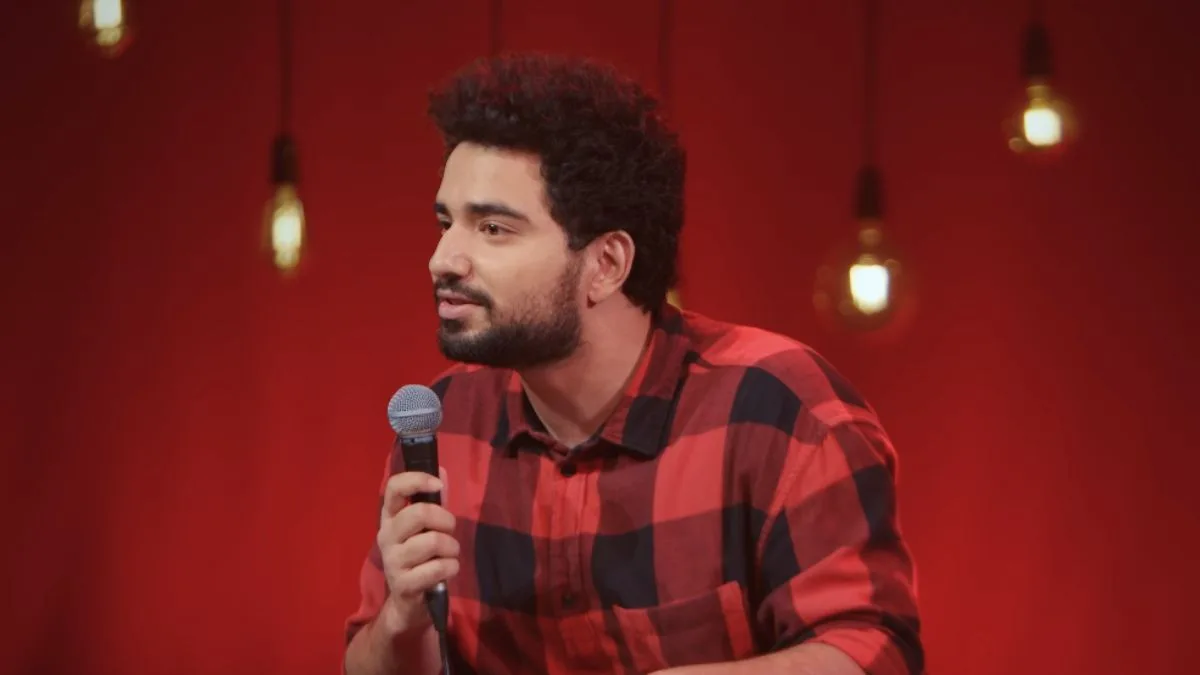
Latent came, Latent went, and yet the noise refuses to die. In India’s ever-churning comedy ecosystem, controversies usually burn fast and fade faster. But this one lingers like an awkward joke that nobody laughs at, yet nobody forgets. And at the center of it all stands Samay Raina and a reputation that now carries as much baggage as applause.
His new special ‘Still Alive’ arrives with the promise of ‘reflection’. The audience laughs even before he begins. The problem, however, isn’t whether he addressed the controversy. The problem is what he didn’t address. And that silence speaks louder than any punchline.
Advertisement
Because this isn’t just about one joke, one tweet, or one backlash. It’s about pattern, culture of “edgy” humour that repeatedly punches down, then hides behind shield of free speech. It’s about victimhood narratives that ignore those actually harmed. And it’s about a comedy scene that laughs loudly but grows quiet when introspection is needed.
The rise of ‘India’s Got Latent’, and the culture it normalised
Before controversy, there was success. Massive success. ‘India’s Got Latent’, Raina’s flagship YouTube show, quickly became a digital phenomenon. It was messy, chaotic, improvisational.
But alongside absurdity came something else: jokes that flirted with ableism, racism, misogyny, and crude sexual commentary. Many viewers shrugged it off as “dank humour”. Others laughed because everyone else was laughing. And gradually, the tone hardened into something familiar: edgy for the sake of being edgy.
The breaking point came when podcaster Ranveer Allahbadia, better known as BeerBiceps, asked a contestant an explicit and widely criticised question. The backlash was immediate. FIRs followed. The show collapsed. And suddenly, a format built on provocation faced consequences it hadn’t anticipated.
Raina addresses this in ‘Still Alive’. He talks about backlash, pressure, legal trouble. But here’s the question: is acknowledging backlash the same as acknowledging harm?
Because the show didn’t exist in a vacuum. It thrived on inflammatory jokes. It banked on humour that hovered at the edge of offensiveness. And when you build a platform on provocation, you don’t get to act surprised when provocation spirals out of control.
This is where the discomfort begins. The narrative shifts from “we crossed a line” to “we were punished unfairly.” That’s not accountability, that’s reframing.
Selective memory: What the special leaves out
If ‘Still Alive’ was meant to be a reckoning, it is also striking for its omissions. One glaring example dates back to June 2024, when Raina appeared on ‘Pretty Good Roast Show’ hosted by Ashish Solanki, roasting Kusha Kapila. That roast contained jokes so harsh they had to be censored, yet fallout landed squarely on Kapila, who faced intense online trolling.
Did Raina revisit that? No.
Before ‘Latent’ shut down, he even posted a story highlighting that Kapila’s ex-husband was among the guests, a move widely seen as insensitive. Again, no reflection in the special. No acknowledgment. Just silence.
Then there’s the infamous tweet about his girlfriend. When she asked him to delete a joke, he spun it into a punchline suggesting he should decide her reproductive choices, ending with “…mat bolna my body my choice.” The comment trivialised an issue tied to women’s bodily autonomy.
In ‘Still Alive’, he apologises. But apologies land differently when the broader tone remains unchanged. If misogynistic remarks like his continue in streams and shows, the apology begins to feel like performance rather than transformation.
This is the recurring theme: selective accountability. Address what’s unavoidable. Ignore what’s uncomfortable. Move forward. Phew!
‘Cancel culture’ vs consequence: The victimhood narrative
After criticism, Raina invoked global comedians like Andrew Schulz, Jimmy Carr, Dave Chappelle, and Ricky Gervais by suggesting fear of cancellation was preventing Indian comedy from evolving. He positioned himself as someone ready to change that.
But this framing raises fundamental question: what does “cancelled” actually mean?
In reality, these comedians, including Raina, continue to perform, sell tickets, gain views, and remain influential. No one is silenced. No one disappears. Criticism doesn’t equal cancellation. It’s simply consequence.
Take the example of Gursimran Khamba, who returned to comedy after the #MeToo movement without meaningful public accountability. The industry moved on. Audiences returned. Fame persisted.
So when Raina positions himself as a victim, narrative feels skewed. He mentions losing shows after ‘Latent’ shut down, yet simultaneously talks about sold-out performances. The contradiction is hard to ignore.
Meanwhile, women targeted in jokes continue facing harassment online; threats, trolling, character attacks. Their consequences are real and ongoing. The imbalance becomes glaring.
Victimhood, in this context, becomes a shield. It shifts focus away from structural issues and centers the comedian’s discomfort instead of the audience’s concerns.
Gender, misogyny, and the ‘edgy humour’ defense
One recurring criticism of Raina’s content is the reliance on misogyny disguised as dark humour. Women contestants being asked about body counts. Frequent use of mother-sister gaalis. Jokes about appearance and bodies.
Even when defending Apoorva Mukhija, who stood up to a participant making nasty remarks, the larger pattern remains unchanged.
Women in ‘Latent’ were rare. Only seven of forty-nine judges were women. Their presence often became the subject of commentary. Jokes targeted figures like Poonam Pandey, Rakhi Sawant, Uorfi Javed, and Bharti Singh, often focusing on bodies or appearances.
When a contestant punched down on Uorfi, she walked out. Later, she wrote on Instagram that people think it’s “cool to abuse someone for views.”
This is where the “edgy humour” defense collapses. Calling something dark doesn’t make it subversive. Sometimes, it simply normalises harm.
And the pattern extends beyond the show. There was a collaboration advertisement with RJ Mahvash that took a dig at Dhanashree Verma amid her divorce from Yuzvendra Chahal. Personal life becomes punchline. Pain becomes content.
The silence of the comedy community
Perhaps the most striking aspect of the controversy is not what Raina said but what others didn’t. Prominent comedians have collaborated with Raina multiple times. They’ve spoken about women’s rights in the past. Yet, during this controversy, their silence was noticeable.
If a community prides itself on being progressive, shouldn’t it also hold its own members accountable?
The lack of public criticism creates a perception of selective activism, speaking up when it’s safe, staying quiet when it’s personal.
Comedy thrives on honesty. But honesty also requires introspection. When peers avoid calling out problematic behaviour, industry risks becoming an echo chamber.
This debate ultimately extends beyond Samay Raina. It’s about stand-up ecosystem where sexist jokes are rewarded as bold, while criticism is dismissed as oversensitivity. Where outrage turns comedians into heroes. Where controversy becomes marketing.
And where apologies (scripted, polished, delivered on stage) blur into performance.
The question isn’t whether comedians should push boundaries. They should. Comedy thrives on discomfort. But pushing boundaries is different from repeatedly punching down.
If humour repeatedly targets marginalised communities, women, or personal tragedies, it stops being daring. It becomes problematic.
So here we are. ‘Latent’ is gone. ‘Still Alive’ is out. The laughs continue. The questions remain.
Was the apology genuine? Was the victimhood narrative justified? Is edgy humour just an excuse? Why is the comedy community silent?