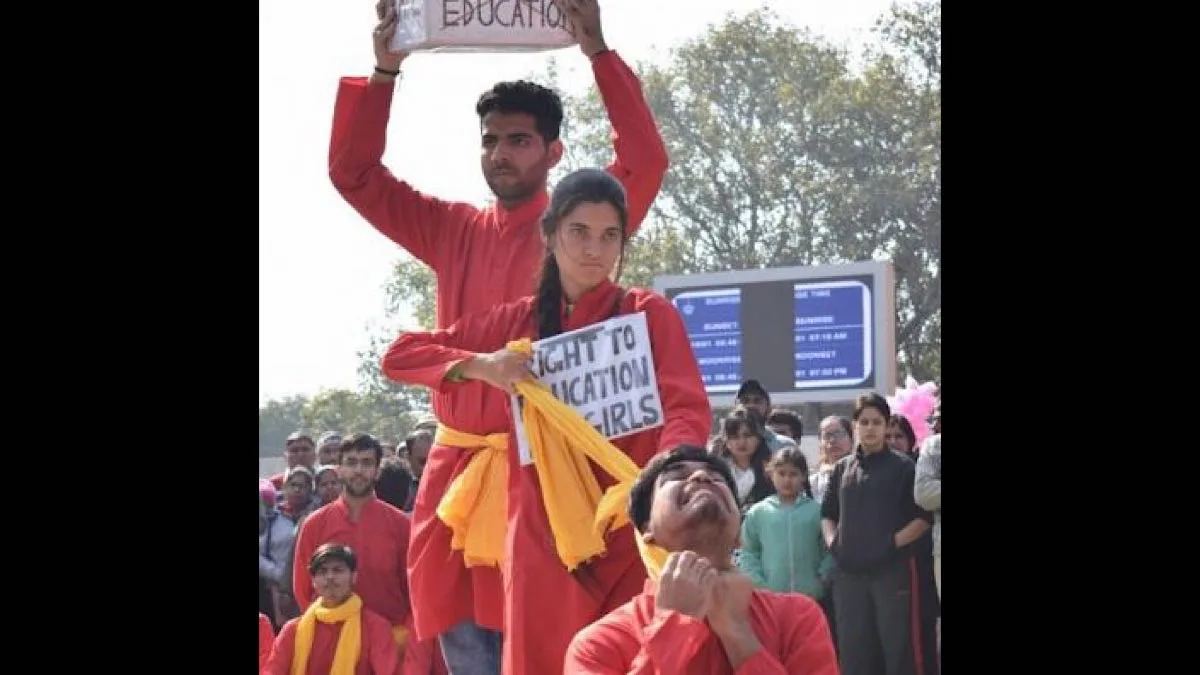
“Tomorrow is National Street Theatre Day, Ma’am,” my junior colleague reminded me yesterday. She is part of a group of conscientious youngsters, who contrary to the cynical idea that this generation is losing interest in our own cultural heritage are not just aware of the history of our iconic institutions, like street theatre, but still feel deeply about the social and political issues that shaped its evolution.
Observed annually on April 12, the date marks the birth anniversary of late Safdar Hashmi, the eminent activist and playwright who was killed in a brutal attack while performing a street play on January 1, 1989.
Advertisement
In the nearly four decades since, Kolkata has not allowed the memory of the iconoclastic, anti-establishment and non-conformist writer-director to fade and each year a number of plays are performed on roadsides and streetcorners in commemoration.
I have not had the privilege of ever having met Safdar Hasmi. However, I was fortunate enough to meet another pioneer of the street theatre, Badal Sircar.
I had been enrolled in the English Literature class at Jadavpur University when I heard from my sister and brother-in-law, who are both graduates from the Film and Television Institute of India, Pune that Badal Da is studying there.
“What do you mean studying there?” I asked. Born on July 15, 1925, Badal Sircar was 70 years old around the time that I am talking about.
“He is doing his BA in Comparative Literature,” they told me with an indulgent smile. They are both very fond of Badal Da and he was equally fond of them as I realized when I made it a point to meet him.
He was sitting in class amongst the seventeen, eighteen, nineteen or twenty year olds, attentively listening to the lecturer who seemed a little embarrassed.
I waited till the class was over and walked over to meet him. I told him I am Mandira’s sister and Amitav’s sister-in-law and he immediately beamed. “Oh, esho esho, bosho bosho,” (Oh, come in, come in, sit down sit down) he said as though it was his own home. He was a tiny man with no hair and exuded a kind of Buddha-like vibe as though he was deeply connected to some divine love. I cannot ever forget the warmth in his voice and the twinkle in his eyes.
I asked him what it felt like to be doing his BA for the first time at the age of 70. He beamed.
“It is very nice. Except that initially the teachers and professors were very reluctant. They told me, ‘Badal Da, aapnake amra ki porabo, amra to apnar ee boi poray ei classey’. (How can we teach you, Badal Da, your books are part of our syllabus).”
He chuckled uproariously.
I never did meet Badal Da again. Though I intended to. Just like that.
Theatre was never my strong subject. In school, possibly during the first semester of class nine or ten, I did sign up for it as an elective. But my acting skills were so unimpressive that one day my drama teacher called me aside and said, “Do you really want to pursue this?” I do remember however one stage performance in which I was able to vindicate my name and my perhaps otherwise unwise selection of drama as an elective subject. As part of the first semester exam, I had been cast as Stella in the production of Tennessee Williams’ play, “Street Car Named Desire” and I happened to get a standing ovation. It was like one of those things when God grants you a gift, like a miracle. The girl who played Blanche du Bois was giving me dagger looks throughout, possibly in anticipation of I messing up my lines.
I have a lot of admiration for people who can perform out on roads and the open streets. It takes guts. That is something that Safdar Hashmi and pioneers of street theatre such as Badal Sircar all had in oodles.
(The writer is Editor, Features)