In August 2025, S&P Global Ratings upgraded India’s sovereign credit rating from BBB ~ to BBB ~ the first such elevation in eighteen years. The government claimed vindication. Fiscal prudence, inflation control, and sustained growth had earned India a place among the world’s more credible economies. Eight months later, on the last trading day of FY26, the Indian rupee breached 95 to the dollar for the first time in history, closing at 94.83 after touching an intraday low of 95.22. FY26 ended as the worst year for the currency in fourteen years, with a depreciation of 9.88 per cent.
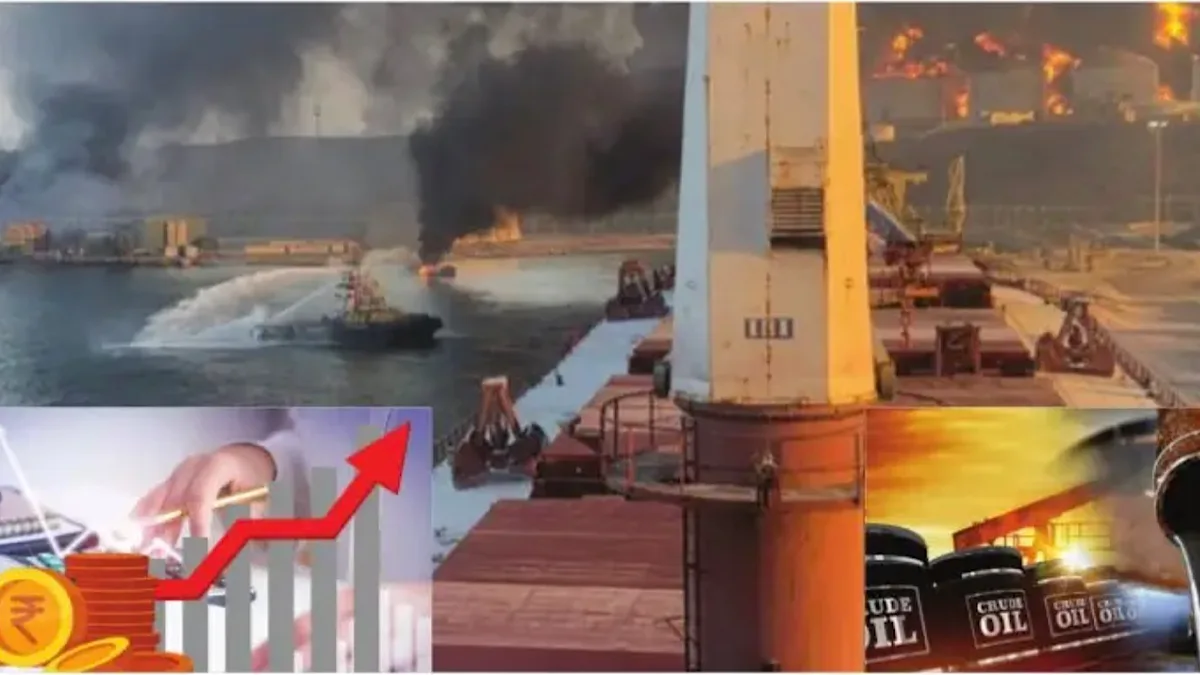
The distance between those two moments ~ the commendation and the collapse ~ is the terrain this article explores. The proximate cause is no mystery. On 28 February 2026, the United States and Israel launched military strikes against Iran’s nuclear infrastructure. Within days, Iran declared the Strait of Hormuz effectively closed. The strait, through which roughly twenty per cent of the world’s daily oil supply transits, was shut to significant commercial traffic within a week. Brent crude, which had settled around $70 a barrel in late February, surged past $100 on 8 March, touched $126 at its peak, and by late March was still trading above $115 ~ a record monthly gain of roughly 55 per cent.
Advertisement
For India, which imports approximately 88 per cent of its crude oil ~ a dependence that has risen, not fallen, over the past decade ~ this was not a distant geopolitical drama. It was a direct assault on the balance of payments. The arithmetic is unforgiving. SBI Research estimates that every $10 per barrel increase in crude widens the current account deficit by roughly 36 basis points of GDP and raises inflation by 35 to 40 basis points. With Brent having risen by over $45 in under a month, the annualised damage runs into tens of billions of dollars. Goldman Sachs has cut its 2026 GDP growth forecast for India from seven per cent to 5.9 per cent, raised its inflation projection to 4.6 per cent, and warned the current account deficit could widen sharply if crude sustains above $130.
The OECD concluded that the Iran war has erased an earlier global growth upgrade and will push G20 inflation 1.2 percentage points higher than projected. India, a net importer at the tail end of every supply chain, absorbs each shock simultaneously. The rupee’s fall has been violent, but the story behind it is more damning than the numbers suggest. Foreign portfolio investors pulled a record Rs 1.14 lakh crore out of Indian equities in March ~ the worst monthly outflow ever recorded, surpassing the previous peak of Rs 94,017 crore in October 2024. Cumulative FPI outflows for 2026 have crossed Rs 1.27 lakh crore. These are not marginal adjustments.
They are a comprehensive repricing of India risk, driven by surging oil, a weakening currency, and the perception that neither Delhi nor Mumbai possesses the tools to arrest the slide. The RBI has spent aggressively to slow the haemorrhage. India’s foreign exchange reserves, which had risen to a record $728.49 billion at the end of February, fell to $698.35 billion by the week ending 27 March ~ a drawdown of $30 billion in four weeks. On the same day, the central bank capped banks’ net open rupee positions at $100 million per business day, an emergency measure to prevent speculative bets from accelerating the currency’s descent. But intervention is a tourniquet, not a cure.
Every dollar the RBI sells is a dollar subtracted from strategic reserves. At the current burn rate, this cushion could thin dangerously within months if the Hormuz crisis persists. Options markets are already pricing a rising probability of $150 oil. India’s policymakers are running a race against a clock they do not control. The government’s response has been reactive. On 27 March, the Centre slashed excise duties on petrol from Rs 13 to Rs 3 per litre and reduced diesel duty to zero ~ the deepest single excise cut in years.
The measure shielded consumers and oil marketing companies from immediate ruin, but at a steep fiscal cost: analysts estimate an annualised revenue loss between Rs 1.1 lakh crore and Rs 1.7 lakh crore. With the government committed to narrowing the fiscal deficit to 4.4 per cent of GDP in 2025–26, the cut narrows the already thin space for countercyclical spending at precisely the moment the economy needs it most. Delhi is absorbing the shock rather than building the structural capacity to withstand it. This distinction matters because the vulnerability the Iran crisis has exposed is not new.
It is the same structural weakness that Make in India was designed to eliminate. Launched in 2014 with the ambition of raising manufacturing’s share of GDP to twenty-five per cent and creating a hundred million jobs, the initiative has conspicuously failed. Manufacturing’s share has slipped to roughly fourteen per cent, down from fifteen when the programme began. The $23 billion Production-Linked Incentive scheme, meant as a corrective, lapsed in early 2025 after participating companies achieved barely a third of their production targets.
India’s economy remains overwhelmingly services-driven; its export basket insufficiently diversified; its dependence on imported energy not merely as acute as twelve years ago ~ but worse. Domestic crude production has declined every year for over a decade. Had the manufacturing base been built as promised, India would today possess a broader export revenue stream, a more resilient current account, and a labour market less dependent on consumption subsidies. The rupee would not be immune to a Hormuz-scale shock, but it would be far less grievously exposed. The failure of Make in India is not merely an industrial policy shortcoming.
It is, in the present crisis, a currency policy failure – because the structure of the economy determines the resilience of the currency, and no amount of central bank intervention can substitute for an industrial base that does not exist. The S&P upgrade of August 2025 was earned. India’s macroeconomic management over the past decade ~ the inflation-targeting framework, the steady accumulation of reserves, the growth rates that outpaced every major economy ~ deserves recognition.
But a credit rating measures direction and intent. A currency crisis measures depth and structure. The rupee is not falling because the world is unkind. It is falling because the economy’s buffers remain thinner than its ambitions ~ because a decade of promised transformation delivered a digital revolution and a services boom but left the industrial foundations largely untouched. The anchor held as long as the seas were calm. The seas are no longer calm.
(The writer is a Fellow Member of the Institute of Chartered Accountants of India, an Associate Member of the Institute of Cost & Management Accountants, and an Ubhayavedānt in scholar based in Kolkata, with over 35 years of experience in finance, auditing, and data science)