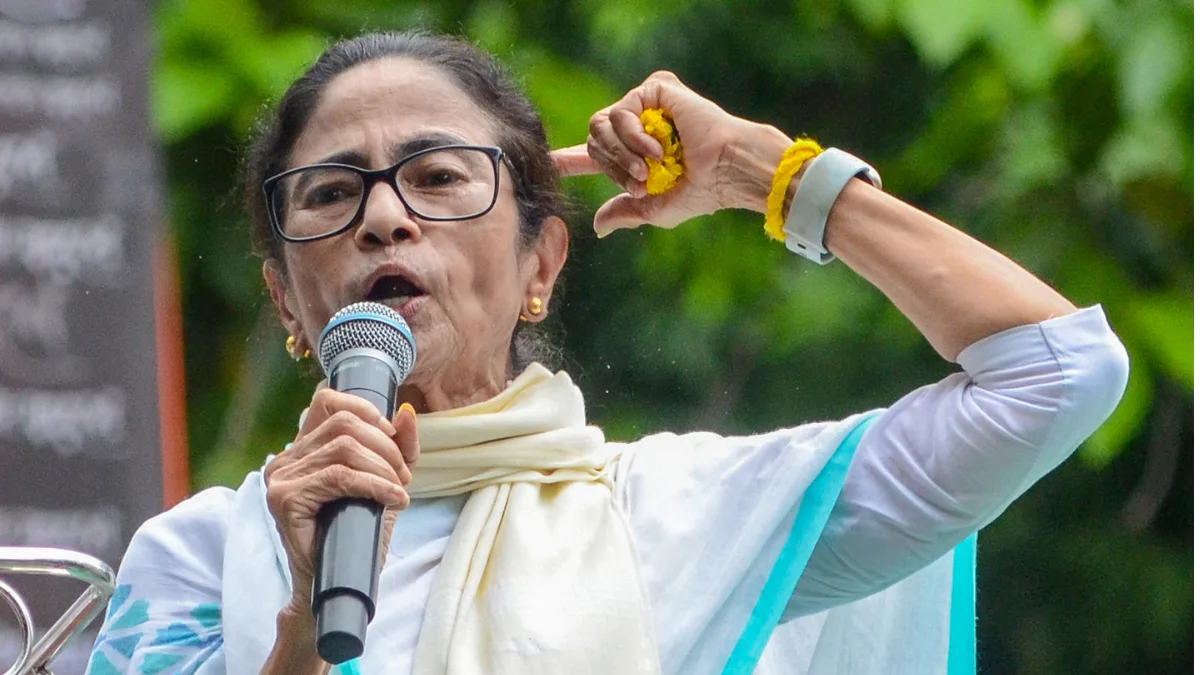
Mamata’s call for anti-BJP unity at Martyr’s Day rally junked by Congress, Left
Bengal BJP president Samik Bhattacharya said Mamata Banerjee should first focus on uniting her own party before attempting to forge an opposition alliance.
India’s decision to finally undertake a full census after more than a decade is not merely an exercise in counting heads.




Census Commissioner of India
India’s decision to finally undertake a full census after more than a decade is not merely an exercise in counting heads. It is an attempt to regain control over a rapidly shifting reality that the state has, for years, only partially understood. In the absence of updated population data since 2011, policymaking has drifted into approximation. Governments have relied on sample surveys and projections to allocate resources, design welfare schemes, and define categories like “rural” and “urban.” But in a country undergoing relentless internal migration, peri-urban expansion, and in formalisation of labour, these approximations are no longer sufficient.
The result is not just statistical error; it is policy distortion. India’s demographic window, marked by a young workforce and declining fertility, adds urgency. Without precise data, this potential dividend risks turning into a liability, as job creation, education planning, and urban infrastructure lag behind the actual pace and geography of population change. Consider flagship programmes such as rural employment, whose effectiveness depends on correctly identifying rural populations. If entire settlements have transitioned into urban or semi-urban zones without being reclassified, funds risk being misdirected. Similarly, the experience of the Covid-19 pandemic exposed how millions of migrant workers ~ largely invisible in official datasets ~ fell through administrative cracks when crisis struck. The new census, overseen by the Office of the Registrar General and Census Commissioner of India, promises to address this informational deficit.
Advertisement
Its digital architecture and self-enumeration options mark a significant shift in state capacity. But technology alone does not guarantee accuracy. The success of this exercise will depend on trust, something that cannot be engineered through apps. That trust deficit is not incidental. The expansion of state databases, including the National Population Register, and periodic controversies around citizenship documentation have created a climate where enumeration is no longer seen as neutral. Even if the census is legally distinct from such initiatives, public perception does not always respect bureaucratic boundaries. When people fear exclusion, they may alter responses, undermining the very reliability the census seeks to establish.
Advertisement
The inclusion of caste data further complicates the picture. Long considered politically sensitive, caste enumeration is now returning to the centre of governance debates. For scholars, such data is essential to understand inequality and target welfare effectively. Yet, it also risks intensifying identity-based politics, especially in a landscape where demands for quotas and representation are already sharply contested. What emerges, then, is a paradox. The census is both a technical necessity and a political act. It promises clarity but operates in an environment of ambiguity; it seeks precision but must navigate perception. Ultimately, this census will do more than update numbers. It will redefine how the Indian state sees its citizens – and how citizens see the state. If done well, it can realign governance with reality. If mishandled, it may deepen the very disconnect it aims to resolve.
Advertisement