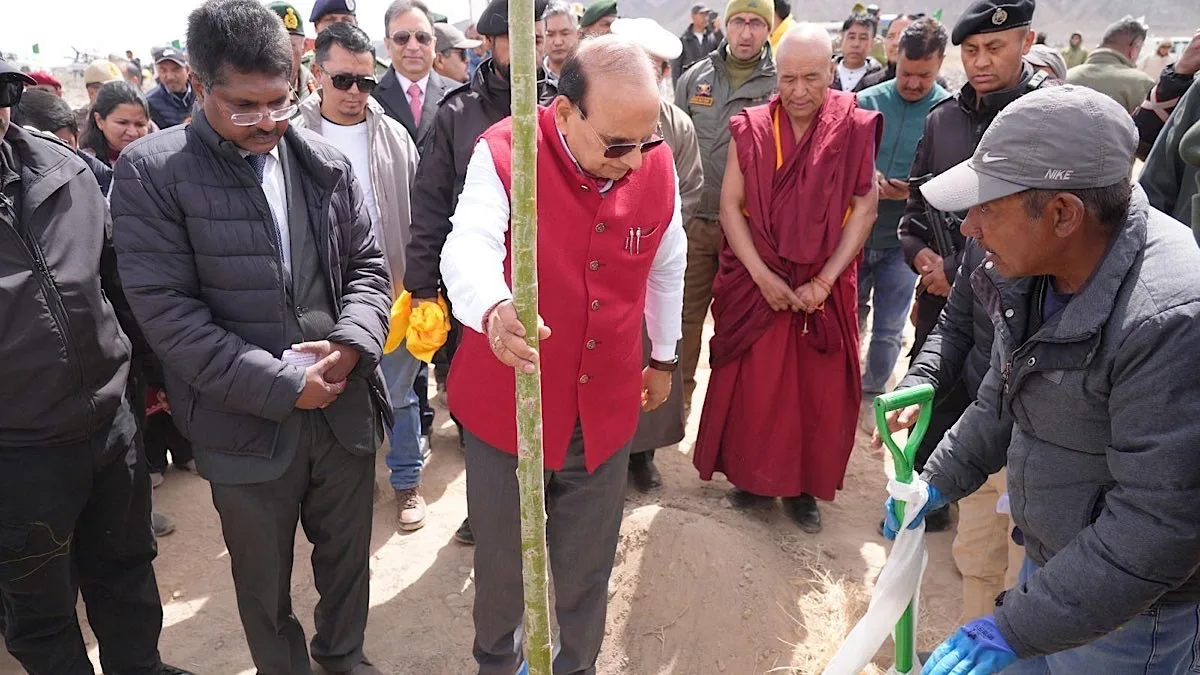
Lieutenant Governor Vinai Kumar Saxena on Monday launched the Indus River Green Corridor Eco-Restoration Plantation at Spituk Pharka, an initiative aimed at restoring the ecological integrity of the Indus riverbanks and creating green buffers in the fragile desert landscape of Leh–Ladakh. The initiative is a one-of-a-kind cold desert riverbank restoration project in India.
As part of the exercise, nearly 1,000 saplings of indigenous species such as oleaster, sea buckthorn, Indian willow, black poplar and white willow were planted along the riverbank through the collaborative efforts of the civil administration, the military, paramilitary forces, police and local communities, especially Spituk Gonpa and its monastic fraternity, which provided one hectare of land for the plantation.
Advertisement
In addition, 1,000 saplings of cherry blossom and apricot were planted along roadsides in Leh city to enhance the city’s green aesthetics.
The event was organised by the Department of Forest, Ecology and Environment in collaboration with Spituk Monastery and the University of Ladakh.
Describing the occasion as historic, the Lieutenant Governor stated that, with the support of local communities, the project would emerge as an instrument of resilience and stability, and as a global model for high-altitude river ecosystem restoration.
He emphasised that the initiative would not only enhance the aesthetic appeal of Leh but also help address Ladakh’s pressing ecological challenges.
The Lieutenant Governor underlined the need to recognise the deep interconnection between nature, development, and culture, stating that forests and rivers in Ladakh are not merely ecological assets but are integral to the region’s identity and sustainability.
Highlighting the vision of Prime Minister Narendra Modi, he spoke about India’s commitment to sustainable development and combating land degradation and desertification.
Emphasizing the importance of community participation, the Lieutenant Governor appreciated the contribution of Spituk Monastery for donating one hectare of land for the project, terming it a commendable example of collaborative governance.
He described the Indus River Green Corridor as not merely a government initiative but a “civilizational project” aimed at restoring the ecological integrity of the Indus River while ensuring a harmonious balance between development and environmental conservation.
Drawing attention to Ladakh’s low forest cover, currently less than one per cent, he termed it a matter of concern and set an ambitious target of increasing it to five per cent over the next two years.
He highlighted the scientific benefits of plantation, including the reduction of wind speed through shelter belts, prevention of soil erosion along riverbanks, improvement in biodiversity and microclimatic stability, and enhancement of oxygen levels.