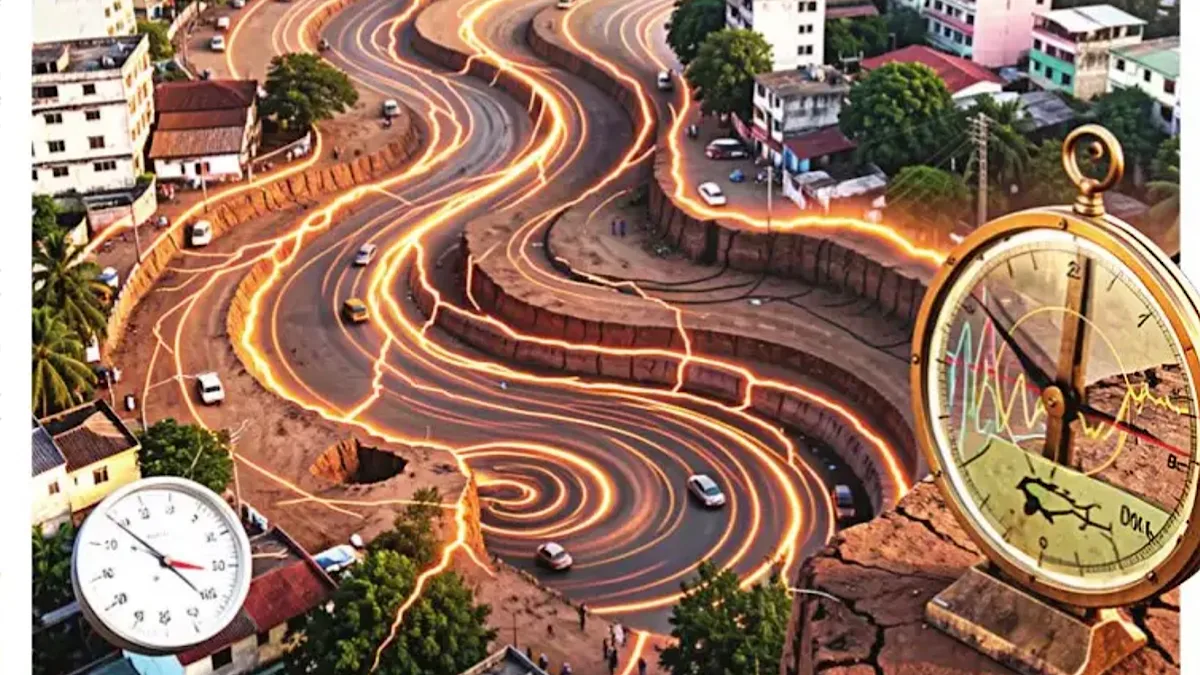
Recently, the people of the city of Kolkata witnessed the earthquake for a short time; individuals ran out of high-rise offices to the streets in panic. Thanks to the internet, we’ve all seen it. Although the intensity of the earthquake was very low, 5 on the Richter scale, later it was known that its origin was in our neighboring country, Bangladesh. Usually, when there is an earthquake, people first ask: what is its intensity? Where’s the source? More or less, we all know that a seismograph is used to measure seismicity, and the Richter scale is used to measure intensity.
But do we know how seismographs are made or how the Richter scale works? Can earthquakes be measured in any other way? The history of the seismograph is very old; in 132 AD, the Han mathematician and astronomer, Chang Heng, created the first seismoscope. The design was unique; the bronze vessel was surrounded by a dragon’s head, with a frog’s mouth at the bottom. As soon as any tremor started, the ball in the dragon’s mouth would fall down into the frog’s mouth and make a sound, and it would be understood that there was an earthquake somewhere.However, there was no way to measure the intensity of the vibration in Chang’s device. Since then, the situation has changed; the design of the instrument has changed repeatedly with the efforts of scientists. In the 18th century, a man named Palmieri built an electrical circuit-based device that could record vibrations. Two decades later, in 1875, Filippo Sochi was the first to use a pendulum, a swinging weight, to capture earthquakes.The pendulum oscillated, writing the line on paper according to the nature of the vibration. Then, in 1880, Ewing, Gray, and John developed the first modern recording seismograph. This is where the journey of modern science begins.
Advertisement
HOW DOES THIS DEVICE WORK?
This machine basically stands on some known laws of inertial mechanics. A heavy object of the pendulum family is suspended in a structure by a wire; during an earthquake, the structure moves while, due to inertia, the mass tries to remain stationary. The vibration produced by the collision of these two is called a seismogram, in which the analysis of fine graphs is known to know the nature of the movement, intensity, source, stability, etc. Nowadays, however, seismographs are no longer paper and ink diagrams but, thanks to advanced technology, sensors, and algorithms, they have become so sensitive that they can independently record various microscopic vibrations in addition to earthquakes. Earthquakes are measured on a special scale, invented by American seismologist Charles Richter and German scientist Beno Gutenberg.
WHAT IS THIS SCALE?
Energy is crucial in science. Until now, scientists did not know any way to measure energy in the event of an earthquake. Richter and Gutenberg, his colleague, had been working since the beginning to determine how to quantify the energy released during an earthquake. Finally, in 1935, these two scientists introduced a logarithm-based scale, which made it easier to determine the magnitude or size of an earthquake. The magnitude of this scale is usually 1–10: up to 3 is called a small earthquake, 3–7 is called a medium earthquake, and when above that, it becomes devastating. An increase of one unit in the Richter scale increases the intensity 10 times, i.e., an earthquake of magnitude 5 is 20 times stronger than an earthquake of magnitude 3. The logarithm used is base 10; therefore, the difference in magnitude between a 3 and a 5 earthquake intensity is calculated in the following way: intensity difference = 10 × (5 − 3) = 20.
Initially, the scale had some limitations, especially in the measurement of strong seismic waves, which often caused saturation problems. If the measurement exceeds a certain value, the instrument’s fork can get stuck, often resulting in an incorrect reading during a high-intensity earthquake. Another major problem was that it only measured the height of the highest wave. As a result, it was not known how much total energy was released in the tremor, or where the large fault appeared, or what the exact size of the rupture was. Richter and Gutenberg later updated the Richter scale to correct these weaknesses. He introduced two more advanced scales—the body-wave magnitude scale and the surface-wave magnitude scale. With the help of the first, primary waves (P-waves) and medium waves (S-waves) are calculated in the earth’s orbit. The second scale is used to calculate the magnitude of the waves in the gain and rails flowing along the earth’s surface.
The history of the seismograph is very old; in 132 AD, the Han mathematician and astronomer, Chang Heng, created the first seismoscope.
In the late 1970s, Japanese scientist Kanamori and American scientist Hanks developed a modern scale, the Moment Magnitude Scale. From a scientific point of view, the Moment Magnitude Scale measures more accurately than the Richter Scale, but the Richter Scale is so popular that its name still hovers in the minds of the general public when it comes to the magnitude of earthquakes. However, in the era of modern technology, people are no longer content. Seismographs have revealed the details of the earthquake, but will it be predicted in advance? Scientists don’t have an answer yet. However, they are trying to use supercomputing and machine learning methods to study the sudden changes in pressure and rock formation along the fault line, if there is a ray of hope in the future.
THE WRITER IS A THEORETICAL PHYSICIST WORKING IN THE FIELDS OF NUCLEAR ASTROPHYSICS, AND COMPUTATIONAL PHYSICS. PRESENTLY, HE IS WORKING AS A FORENSIC EXPERT IN THE PHYSICS DIVISION OF THE STATE FORENSIC SCIENCE LABORATORY, KOLKATA. BESIDES THIS, HE IS A POPULAR SCIENCE WRITER WHO LOVES TO WRITE INTRIGUING PIECES RELATED TO PHYSICS, ASTRONOMY, ASTROPHYSICS, AND MATHEMATICS FOR YOUNG MINDS.