Mamata’s call for anti-BJP unity at Martyr’s Day rally junked by Congress, Left
Bengal BJP president Samik Bhattacharya said Mamata Banerjee should first focus on uniting her own party before attempting to forge an opposition alliance.
Changing the law with retrospective effect while an issue is pending before the Supreme Court of India raises serious institutional concerns.




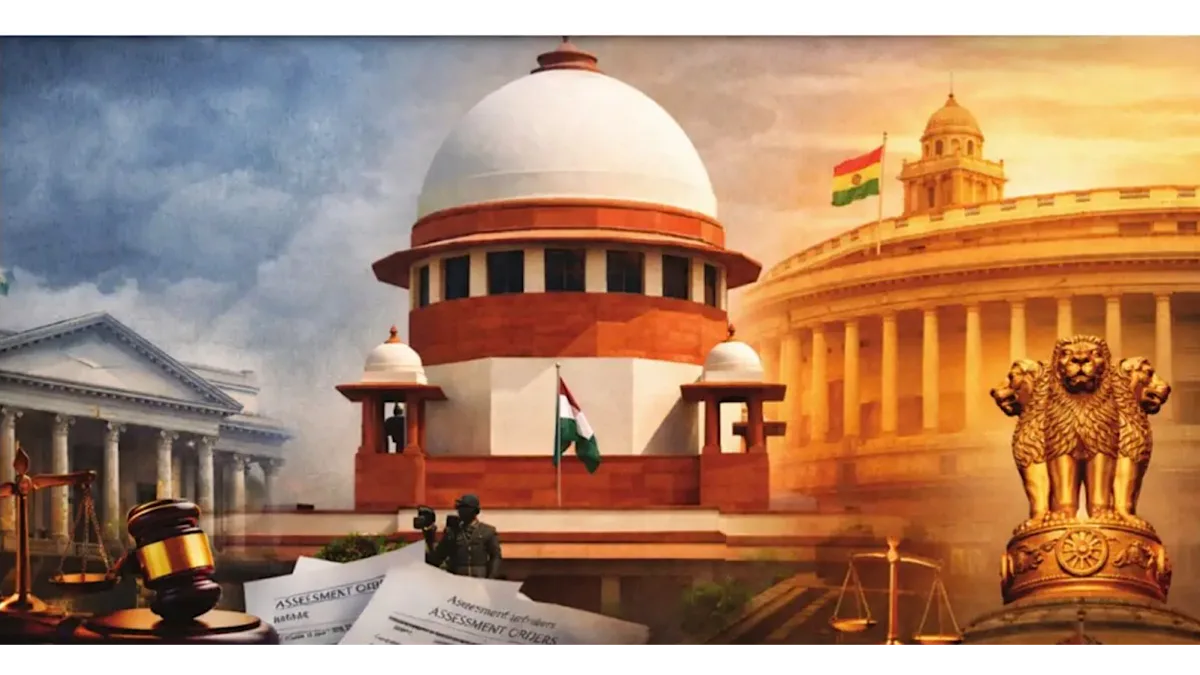
Photo:SNS
Changing the law with retrospective effect while an issue is pending before the Supreme Court of India raises serious institutional concerns. The Finance Bill 2026 does precisely this in the context of income tax reassessment. It retrospectively validates reassessment notices issued by Jurisdictional Assessing Officers (JAOs) and cures defects in orders that did not carry the mandatory Document Identification Numbers (DIN).
This is being done when the Supreme Court is already examining the jurisdictional issue in Union of India v. Suryalakshmi Cotton Mills and connected matters. The controversy traces back to the 2021 shift to a “faceless” assessment regime under Section 151A of the Income Tax Act, 1961. Several High Courts, including those of Bombay, Telangana and Madras, held that once the National Faceless Assessment Centre became operational, reassessment notices under Section 148 had to be issued only by Faceless Assessing Officers (FAOs). According to these courts, actions by JAOs were without jurisdiction and therefore void.
Advertisement
The Bombay High Court in Hexaware v. ACIT (2022) reasoned that once the faceless framework was introduced, every function under the relevant chapter had to be routed through that system. The Delhi High Court, however, in TKS Builders v. ITO (2024), took a different view. It held that the faceless scheme was not exclusive and that the powers of JAOs continued to exist alongside it. This divergence created a situation where identical reassessment notices were upheld in some jurisdictions and struck down in others. A parallel dispute arose over DIN compliance.
Advertisement
The Central Board of Direct Taxes (CBDT), through a 2019 circular, mandated that every communication relating to assessment must carry a computer-generated DIN. The requirement was intended to ensure transparency and prevent back-dated or unauthorised orders. Many reassessment notices were challenged on the ground that they lacked a valid DIN, and several courts invalidated such proceedings. The Finance Bill now introduces two significant provisions. First, a new Section 147A, with effect from 1 April 2021, declares that for the purposes of Sections 148 and 148A, “Assessing Officer” shall be deemed always to have included the JAO, “notwithstanding” any scheme under Section 151A or any court judgment.
Second, new Section 292BA, with effect from 1 October 2021, provides that an assessment shall not be invalid merely due to any defect or omission in quoting DIN, so long as the communication can be traced or identified. This is not merely a procedural clarification; it is a retrospective legislative validation of actions that courts had already found to be without jurisdiction or procedurally defective. From a jurisprudential standpoint, such amendments draw upon Parliament’s recognised power to enact curative statutes that remove the legal basis of judicial decisions without formally overruling them, as affirmed in decisions including K.S. Paripoornan v. Kerala (1994).
However, the Supreme Court has consistently maintained that this power has limits. The legislature may amend the law retrospectively, but it cannot simply declare judicial outcomes ineffective or extinguish rights already crystallised through judicial determination. The use of deeming language and “notwithstanding any judgment” clauses, particularly when the very issue remains pending before the Supreme Court, raises the question whether the amendment merely cures a defect or seeks to predetermine adjudication. The immediate consequence is that reassessment notices earlier quashed on jurisdictional or DIN grounds stand retrospectively validated.
For the Revenue, this avoids large-scale annulments and possible refunds. It also removes the inconsistency created by conflicting High Court judgments. From an administrative standpoint, the amendment is presented as a clarification intended to protect completed or pending proceedings from being defeated on technical grounds. However, the method adopted raises constitutional questions. The power of Parliament to enact retrospective tax legislation is well recognised. At the same time, the Supreme Court has consistently held that while the legislature may cure the basis of a judicial decision, it cannot simply overrule or nullify a judgment by legislative declaration.
When a matter is already pending before the Supreme Court, a retrospective amendment that directly addresses the issue under consideration may be seen as influencing or predetermining the outcome. India has witnessed the consequences of retrospective tax amendments before. The amendment following the Supreme Court’s decision in Vodafone International Holding BV v. Union of India (2012) sought to override the Court’s interpretation of capital gains taxation in cross-border transactions. That amendment led to prolonged arbitration, adverse awards, and ultimately a policy reversal in 2021 after significant uncertainty and reputational cost. The present situation differs in subject-matter but raises a similar concern.
The DIN validation provision also merits scrutiny. The 2019 circular was designed to institutionalise accountability in tax administration. If compliance with DIN requirements can be regularised retrospectively, it may weaken the deterrent effect of procedural safeguards. Procedural discipline is not a mere technicality; it is a protection against arbitrariness. It is unlikely that the amendment will end litigation. Instead, the focus may shift from jurisdictional defects to constitutional validity. Taxpayers who obtained favourable judgments may challenge whether their accrued rights can be taken away by retrospective legislation.
The Supreme Court will eventually have to examine whether Sections 147A and 292BA amount to a permissible clarification or an impermissible legislative override. At a broader level, the episode highlights the importance of tax certainty. Frequent retrospective amendments, particularly when the issue is sub judice, create instability. Investors assess not only tax rates but also the predictability of legal outcomes. If the law changes after disputes arise, confidence in the system weakens.
[THE WRITERS ARE, RESPECTIVELY, AN ADVOCATE PRACTICING BEFORE DELHI HIGH COURT, AND A CHARTERED ACCOUNTANT BASED IN MUMBAI]
Advertisement