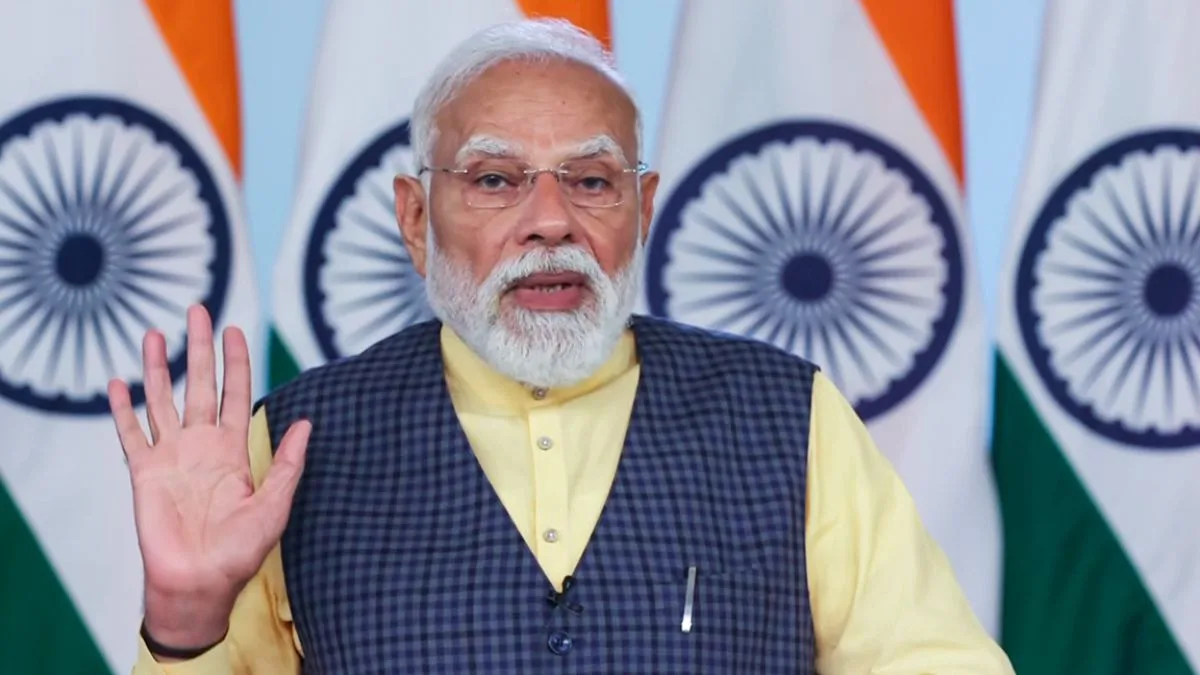
Prime Minister Narendra Modi on Tuesday called on industry leaders, investors, and state governments to unite behind the Union Budget’s vision of growth, emphasising quality manufacturing, stronger exports, and sustainable development as essential pillars for building a developed India. Speaking at the second session of the post-budget webinar series titled “Sustaining and Strengthening Economic Growth,” Modi welcomed the large-scale participation, describing it as “a very successful experiment” in collaborative governance. “Such large-scale discussion on the budget is, in itself, a very successful experiment,” he said, addressing thousands of participants and experts joining virtually.
Framing the discussions within the context of India’s expanding role on the global stage and evolving international supply chains, Modi declared, “Our direction is clear, our resolve is clear: Build more, produce more, connect more — and now the need is to export more.” He highlighted how manufacturing, logistics, MSMEs, cottage industries, and urban centres, while seemingly distinct, are deeply interconnected. “Strong manufacturing boosts exports, competitive MSMEs enhance innovation and flexibility, improved logistics reduce costs, and well-planned cities attract both talent and investment,” he explained, noting that the current Budget aims to strengthen all these pillars.
Advertisement
Modi stressed that policy alone does not guarantee success, urging industry, financial institutions, and state governments to collaborate on effective implementation. He encouraged prioritising strategies to raise manufacturing output, make cost structures competitive globally, accelerate investment, and ensure inclusive growth reaching every part of the country.
Highlighting efforts in manufacturing, he cited initiatives such as Dedicated Rare Earth Corridors and container manufacturing to strengthen the trade ecosystem. Modi also referenced the BioPharma Shakti Mission announced in the Budget, which aims to position India as a global hub for biologics and next-generation therapies, moving towards leadership in advanced biopharma research and manufacturing.
Acknowledging global companies’ search for reliable manufacturing partners, Modi said, “The era of being conservative about research spending is over,” urging confident investments in new technologies and research. He reiterated the importance of standards: “As opportunities arise for us to move forward, we should have only one mantra: Quality, Quality, Quality.”
On trade, Modi remarked that India’s Free Trade Agreements open a “vast gateway of opportunities,” but cautioned that success depends on Indian products meeting and exceeding global standards. “If someone is building a massive ship and requires a small component, even that small part may be of critical importance. In today’s competitive world, quality creates golden opportunities for us,” he said.
Modi also highlighted MSME reforms that remove fears of losing government benefits upon expansion. He noted ongoing efforts to improve credit access, promote technology upgrades, and build capacity, but emphasised that real progress requires MSMEs to compete and strive for excellence actively. “I urge MSMEs to enhance productivity, raise quality standards, adopt digital processes, and integrate into stronger value chains,” he said.
Infrastructure and logistics remain central to the government’s growth strategy, with record capital expenditure proposed in the Budget. Modi outlined plans for high-capacity transport systems, better coordination across railways, highways, ports, airports, and waterways, expansion of freight corridors, and multimodal connectivity. He spoke of new waterways, ship repair facilities, regional centres of excellence, and seven new high-speed rail corridors as growth connectors, while cautioning, “The real benefit of this infrastructure will be realised only when industries and investors align their strategies with this vision.”
Urbanisation, he added, is critical to India’s long-term development. “Future growth will depend on how effectively cities are planned and managed,” Modi said, calling for ideas to transform Tier-II and Tier-III cities into new growth anchors.
Addressing sustainability, Modi noted that global markets increasingly evaluate environmental responsibility alongside cost. He described the Carbon Capture, Utilisation and Storage Mission as a key initiative and urged businesses to embed sustainability in their strategies. “Industries that invest in clean technologies in a timely manner will gain better access to new markets in the coming years,” he said.
Modi further underscored that building a developed India requires collective ownership. “The Budget has provided the framework; now you must generate momentum together,” he told participants, emphasising that every suggestion and experience shared could translate into tangible progress on the ground.