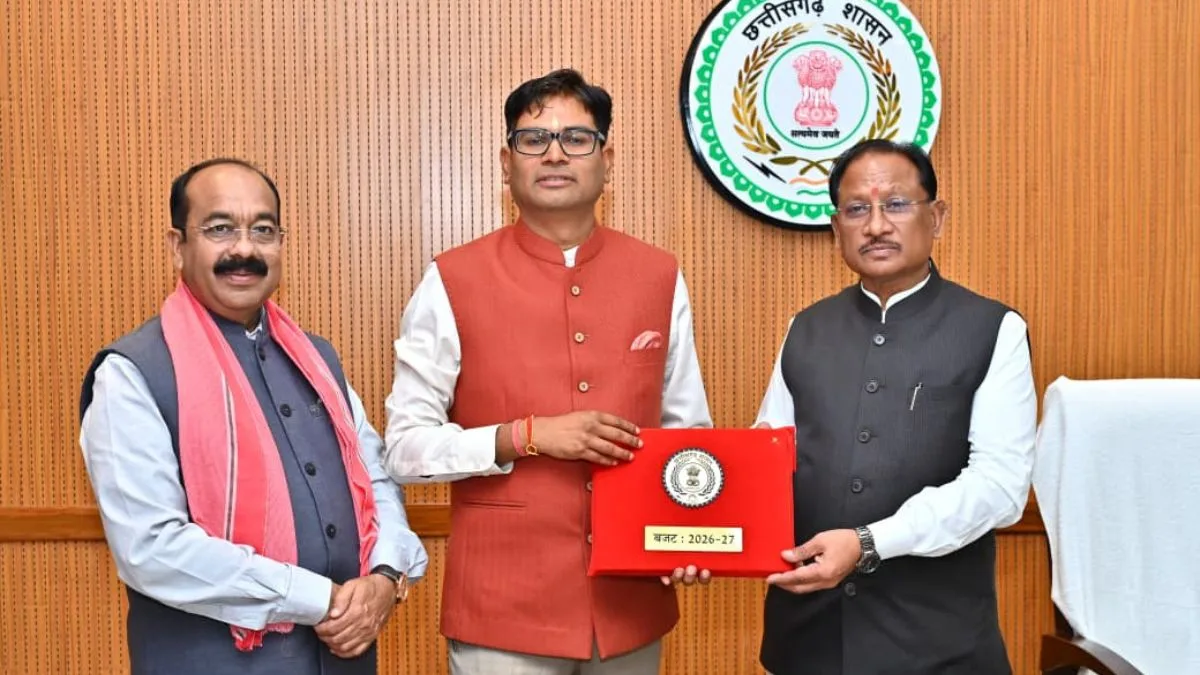
Chhattisgarh Finance Minister O.P. Choudhary on Tuesday presented a ₹1.72 lakh crore Budget for 2026-27, casting the state’s silver jubilee year as a strategic pivot towards ‘Viksit Chhattisgarh 2047’ in alignment with the national vision of Viksit Bharat 2047. Describing it as a “Sankalp Budget”, the government projected the outlay as a carefully balanced expansion, retaining key welfare commitments while significantly strengthening infrastructure, industrial growth and governance reforms.
The Budget size rises from ₹1.65 lakh crore in 2025-26 to ₹1.72 lakh crore this year. Capital expenditure has been pegged at ₹26,500 crore, reaffirming the state’s emphasis on asset creation and long-term economic capacity. The fiscal deficit is projected at 2.87 per cent of GSDP, marginally lower than last year’s 2.91 per cent, signalling an attempt to maintain fiscal discipline alongside expansion. With GSDP estimated to touch ₹7.09 lakh crore in 2026-27 at current prices, the state has framed its fiscal blueprint as both growth-oriented and nationally aligned.
Advertisement
Total receipts and expenditure are balanced at ₹1.72 lakh crore. Revenue receipts are estimated at ₹1.43 lakh crore, while capital receipts stand at ₹29,000 crore. However, the Budget projects a revenue deficit of ₹2,000 crore against last year’s surplus, a shift likely to draw close scrutiny in the Assembly.
Committed liabilities account for 32 per cent of total expenditure, while 16 per cent is devoted to capital outlay. Officials argue that this composition reflects a deliberate shift towards infrastructure-led growth without rolling back social commitments.
Nearly 70 per cent of the Budget has been allocated to major departments. School Education leads with ₹22,360 crore. Panchayat and Rural Development receives ₹16,560 crore. Agriculture has been allotted ₹13,507 crore, while Food and Civil Supplies gets ₹12,820 crore.
The government has retained its flagship schemes. ₹10,000 crore has been earmarked for Krishak Unnati Yojana. ₹8,200 crore has been allocated for Mahtari Vandan Yojana. Energy subsidy stands at ₹6,700 crore. Paddy procurement facilitation receives ₹6,000 crore.
Under housing and rural development, ₹4,000 crore has been set aside for PMAY-Gramin, while another ₹4,000 crore supports the Viksit Bharat-linked rural development framework. The emphasis, officials said, is on income security for farmers, direct benefit support to women and steady rural consumption.
In line with national priorities to strengthen manufacturing and supply chains, the state has allocated ₹750 crore for capital investment subsidy to industrial units. ₹250 crore has been earmarked for establishing 23 new industrial parks and ₹200 crore for land bank development.
Food processing and agro forest industries in Bastar and Surguja division have been given ₹100 crore. Electronics Manufacturing Cluster (EMC) 2.0 and startup incentives aim to attract new-age sectors.
The Budget also makes provisions for business intelligence units, a GST call centre, ease of-doing business reforms and the establishment of Chhattisgarh State Financial Services Limited to strengthen financial management of public enterprises.
Development spending in Bastar and Surguja accompanies recent security gains in Left Wing Extremism affected districts. The Budget provides for 1,500 new Bastar Fighter posts, a new Prayas residential school in Bijapur, additional nutrition support, and allocations for goat rearing, pig rearing and beekeeping.
₹720 crore has been earmarked for PM JANMAN and ₹200 crore for Dharti Aaba- Janjati Gram Utkarsh Abhiyaan. Residential schools, hostels and Charan Paduka schemes have also received allocations.
Public Works has received ₹9,451 crore. ₹200 crore has been allocated for Mukhyamantri Drutgami Sadak Sampark Yojana. ₹50 crore will connect 206 previously unreachable villages. ₹80 crore has been earmarked for airport infrastructure in Bilaspur, Ambikapur and Jagdalpur. Under energy, ₹400 crore has been set aside for PM Suryaghar Yojana and ₹100 crore for 90 new 33/11 KV power stations.
The government also highlighted expressway projects linking Raipur to Visakhapatnam and Dhanbad as strategic corridors that could deepen integration with national logistics networks.
₹33 crore has been allocated for CG-ACE to support aspirants preparing for UPSC, CGPSC, NEET and JEE. ₹75 crore has been earmarked for skill development and ₹50 crore for ITI and polytechnic upgrades.
In social welfare, ₹450 crore has been set aside for the Mukhyamantri Pension Scheme, ₹400 crore for the National Old Age Pension Scheme and ₹265 crore towards broader social security measures. A provision has also been made for a Third Gender Welfare Board. Health allocations include dialysis centres, Jan Aushadhi Kendras and infrastructure support for CHCs and PHCs.
The silver jubilee Budget is framed as more than an annual financial statement. It is being projected as a structural roadmap towards 2047- the centenary of India’s Independence.
By aligning infrastructure expansion, industrial promotion, agricultural reform, tribal outreach and governance modernisation with the broader Viksit Bharat narrative, the state government has placed Chhattisgarh within the national transformation arc.
The test, however, will lie in execution in whether capital allocations translate into productive assets, and whether industrial incentives draw sustained private investment.