Sea Change
India’s maritime ambitions cannot be measured by a ceremonial warship commissioning or ambitious infrastructure announcements alone.
The new US strategic blueprint ties economic statecraft to national security, promising tougher trade enforcement and stronger Indo-Pacific alliances while naming India as a pivotal regional economy.




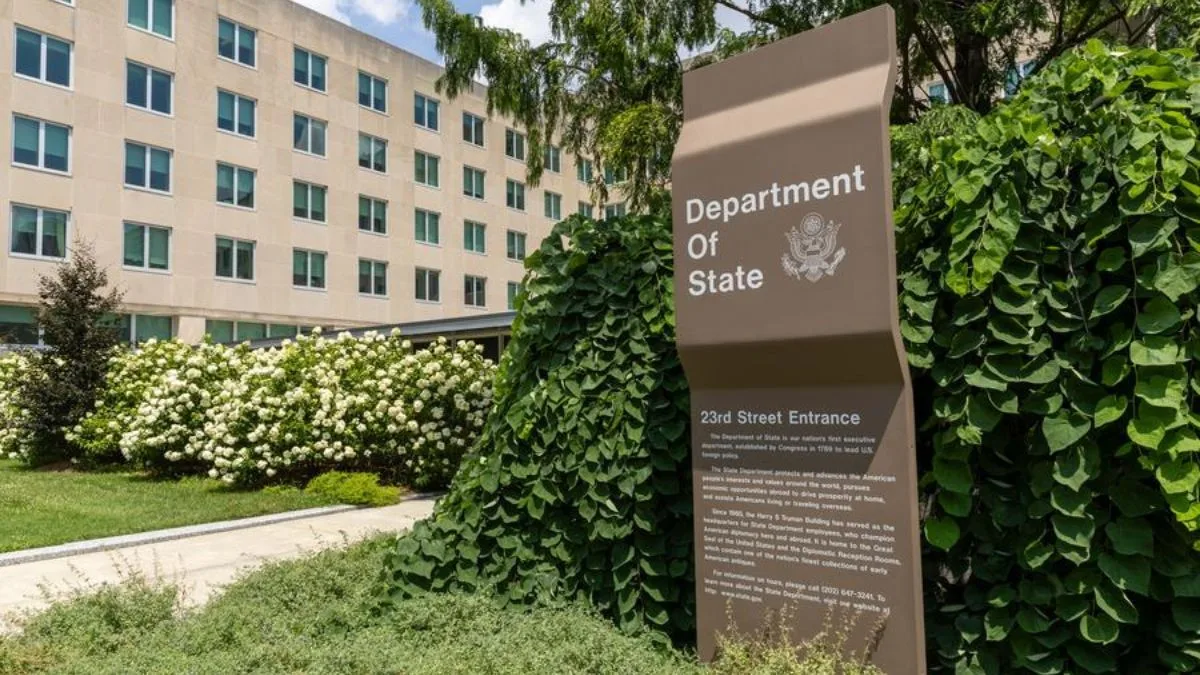
The US State Department headquarters in Washington. (Photo: Xinhua/IANS)
The United States has described its approach to China’s rise as “the defining story of the 21st century” and indicated that India will figure prominently in its Indo-Pacific calculus, albeit within clearly defined economic and security parameters.
The formulation appears in the US State Department’s Agency Strategic Plan for Fiscal Years 2026-2030, which positions the Indo-Pacific at the centre of global economic and geopolitical competition.
Advertisement
The document underlines that Washington’s response to Beijing is not just about trade rivalry but also about safeguarding American national interests in a region that now accounts for nearly half of global GDP and hosts critical sea lanes and supply chains.
Advertisement
“Asia is already the source of nearly half of the world’s gross domestic product by some estimates, and crucial sea lanes and supply chains crisscross the region,” said the document.
While reiterating that “regional peace and stability benefit the United States irrespective of competition with countries such as China,” the strategy names India as a growing regional economy with which the US will “seek partnership”. However, it adds that such engagement will be pursued “on terms that advance US security and economic interests and avoid repeating past mistakes.”
Economically, the plan calls for building secure and resilient supply chains, countering “Chinese-created dependencies”, and stepping up efforts to prevent tariff evasion through third-country transshipment. On the security front, it stresses maintaining a “favourable military balance in the Indo-Pacific to keep the trade routes free and open and to deter aggression”, noting China’s “unprecedented military buildup”.
Furthermore, Washington says it seeks neither war nor regime change and will keep communication channels open to reduce risks. The strategy also emphasises stronger ties with allies and groupings such as the Quadrilateral Security Dialogue to counter what it describes as attempts by China to shape an exclusionary regional order.
Advertisement