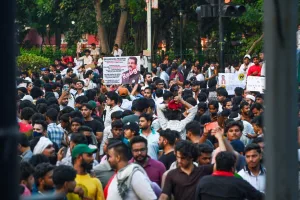
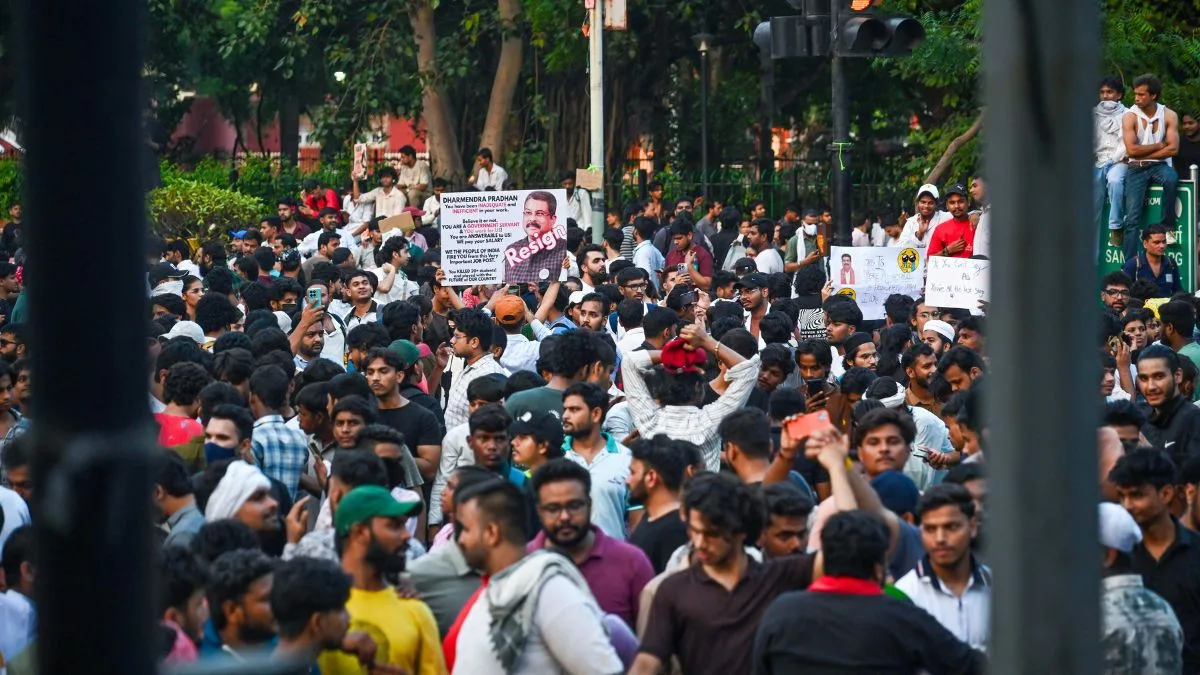
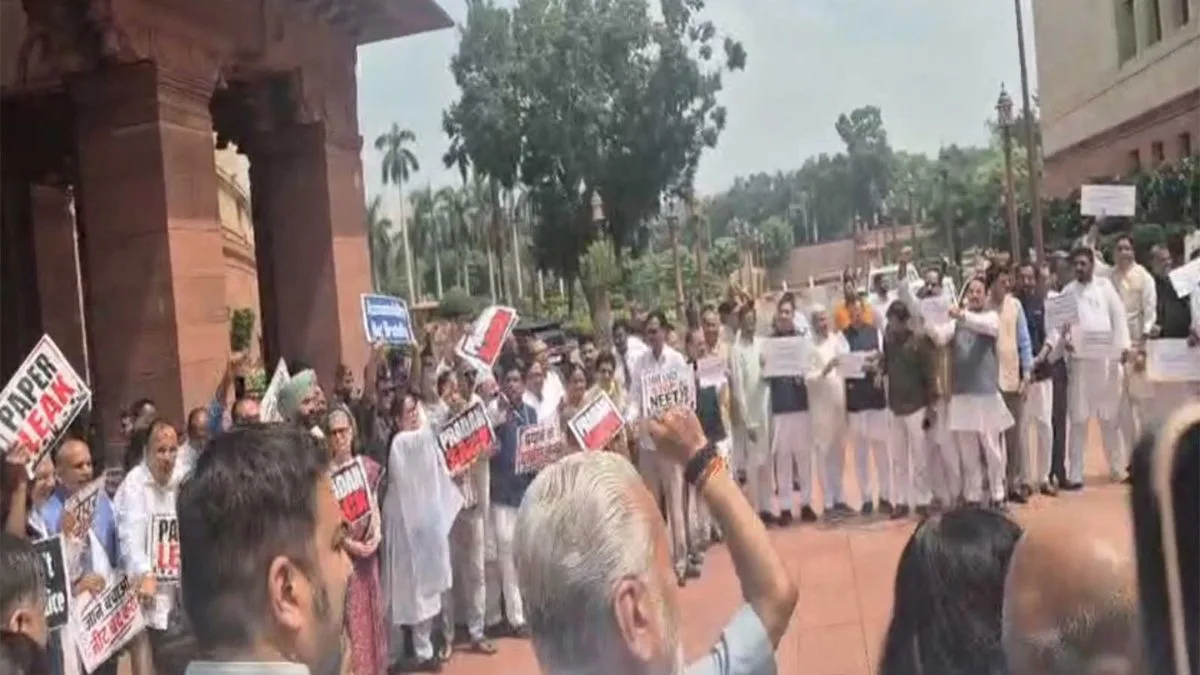
CJP Protest: ‘My apologies if you don’t see me at Jantar Mantar today,’ says Abhijeet Dipke
Abhijeet Dipke has assured the protesting students that he will be back at the Jantar Mantar by evening.
The budgetary allocation to the Ministry of New and Renewable Energy has been enhanced further to a record high of ₹32,914 crore (BE 2026–27), with a bulk of that (₹22,000 crore) allocated to the flagship solar rooftop scheme PM Suryaghar Yojana. Coupled with exemptions for battery manufacturing, VGF for BESS, and grants for CCUS, the government’s focus is rightly tilting towards building an energy transition ecosystem.





File Photo: IANS
Aarti Khosla, Founder & Director, Climate Trends
The budgetary allocation to the Ministry of New and Renewable Energy has been enhanced further to a record high of ₹32,914 crore (BE 2026–27), with a bulk of that (₹22,000 crore) allocated to the flagship solar rooftop scheme PM Suryaghar Yojana. Coupled with exemptions for battery manufacturing, VGF for BESS, and grants for CCUS, the government’s focus is rightly tilting towards building an energy transition ecosystem. Continued boosts to power distribution reforms would bring 360-degree improvement in India’s green energy supply chain. However, given the extent of air pollution, the focus on mitigation could have been stronger, including faster EV adoption, fast charging infrastructure, and related areas.
Advertisement
Prof Anjal Prakash, Clinical Associate Professor & Research Director, Bharti Institute of Public Policy, ISB (IPCC Author)
Advertisement
The Budget 2026–27 signals a decisive shift from policy announcement to rigorous execution, framed by the Reform Express agenda which has already operationalised over 350 reforms. To translate the Viksit Bharat intent into tangible economic impact, the government is leveraging competitive federalism through challenge-mode financing. This compels states to compete for central resources—ranging from Chemical Parks to University Townships—ensuring funds support viable, reform-oriented projects rather than entitlement-based allocations.
Technology serves as the primary implementation engine to bridge the gap between allocation and outcome. The rollout of Bharat-VISTAAR in agriculture illustrates a move from generic aid to customised, AI-driven risk mitigation for farmers. Simultaneously, a whole-of-government approach in customs—integrating regulatory clearances into a single digital window—aims to dismantle bureaucratic silos that traditionally hamper trade efficiency.
Fiscal prudence anchors this approach, with a targeted fiscal deficit of 4.3% and the weeding out of outdated customs exemptions for domestically manufactured items such as solar silicon. Success now rests on effective utilisation of plug-and-play ecosystems by states and the private sector.
Duttatreya Das, Energy Analyst – Asia, Ember
While the Budget delivered no big-ticket announcements for renewables, continued duty exemptions, support for critical minerals, and manufacturing reforms are expected to quietly strengthen clean energy supply chains. Additional capital subsidies could have further unlocked the potential of PLI-led manufacturing, particularly in upstream solar and energy storage.
Vibhuti, Director – South Asia, Institute for Energy Economics and Financial Analysis (IEEFA)
While the Budget reflects strong macro-fiscal ambition—reducing the fiscal deficit to 4.4% of GDP this year and 4.3% next year, alongside lowering the debt-to-GDP ratio—the support for India’s energy transition remains uneven.
Allocations for PM Surya Ghar Muft Bijli Yojana and bioenergy have increased, but spending on wind energy, transmission, and energy storage has stagnated or declined. This is concerning as these are indispensable for integrating higher renewable energy shares into the grid.
Support for rare earth minerals strengthens tail-end supply chains, but limited PLI backing for solar modules and cells leaves EVs—especially buses, trucks, and passenger vehicles—undersupported despite worsening air pollution. Meanwhile, higher allocations for coal gasification and CCUS raise questions given their cost and uncertainty.
While increased funding for REC and IREDA is welcome, expanded credit guarantees and risk-sharing instruments were needed to crowd in private capital, especially for EV manufacturing and MSMEs.
Labanya Prakash Jena, Director, Climate and Sustainability Initiative
The restructuring of PFC and REC can significantly boost the power sector by improving credit allocation and supporting clean energy transition. Exemptions on capital goods for critical minerals will strengthen domestic processing capacity, while duty exemptions on inputs like sodium antimonate will reduce solar manufacturing costs. Banking sector reforms can better align finance with climate ambitions, and municipal finance incentives can encourage green municipal bonds for pollution control and urban environmental projects.
Trishant Dev, Deputy Programme Manager, Centre for Science and Environment (CSE)
Duty exemptions for lithium-ion cell manufacturing and solar glass inputs frame India’s energy transition within a broader push for industrial competitiveness and resilient supply chains, supporting domestic production of critical inputs and access to key minerals.
Sehr Raheja, Programme Officer, CSE
The Budget’s focus on critical minerals—through duty exemptions and Rare Earth Corridors—signals growing emphasis on supply chain security and domestic value addition, both critical for green industrialisation and the energy transition.
Arunabha Ghosh, CEO, Council on Energy, Environment and Water (CEEW)
Budget 2026 shapes the next generation of Indian capabilities across energy, technology, cities, and agriculture. Rare Earth Corridors and Semiconductor Mission 2.0 move India from intent to execution, addressing gaps in mineral processing.
City Economic Regions offer a timely response to climate risks faced by urban India, while incentives for municipal bonds can unlock private capital. The prioritisation of CCUS across heavy industries strengthens India’s net-zero pathway.
Bharat Vistaar and AI-enabled agri stacks can improve farmer incomes and resilience, while strengthened disaster risk financing—₹2.04 lakh crore for 2026–31—enhances protection against climate shocks. Together, these measures position India for a competitive, climate-resilient, low-carbon future.
Rishabh Jain, Fellow, CEEW
Rare Earth Corridors mark a shift to state-level execution, bridging upstream mining and downstream manufacturing. Fiscal support through tax deductions and duty exemptions de-risks private investment. However, success will require offtake guarantees, R&D investment, and international technology partnerships.
Abinash Mohanty, Global Sector Head – Climate Change & Sustainability, IPE Global
The Budget remains a gap-filler on climate adaptation, despite climate losses exceeding 3% of GDP annually. While mitigation receives continued support through CCUS, green hydrogen, and storage financing, the absence of a scaled adaptation roadmap risks uneven outcomes. Clean energy ambition must be matched with investments in resilience.
Saurabh Kumar, Energy Expert
The Budget reinforces Viksit Bharat goals with a strong push for atmanirbharta. Key highlights include ISM 2.0, enhanced electronics manufacturing support, Rare Earth Corridors, and incentives for BESS systems at par with EVs. Support for data centres and AI capacity will further drive clean energy demand.
Ulka Kelkar, Executive Program Director, Climate, Economics & Finance, WRI India
Strengthening MSMEs through improved finance and risk-mitigation is timely. These measures can help MSMEs remain competitive while building climate resilience and adopting cleaner, resource-efficient practices.
Jaya Dhindaw, Executive Program Director – Sustainable Cities, WRI India
City regions and the focus on Tier 2 and Tier 3 cities are important first steps. However, without institutional ownership, funding, and integrated planning across municipal boundaries, they risk remaining symbolic. Low-carbon, climate-resilient infrastructure must be foundational.
Bharat Jairaj, Executive Program Director – Energy, WRI India
The enhanced allocation for PM Surya Ghar underscores commitment to household clean energy. Rooftop solar can significantly reduce electricity costs for around 3.3 lakh MSMEs, driving inclusive economic growth.
Jagjeet Sareen, Partner & India Head, Dalberg Advisors
Budget 2026 deepens the National Manufacturing Mission with concrete cleantech measures, supporting end-to-end value chains across solar, wind, hydrogen, EVs, batteries, and transmission equipment. The shift from intent to implementation is now clearly visible.
Advertisement