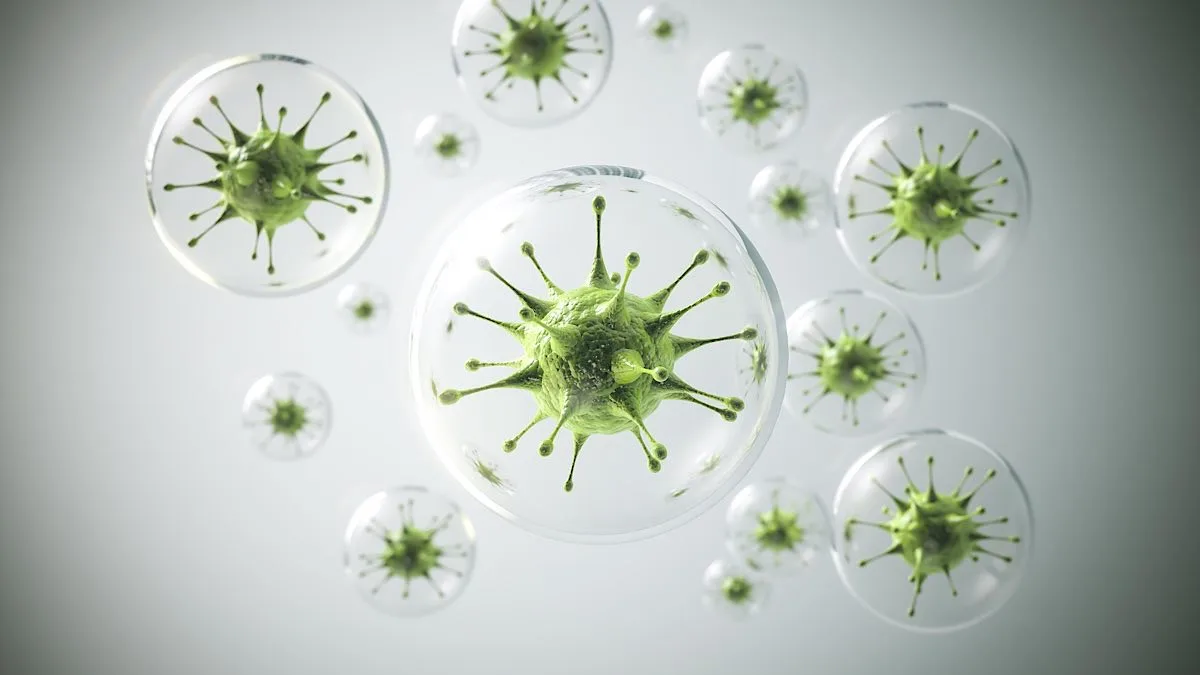
Micro-organisms constitute a very antique group of living organisms which appeared on the Earth’s surface almost 3000 million years ago. The questions arising from the study of the origin and evolution of microorganisms are extremely complex. Some scientists assumed that microbes were the first living organisms on Earth. Others maintained that non-cellular forms of living matter (photobionts, protobionts, etc.) appeared prior to the microbes. It is now generally believed that organisms evolved along the following lines: viruses containing RNA, viruses containing DNA, mycoplasmas, chlamydias, rickettsiae, bacteria, blue-green algae, lower and higher fungi, plants, and animals.
Medical microbiology is mainly concerned with the study of pathogenic bacteria, actinomycetes, spirochaetes, rickettsiae, viruses, fungi, and common protozoa, all grouped under the name of microbes or micro-organisms.
Advertisement
The great majority of microbes are invisible to the naked eye. They comprise multicellular organisms (the blue-green algae, some fungi and chlamydobacteria, possibly some corynebacteria, mycobacteria, cocci), unicellular organisms (bacteria, actinomycetes, spirochaetes, and protozoa), and non-cellular organisms (viruses).
The great Swedish naturalist C. Linnaeus, who had never used a microscope, was unable to identify the numerous and diverse forms in the minute world of micro-organisms, and classified all the microbes into one genus, which he originally named Chaos.
The first attempts to classify microorganisms were based solely on morphological properties. The Danish naturalist O. Miiller (1786) subdivided the bacteria into two genera, Monas and Vibrio.
In 1827, the Russian zoologist A. Lovetsky, while studying different organisms, identified three genera of microbes: Bacillus, Vibrio, and Proteus, and described a number of other bacteria.
In 1838, the German scientist C. Ehrenberg subdivided the micro-organisms into bacteria, vibrios, spirilla, and spirochaetes.
The German botanist F. Cohn in 1854 classified all bacteria as plants.
In 1871, he contributed to the knowledge of microbe taxonomy by adding the genera: micrococci, bacteria, bacilli, vibrios, spirilla, and spirochaetes.
In 1856, L. Tsenkovsky, the father of Russian microbiology, pointed out the similarity between bacteria and blue-green algae, and thus scientifically based the classification of micro-organisms with respect to their evolution
The German botanist C. Nageli in 1857 combined all bacteria into a special group of plant micro-organisms – the class Schizomycetes.
Investigations during the morphological period of the development of microbiology were dominated by a descriptive approach, and microbes were studied without considering their evolution, variations, and relation to environmental conditions. As a result, the investigations in microbiology could not be used in agriculture, industry, or medicine.
A considerable amount of facts concerning the different properties of micro-organisms were accumulated during the 19th century, the list of microbe species gradually increased, and a need for classifying them arose. Even at present, however, this problem has not been completely solved.
K. Lehmann and R. Niemann in 1896 laid the foundations for a scientific approach to the classification of microbes. In their system of classification, all micro-organisms were subdivided into three families: Coccaceae, Bacteriaceae, and Spirillaceae. Eventually, this classification was considerably altered and was supplemented to a large degree, but even this could not satisfy microbiologists. Consequently, it was gradually abandoned in favour of more complete and modern classifications.
In 1923, D. Bergey published the first manual of international determinative bacteriology. Later editions (1938-1974) were prepared by the International Committee for the Systematisation of Bacteria and were called Bergey’s Manual of Determinative Bacteriology.
The definition of a species has always presented a difficult but important problem in the classification of micro-organisms, and many definitions of a species have been proposed.
On the basis of modern practice a microbial species is used to designate a group of related organisms which: (a) have ascended from a common ancestor, (b) are kept intact by factors of selection, (c) are adapted to a particular environment, (d) are similar in manner of metabolism and character of interspecies relations, and (e) are closely related morphologically, physiologically, and genetically. For pathogenic species of bacteria, the ability to produce certain defence substances, antibodies, in the body of animals and man is taken into account.
In the identification of an unknown species, of great importance will be a constant criterion based on the ratio of paired nitrogenous bases in the DNA of bacteria.
The guanine and cytosine (G + C) content in DNA is now determined in moles/per cent.
In order to decide to which species the micro-organism under study should belong, it is necessary first of all to establish its main properties, next to identify it by these properties, and then to determine its position in the classification of microbes according to a key.
In microbiology, the binomial system of nomenclature is accepted, where each species has a generic and a specific name. The generic name is written with a capital letter, and the specific name — with a small letter. For example, the golden pus coccus is called Staphylococcus aureus; ±e anthrax bacillus, Bacillus anthracis; the diphtheria bacillus, Coryne-bacterium diphtheriae; the tubercle bacillus, Mycobacterium tuberculosis; the tetanus bacillus, Clostridium tetani, etc.
If deviations from the typical species properties are found on examination of the isolated bacteria, then the culture is considered a subspecies. Infrasubspecies subdivisions are also distinguished, which are not arranged in the order of the classification ranks but are based on the difference between the organisms in some slight hereditary properties: antigenic — serovar (syn. serotype), morphological—morphovar, chemical — chemovar, biochemical or physiological — biovar, pathogenicity—pathovar, relation to phages — phagovar. Introduction of the suffix ‘var’ instead of ‘type’ makes it possible to avoid misunderstandings because the term type is used as a nomenclature form of the Eucaryotae kingdom.
The term strain designates a microbial culture obtained from the bodies of humans or animals and from the environment.
A mixed culture consists of more than one species of micro-organism isolated from a natural medium (non-sterile body cavities, body tissues, food products, water, air, soil, washings). Pure cultures represent a single species of a particular microorganism.
Following the rapid development of microbial genetics and selection, the concept of population has been introduced; this is an elementary evolutional unit (structure) of a definite species with no noticeable isolation barriers within them between which free crossing occurs. The term clone was applied in microbiology to designate a group of individuals arising from one cell.
(The author is an associate professor (retd.) and former head of the department of botany at Ananda Mohan College.)