Finance Minister Nirmala Sitharaman on Sunday presented the Union Budget 2026–27, notably without any overt political messaging ahead of Assembly elections in five states later this year—Tamil Nadu, Kerala, West Bengal, Puducherry and Assam.
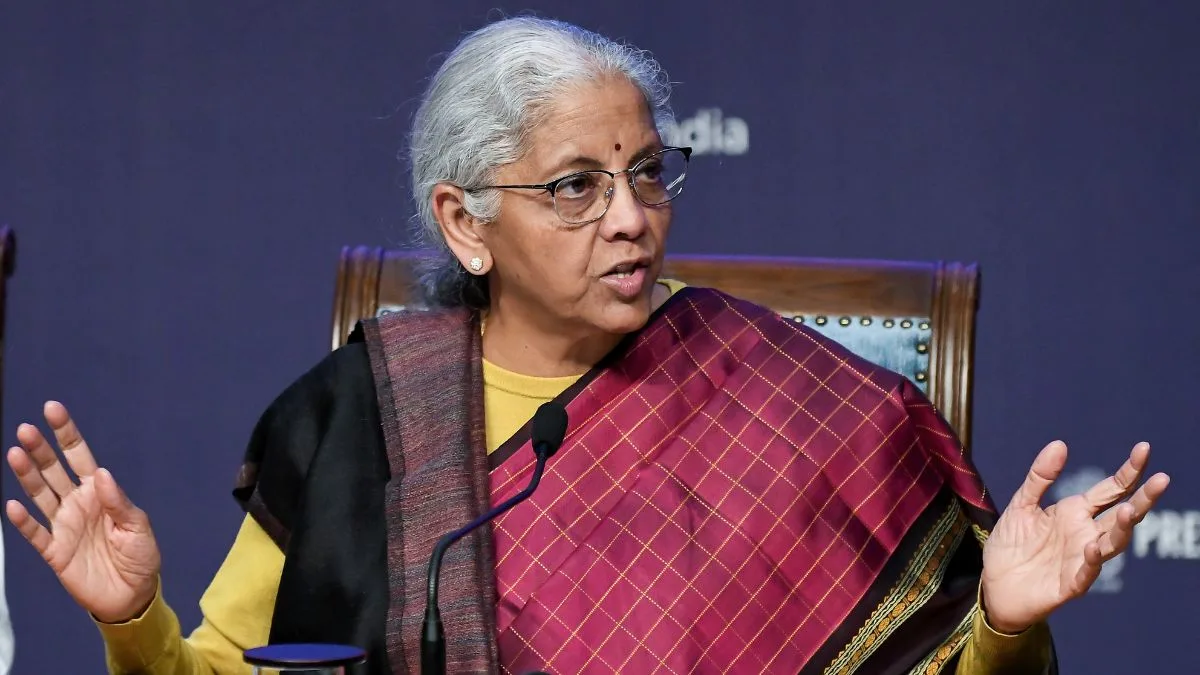
Clad in a Kattam Kanjeevaram silk saree from Tamil Nadu, Sitharaman delivered her ninth consecutive Budget, structured around “three kartavyas and seven strategic and frontier sectors.” While the sartorial choice carried cultural symbolism, the Budget itself avoided state-specific largesse for poll-bound regions.
Advertisement
As the BJP prepares for a crucial electoral battle amid signs of upper-caste discontent, the absence of clear political signalling stood out. There were no targeted announcements for allies, no income tax relief for the middle class, and no direct outreach to salaried taxpayers, apart from a promise to simplify tax return forms. Trinamool Congress MPs also noted that West Bengal did not find a specific mention in the speech.
Maintaining a distinctly non-populist tone, the Finance Minister prioritised infrastructure, manufacturing, technology, and energy security against the backdrop of global headwinds such as supply chain disruptions and energy volatility. The markets, however, reacted negatively, with benchmark indices Sensex and Nifty slipping after the government raised the Securities Transaction Tax on commodity futures.
Responding to questions on the absence of special sops for election-bound states, Sitharaman said, “I think there is enough to cover all the election states. If I do, you will ask me why I have done it only for the election states. Now I have it for election and non-election states as well. You want me to spell out what has been done only for the election states—I am quite happy to do it.”
Instead, she emphasised the Budget’s inclusive framework, pointing to large infrastructure and industrial announcements that would also benefit poll-bound states. These include freight corridors for West Bengal, rare earth corridors for Tamil Nadu and Kerala, and infrastructure projects in Assam and Puducherry, underscoring the Centre’s stated approach of equitable development across regions.
Against a challenging geopolitical backdrop, the Budget focuses on scaling up manufacturing in seven strategic and frontier sectors such as biopharmaceuticals, semiconductors, and electronic components. It proposes dedicated rare earth corridors in mineral-rich states including Odisha, Kerala, Andhra Pradesh and Tamil Nadu to boost mining, processing, research, and manufacturing, and to reduce dependence on China.
A scheme to support states in setting up three chemical parks and strengthening the Capital Goods Capability Integrated Programme for the textile sector was also announced.
For states, the Budget outlines new Dedicated Freight Corridors linking Dankuni in the east to Surat in the west, 20 new National Waterways, a Coastal Cargo Promotion Scheme aimed at long-term energy security, and seven high-speed rail corridors—Mumbai–Pune; Pune–Hyderabad; Hyderabad–Bengaluru; Hyderabad–Chennai; Chennai–Bengaluru; Delhi–Varanasi; and Varanasi–Siliguri.
While there were no headline-grabbing dole announcements, schemes such as the Self-Help Entrepreneur (SHE) initiative for rural women were positioned as efforts to bridge urban–rural divides. Observers note that regional projects were embedded within national corridors rather than pitched as state-specific incentives.
West Bengal, ruled by the Trinamool Congress, was allocated enhanced freight corridors from Dankuni and improved rail connectivity aligned with the Varanasi corridor. Tamil Nadu and Kerala featured prominently in the rare earth strategy, while Kerala also saw eco-tourism initiatives, including turtle beach conservation. Sectoral announcements on coconut, cashew, and sandalwood appeared tailored to southern states.
“We are laying the path and giving a push to the economy to maintain the growth momentum,” Sitharaman said. “Primarily, we are looking at building the ecosystem with structural reforms. Reforms have been carried out, and we are continuing with them.”
Overall, the Budget positioned the government as a steward of its “Viksit Bharat 2047” vision, eschewing overt electoral messaging while subtly aligning regional development with national priorities ahead of the 2026 Assembly elections.