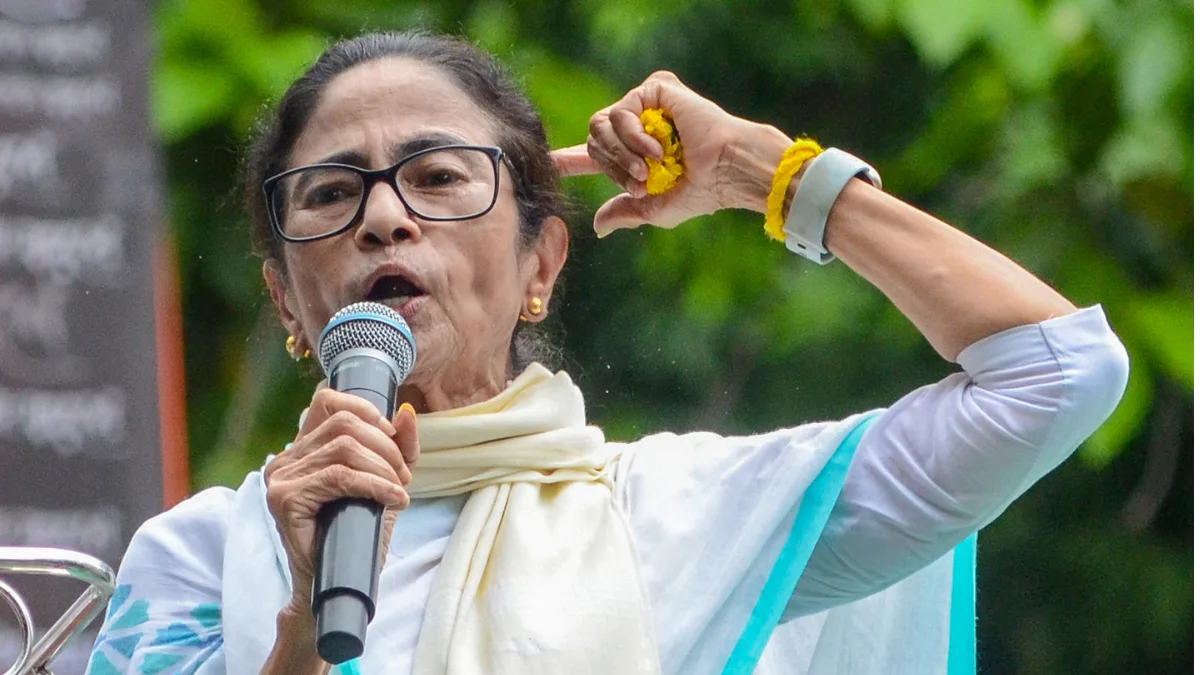
Mamata’s call for anti-BJP unity at Martyr’s Day rally junked by Congress, Left
Bengal BJP president Samik Bhattacharya said Mamata Banerjee should first focus on uniting her own party before attempting to forge an opposition alliance.
As India approaches the next census, the return of delimitation to the political agenda has revived an ok- and uneasy question: how should representation balanced in a country where population growth has diverged sharply across regions? At its core, delimitation is a democratic necessity.




File Photo: IANS
As India approaches the next census, the return of delimitation to the political agenda has revived an ok- and uneasy question: how should representation balanced in a country where population growth has diverged sharply across regions? At its core, delimitation is a democratic necessity. Electoral boundaries cannot remain frozen in a society that changes continuously. Yet democracy is not arithmetic alone. It also rests on trust between regions, faith in constitutional fairness, and a shared belief that national rules do not penalise responsible behaviour. This is where the tension lies.
States that succeeded in stabilising population growth now fear political marginalisation, while states with faster demographic expansion argue ~ reasonably ~ that representation must reflect present realities. Both claims are legitimate. Treating this as a moral contest between “responsible” and “lagging” states risks reducing a structural constitutional issue into a political grievance. A purely population-based redistribution of parliamentary seats may satisfy numerical equality, but it can also distort federal balance. In a country as large and diverse as India, representation serves two functions: reflecting citizens and protecting states as political units. Ignoring either weakens the Union. The challenge, therefore, is not whether delimitation should occur, but how its impact can be moderated.
Advertisement
One approach lies in expanding the size of the Lok Sabha rather than redistributing existing seats. This would allow growing states to gain representation without forcing others, especially in the south and west to lose political voice. While this raises concerns about legislative efficiency, larger democracies across the world have adapted to bigger parliaments through committee systems and procedural reforms. Another stabilising mechanism is the continued relevance of the Upper House. In an era when fiscal powers and welfare delivery are increasingly centralised, the Rajya Sabha can be an institutional space where states, irrespective of size, retain equal constitutional weight with equal representation for all states as in the US Senate. This balance could become especially important as the lower house grows more population driven. There is also a case for re-examining the administrative size of states themselves.
Advertisement
Several Indian states now govern populations larger than most countries. Smaller political units can improve administrative responsiveness while also diffusing excessive concentration of parliamentary power. Such reorganisation, however, must emerge from political consensus rather than electoral calculation. What must be avoided is a winner-takes-all framing If delimitation is projected as a transfer of power from one region to another, it will harden identities and deepen mistrust. Federal systems survive not by perfect equality, but by perceived fairness. India’s Constitution was never meant to operate mechanically. It was designed to evolve through negotiation, accommodation, and restraint. Delimitation after the next census will test whether that spirit still endures. Handled wisely, it can modernise representation while strengthening national cohesion.
Mishandled, it risks turning demography into destiny – and
democracy into a permanent regional contest.
Advertisement