Through the Veil
“Man is born free, and everywhere he is in chains.” Rousseau’s words, written centuries ago, continue to resonate with disturbing clarity in our modern world.
In the preface to her second book of poems, Signing in the Air, Malashri Lal explains her choice of the title for her book by stating, “while ‘signing’ is a manner of asserting identity, I’ve chosen to scribble in the empty air where intimations of spirituality as well as social truth coexist without definable boundaries.”




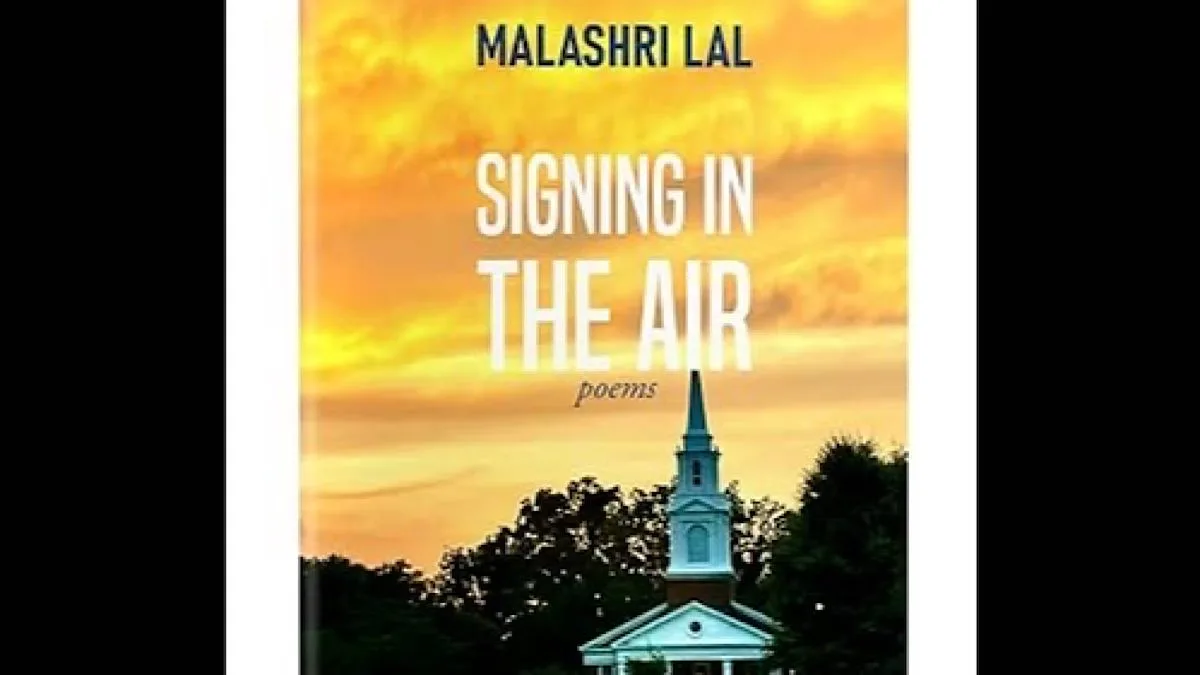
Photo:SNS
In the preface to her second book of poems, Signing in the Air, Malashri Lal explains her choice of the title for her book by stating, “while ‘signing’ is a manner of asserting identity, I’ve chosen to scribble in the empty air where intimations of spirituality as well as social truth coexist without definable boundaries.” As in her first book of poems, Mandalas of Time, the 76 poems in this volume span a wide trajectory, from the terrestrial to the spiritual. In fact, the Invocation to the Divine Feminine sets the mood and tenor of these very sensitive, sombre and nuanced poems that blend memories, introspection, incisive comments and musings with superb skill. Each of the well-structured five sections, Whispers of the Earth, Installations, Echo of Myths, Meditative Missives and Women Who Wander map the journey of the perceptive poet who is able to seamlessly traverse the domain of the phenomena and the noumena with remarkable ease.
So, in the first section, while the first poem Marigolds in Basant gestures towards the receding of the spring season, the following poems address the torridness of summer, and the arrival of monsoon, though the poet wryly comments, “Cloud messengers have been stricken with amnesia/They forget to carry the basket of rain…”. Furthermore, the poet underscores the metamorphosis of the twentieth century cloud messenger as she observes with ire and irony, “The cloud-megha resemble the umbrella/over Hiroshima, when/bodies vaporised in the intense heat…”
Advertisement
The autumnal poem, ‘Sarat Ritu Amidst Terror’, sketches disturbing images of violence and ‘hungry fatherless children’ and the poem on the imminence of the winter season, Hemanta, recalls the mystic monk Vivekananda while stating that the ‘curse of warfare’ merges indistinguishably the victor and the victim. The conclusion of the poem ‘Birds of Paradise in Winter: Shishir’ expresses the poet’s angst and indignation with uncharacteristic vehemence: ‘Paradise is a cheat/birds, a misnomer/Language, only a blister.’ In the poem ‘Tulip Garden’ the poet notices how the tulips in gorgeous hues provoke selfie-takers, and the tulips flowers in the pictures feature as the frame for self-portraits.
Advertisement
The poems in the section ‘Installations’ recall local culinary delicacies, from jalebis to Naani’s magic meals, smoked hilsa of Dhaka with the rapid changes that have transformed dietary preferences, and the vintage rasoi with the clay oven has been replaced by the gleaming kitchen where food is delivered rather than cooked. The poet sums up the lost aroma of traditional cooking as a bonding adhesive in the concluding line of the poignant poem- ‘The Rasoi is a lost memory of bonded families.’ In the poem ‘Pomegranate’, the empirical and the extra-sensory perception blend in an uncommon reflection as the poet concludes the poem, ‘Another dream shattered/Another illusion revealed.’ Simultaneously, the poet addresses the tragic loss of young lives who were trapped in a waterlogged basement library- ‘three floating bodies were the oblation/That broke the spell of coaching dreams.’. Nonetheless, heart-wrenching is the poem ‘In Transit’, where the depressed, lonely mother, uprooted from her home, sees herself as an alien in America, and is eventually admitted to a senior citizens facility by her son, “Ma, you will be happy here with so many like you.”
In fact, many of the poems express the poet’s dis-ease with the callous chaos of contemporary times, with reckless violence darkening the skies. In the poem Parliament of Birds, the very first line encrypts the invasion of urbanisation and development as the poet states, ‘Bulldozers have uprooted old trees…’
In the section on myths and mythic figures, ‘Hidima on Delhi Streets’ and ‘Ahalya’ balance the contemporary ecosystem with the mythic magic, giving identity and voice to both, with subtle irony. These two poems are followed by poems about Lakshmi and Alakshmi, Holika, Brahma temple, Teej and Goddess Parvati, among others, including some well-crafted haikus and a poem on Ranthambore with tigers and their persecutors, the tourists, armed with cameras.
In the ‘Meditative Missives’ section, the voice of the poet is pensive, philosophic, wafting between memories of loved ones, certain stirrings of extra sensory perception as in the poems ‘Palm-Prints’, ‘Baba at the airport’, ‘Mimicking Nirvana’ and the two poems ‘Vanaprastha’ and ‘Inviting Yama’, that configure life’s journey from the earthly sojourn to the ultimate home, which promises reunion with all those one had loved and lost, ‘parents, siblings, colleagues and neighbours’.
The final section ‘Women Who Wander’ begins with “Grandma’s Blouse’ which is a symbol and metaphor of the evolving times and lifestyle transformations that are too often gently internalised within an heirloom and legacy. In fact, it is to this dynamic grandmother that the poet Malashri Lal has dedicated this book of poems- ‘for my intrepid grandmother (thamma)- Jyotirmoyi Mukherjee, teacher, writer, social reformer.”
The poems in Signing in the Air weave cherished memories from girlhood to the decades of mellow maturity, with poignancy and nuanced expressions of loss, grief, sadness, and longing along with the spiritual fortitude of calmness and transcendence. In this respect, the poem, ‘Anxiety’ delves into an unexpected domain of neurosis and the horror of mental trauma, described with unnerving images as the stanza springs both shock and surprise- The ghouls of dead spirits/drag her into a pit of reptiles/ though she is demurely seated in the/hospital chair’.
Malashri Lal’s poems in ‘Signing in the Air’ are often memoir pieces, creating lost moments and still points of time, looking both into the lived experiences of the past and the challenges and changes that the present registers. There is a deep reiteration of spiritual anchorage that makes the poet intone in aesthetic sublimity the erratic, inexplicable puzzles that lived experiences unleash on humankind, and how many succumb while some transcend, realising the impermanence of earthly days and Selfhood, the Jivatma, and the permanence of Not-Self, the eternal, Ananta. Malashri Lal has tracked a meaningful poetic journey from The Mandalas of Time to Signing in the Air, as she states in her preface that her poems, “represent a séance of words, in the darkness of the mystical unknown with the glow of candlelight that flickers with an awareness of continuities”. As in Mandalas of Time, Malashri Lal’s poems in Signing in the Air are enriching and enlightening, bearing the unmistakable caress of a healing touch.
Spotlight
Signing in the Air
Malashri Lal
New Delhi: Hawakal, 2025
Price: Rs 600, 128 pages
Advertisement