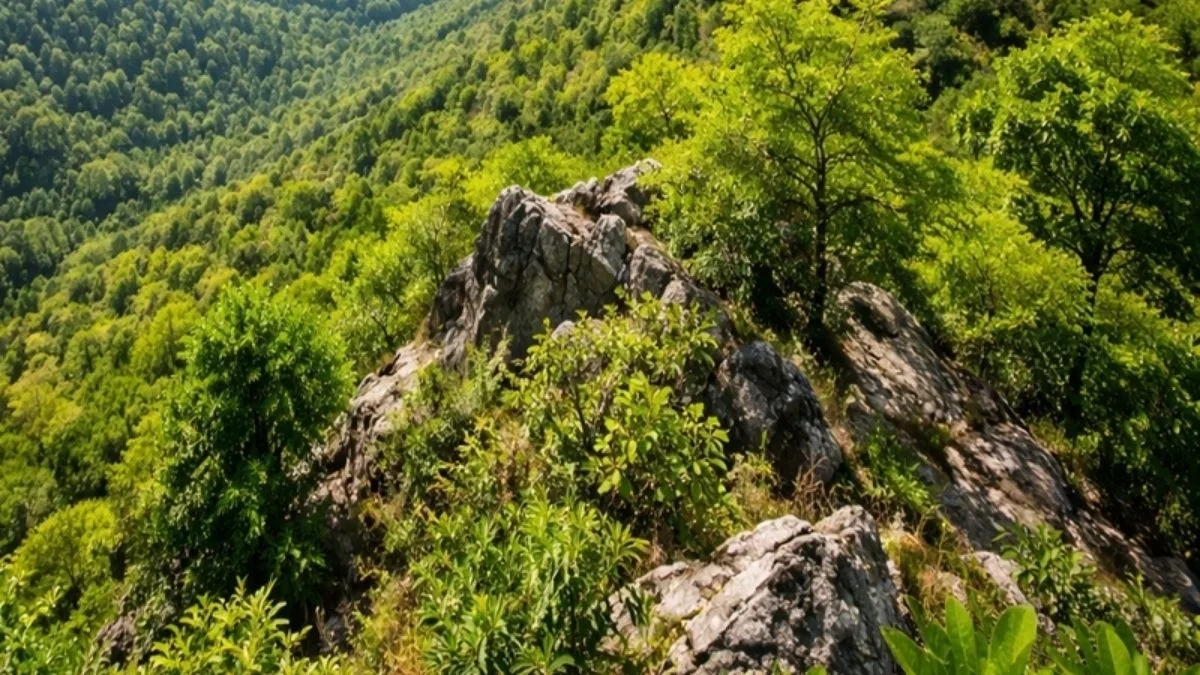
Deforestation, unsustainable land use, rapid urbanisation, widespread land degradation and desertification have put immense pressure on the Aravalli range, according to a report titled “Eco-restoration of the Aravalli Landscape”, released by Union Environment Minister Bhupender Yadav on Wednesday at the National Conference on Eco-restoration of the Aravalli Landscape: Strengthening the Aravalli Green Wall.
The report notes that encroachments, deforestation, illegal mining and the rapid expansion of urban infrastructure across the Aravalli ranges have severely affected groundwater recharge, biodiversity, air quality and climate regulation—factors that weakened the region’s ability to function as a natural green barrier, accelerating desertification and threatening the ecological stability of the northern plains.
Advertisement
It also highlights that the diversion of forest land, particularly around the Sariska and Bardod wildlife sanctuaries before the 1980s, led to a sharp decline in native forest cover. The research by the Sankala Foundation also presents a scientific, community-driven, and scalable framework to strengthen the Ministry’s Aravalli Green Wall Project under the National Action Plan to Combat Desertification and Land Degradation. It emphasises that restoration efforts must be landscape-scale, data-driven, community-anchored and multidisciplinary, noting that isolated interventions are no longer adequate given the scale of degradation and ecological pressures in the region.
The Aravalli range acts as a vital natural barrier and life-supporting ecosystem for the National Capital Region and the Indo-Gangetic Plains. Yadav said the government launched the Aravalli Green Wall Project as part of Prime Minister Narendra Modi’s vision and India’s commitment under the UNCCD to restore 26 million hectares of degraded land.
Under this initiative, 6.45 million hectares of degraded land in the Aravalli region have been identified, with greening work initiated over 2.7 million hectares across Gujarat, Delhi, Haryana and Rajasthan. Divisional Forest Officers from 29 Aravalli districts are implementing the project, focusing on plantations of native species suited to arid and semi-arid conditions, he said.
Yadav added that around 97 square kilometres of Aravalli revenue land, stretching from Naurangpur to Nuh in Haryana and heavily degraded, has been identified for afforestation and has also been declared a Protected Forest by the state for better protection and management. The conference brought together policymakers, forest officials, experts, practitioners, and civil society representatives to deliberate on the ecological significance of the Aravalli range and explore pathways for its long-term restoration.