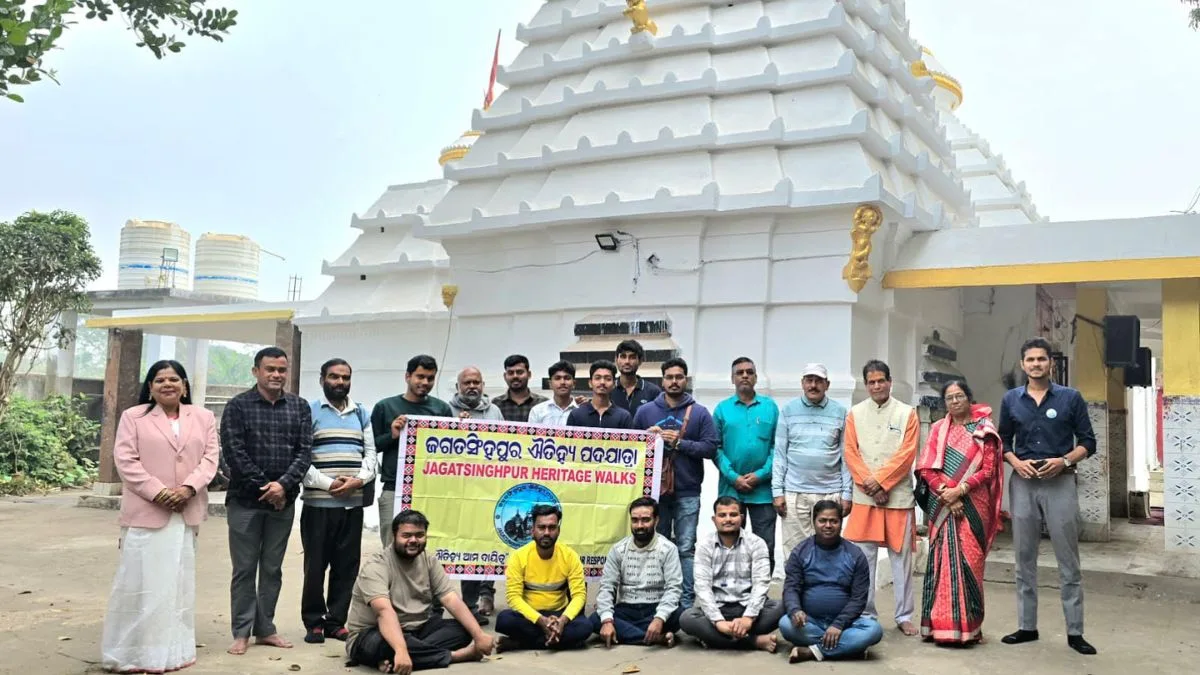
Heritage enthusiasts explored the Maratha era Muchukunda Somnath Temple in Odisha’s Jagatsinghpur town, a place of worship that does not merely stand in space, but stands in layers of time.
The temple is commonly believed to belong to the post-Mughal period, particularly the phase associated with Maratha influence in Odisha. This attribution is based primarily on architectural typology, regional historical context, and comparative stylistic observation; it must be noted, however, that no epigraphic evidence has yet been identified at the site. Even so, while the shrine may not be “very ancient” by early medieval standards, it is not young either, and its architecture carries a distinct regional stamp, said Srikanta Singh, Convener Jagatsinghpur Heritage Walks.
Advertisement
Built with a stone “peedh deula” style “vimana” and “jagamohan”, the structure rises to about thirty feet, presenting a compact yet typical of many Odishan Shaiva shrines. Within the sanctum sanctorum, the Shiva Lingam and the stone pillars associated with “navagraha” worship are notably old, suggesting that the sacred nucleus of the site preserves an antiquity that predates the visible superstructure. This observation, however, remains interpretative and would benefit from archaeological investigation.
On the temple’s sides is the companion deities worshipped in Shaiva tradition, Lord Ganesha, Lord Kartikeya, and Mother Parvati.
Although the idols today sit beneath thick layers of chemical paint, the underlying sculptural form remains partially legible. When sculpture is read as one would read a manuscript, shape, proportion, and workmanship suggest stylistic features that point toward the Somavansi period.
This inference gains strength when examining details such as the crown and head-ornament styles of the figures, and the Gandharva–Vidyadhara motifs carved near the upper portions, whose compositional grammar echoes earlier medieval sculptural conventions.
Within the same temple complex stands an ancient image of Umamaheshwar, likewise associated with Somavansi sculptural idioms. Local worshipers have played an important role in identifying its antiquity, particularly by referring to the idol’s appearance when it is undressed or free from recent coatings. While such community knowledge is invaluable for heritage understanding, it is treated here as supplementary to formal art-historical analysis. Time has not been gentle with the image, which bears visible damage.
A broken idol of Shri Vishnu is also present within the complex, suggesting either an earlier Vaishnavite presence, shared sacred geography, or the long Odishan tradition of allowing multiple devotional strands to coexist within a single ritual landscape rather than indicating sectarian displacement.
The Muchukunda Somnath Temple is not merely a stop on a heritage walk. It is an evolving sacred landscape where stone, story, and community practice intersect, and where time does not move linearly but gathers in cycles. Prominent among the participants are convenor of Odisha Heritage Walks Biswaranjan Dehury, retired teacher Utkal Moganty, writer Basanta Manjari Dash and journalist Sashanka Panda and Hemanta Dash.