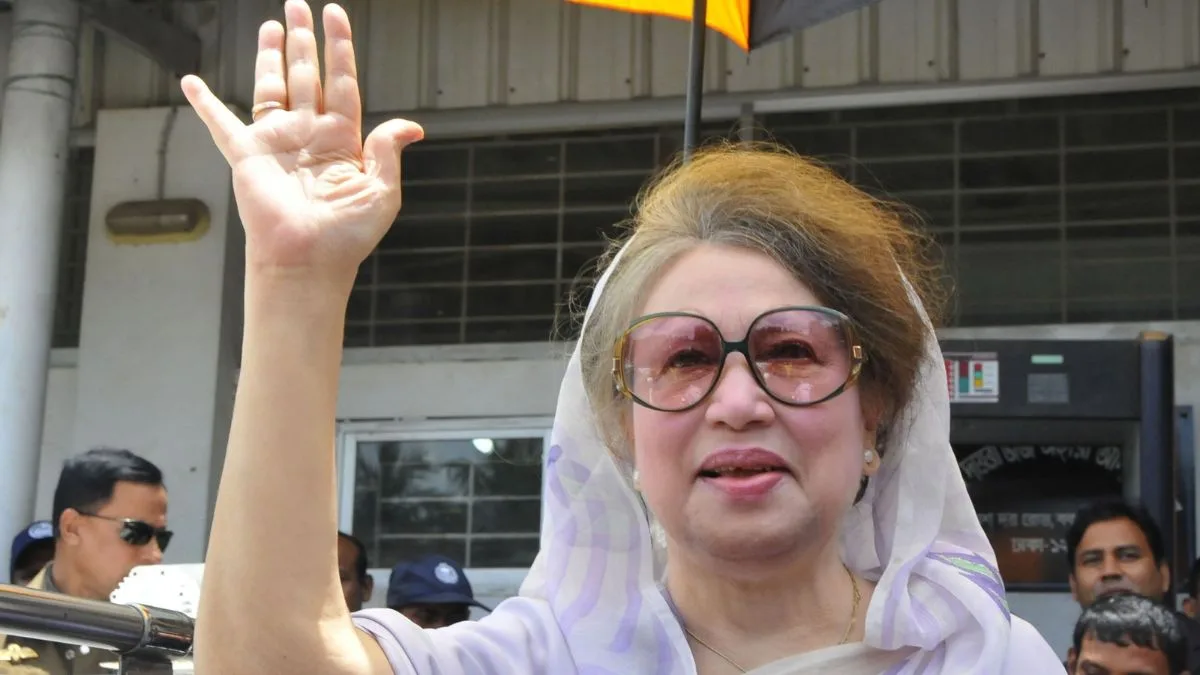
Begum Khaleda Zia, one of Bangladesh’s most enduring and influential political figures and a three-time prime minister, passed away at the age of 80 after a prolonged battle with multiple ailments.
With over four decades of political career, she leaves behind a complex legacy defined by her role in strengthening democracy, shaping multi-party politics, and breaking barriers for women in leadership.
Advertisement
Early life & family
Khaleda Zia was born to Iskandar Majumder and Taiyaba Majumder on 15 August 1946, in Dinajpur, a district of undivided Bengal. Following the Partition, her father migrated to what was then West Pakistan from Jalpaiguri in India, where he used to run a tea business.
She studied at Dinajpur Government Girls’ High School and Surendranath College. In 1960, she married Ziaur Rahman, a freedom fighter who later became President of Bangladesh.
Rise to Political Leadership
Her political journey began after the assassination of President Ziaur Rahman in 1981. In 1982, she joined the Bangladesh Nationalist Party (BNP) as a general member. By 1984, she had been elected chairperson of the party.
Khaleda Zia emerged as a central figure in the pro-democracy movement against General Hussain Muhammad Ershad’s military rule. She formed a seven-party alliance, rejected the controversial 1986 elections, and was detained seven times for her defiance. She led the movement for the restoration of democracy in 1990.
In 1991, Khaleda Zia became the country’s first woman prime minister. She returned to power twice, briefly in 1996 and again from 2001 to 2006.
Khaleda Zia’s later years were overshadowed by legal battles, including convictions in the Zia Orphanage Trust and Zia Charitable Trust cases in 2018, which resulted in a 17-year sentence.
The incessant ‘Battle of the Begums’
The countless episodes of the never-ending feud between Khaleda Zia and Bangladesh Awami League leader Sheikh Hasina have always dominated the Bangladesh political landscape.
In 2009, when Khaleda Zia was involved in the fight for the democracy movement, the Bangladesh government, led by former Bangladesh Prime Minister Sheikh Hasina, allegedly expelled Zia from her house and put her under house arrest twice.
When Sheikh Hasina was awarded the death sentence in July 2024 by the International Crimes Tribunal (ICT), the Khaleda Zia-led Bangladesh Nationalist Party hailed it as the delivery of justice.
Global recognitions
Khaleda Zia was recognised internationally for her contributions to democracy and women’s empowerment. Forbes ranked her among the world’s 100 most powerful women in 2025 for her contributions to women’s empowerment, while New Jersey’s State Senate honoured her in 2011 as a “Fighter for Democracy”.