Delhi: AQI rises to 208, CAQM invokes GRAP-1 measures
The decision was taken after reviewing the air quality scenario in the NCR as well as India Meteorological Department (IMD)/Indian Institute of Tropical Meteorology (IITM) forecast
Delhi recorded a marginal improvement in air quality on Wednesday, but AQI levels remained ‘very poor’ as dense fog reduced visibility and strict GRAP Stage-IV measures stayed in force.




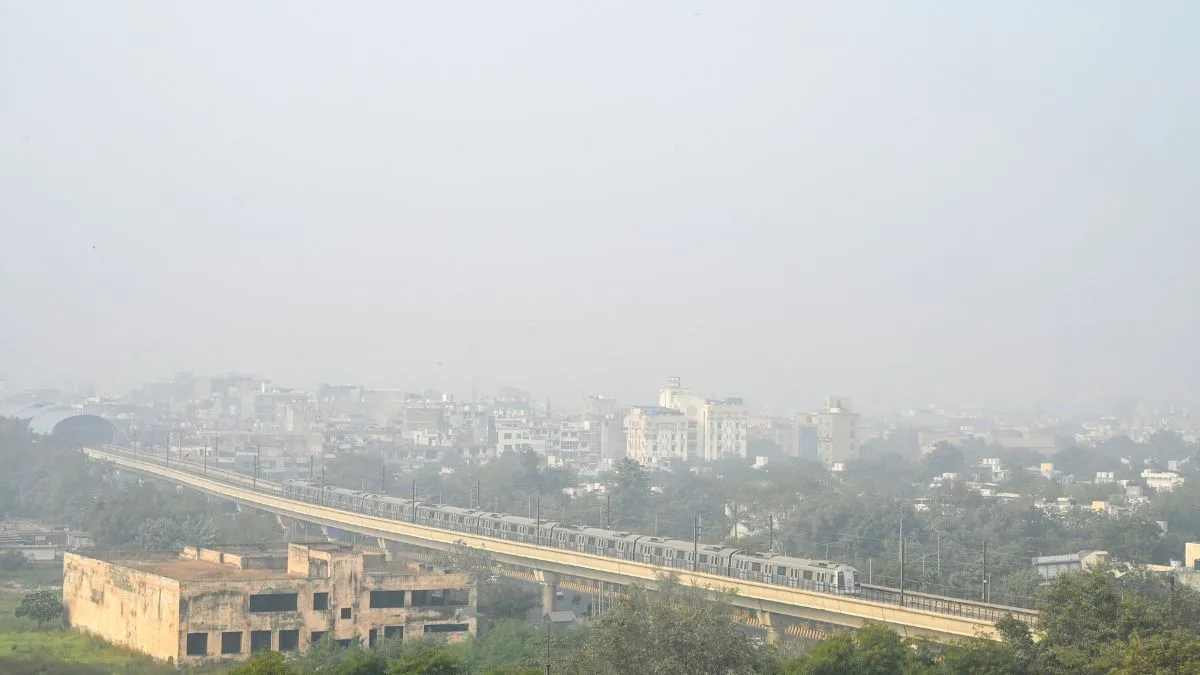
Delhi: A bird’s-eye view of a metro train running on the track amid reduced visibility due to dense fog and smog, in Delhi-NCR. (Photo: IANS)
Delhi woke up to another grey morning on Wednesday, with air quality showing a marginal improvement but continuing to stay in the “very poor” category as dense fog reduced visibility across large parts of the capital.
Data from the Central Pollution Control Board showed alarmingly high Air Quality Index (AQI) readings at multiple locations. The ITO area recorded an AQI of 374, while India Gate stood at 354, both categorised as “very poor”, even as Republic Day parade rehearsals went on amid hazardous conditions, according to news agencies – UNI and ANI – inputs.
Advertisement
High pollution levels were reported across the city. Sarai Kale Khan recorded an AQI of 360, Ghazipur NH-24 stood at 368, and the Indira Gandhi International Airport also logged 368, indicating that pollution was spread across Delhi rather than confined to isolated hotspots.
Advertisement
Visuals from the ITO stretch showed a thick layer of smog hanging over the area through the morning hours. In response to the deteriorating air quality, the Commission for Air Quality Management invoked all actions under Stage-IV of the Graded Response Action Plan (GRAP) across Delhi-NCR, bringing the strictest set of pollution curbs into force.
The pollution episode coincided with dense fog conditions. The India Meteorological Department issued a district-level nowcast at 3:17 am IST, warning of dense fog over New Delhi, North, North-West, South-West and West Delhi, while moderate fog was expected in other districts.
Visibility at Palam Airport dropped sharply overnight, to around 400 metres at 2:00 am IST and further down to nearly 100 metres by 2:30 am. Conditions improved slightly by morning, with visibility increasing to about 250 metres at 6:30 am, though officials cautioned that it could deteriorate again.
A follow-up nowcast at 5:30 am indicated moderate fog over most parts of the city, advising commuters to remain cautious during morning travel. The weather office also warned of possible disruptions to air, rail and road traffic, along with slower commute times.
Wind speeds of around 15 kmph over the past 24 hours helped bring a small dip in AQI levels. However, pollution concentrations remained well above safe limits, keeping the capital under sustained air quality stress, the IMD said.
Health advisories continued for vulnerable groups, especially people suffering from asthma and bronchitis.
According to news agency IANS, Delhi’s 24-hour average AQI stood at 349 on Wednesday morning, an improvement from Tuesday, when the capital recorded a severe AQI of 412 at 4:00 pm. On Tuesday, five monitoring stations reported severe-plus AQI levels above 450, while 26 stations remained in the severe category.
Neighbouring NCR cities also continued to report poor air. Noida recorded an AQI of 355, Greater Noida 344, Gurugram 316 and Ghaziabad 309, all in the “very poor” bracket.
Amid the ongoing crisis, the Delhi Cabinet under Chief Minister Rekha Gupta on Tuesday approved a series of decisions aimed at strengthening environmental governance, ANI reported.
Announcing the outcomes, Environment Minister Manjinder Singh Sirsa said the Cabinet had approved an allocation of Rs 100 crore for rejuvenating water bodies under the Delhi government. Of around 1,000 water bodies in the capital, 160 fall under the government’s jurisdiction.
“The rejuvenation of Delhi’s water bodies will play a crucial role in pollution control. The Chief Minister has directed that every possible financial support be extended to complete this work within the year,” Sirsa said.
Elsewhere in north India, dense fog and cold wave conditions continued. Ambala in Haryana witnessed dense fog with an orange alert in place, while parts of Uttar Pradesh, including Ayodhya, Kanpur and Moradabad, remained under yellow or orange alerts due to poor visibility and low temperatures.
Advertisement