Punjab govt rolls out VB-G RAM G to strengthen rural employment guarantee
The Minister said that while MGNREGA remained operational till June 30, 2026, the VB G RAM G scheme came into effect from July 1.
The rights groups, united under the banner of the NREGA Sangharsh Morcha, stated that the proposed legislation is not a reform but a rollback of democratic and constitutional guarantees won by workers through decades of sustained struggle.




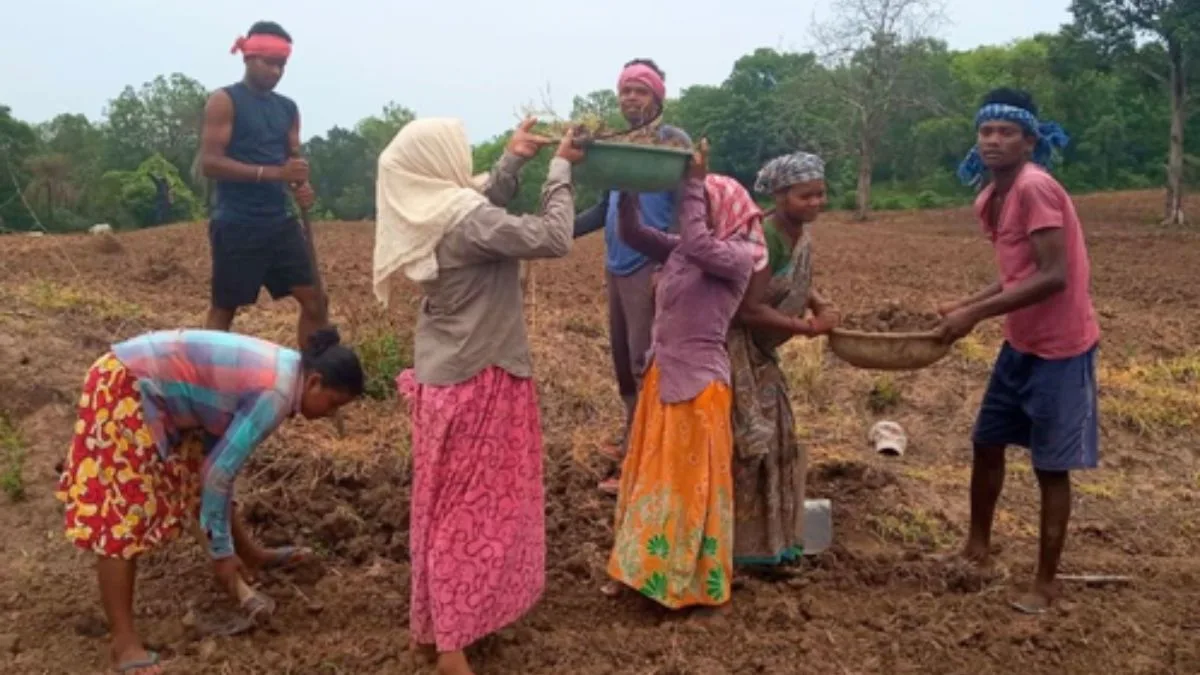
Representative Image (IANS)
A confederation of labour rights bodies has opposed the proposed Viksit Bharat – Guarantee for Rozgar and Aajeevika Mission (Gramin) Bill, 2025 (VB-G RAM G), which seeks to repeal the Mahatma Gandhi National Rural Employment Guarantee Act, 2005 (MGNREGA). The organisations said the Bill “strikes at the core of social and economic justice by shifting power away from workers, Gram Sabhas and States into the hands of the Union Government.”
The rights groups, united under the banner of the NREGA Sangharsh Morcha, stated that the proposed legislation is not a reform but a rollback of democratic and constitutional guarantees won by workers through decades of sustained struggle.
Advertisement
By replacing the statutory right under MGNREGA with a centrally controlled, budget-capped and surveillance-heavy scheme, the Union Government is seeking to dismantle a historic rights-based legislation and reduce the right to work to a discretionary dole, the statement said.
Advertisement
“This Bill violates the spirit of the Constitution, undermines the 73rd Constitutional Amendment, and strikes at the core of social and economic justice by shifting power away from workers, Gram Sabhas and States into the hands of the Union Government,” it added.
The NREGA Sangharsh Morcha unequivocally rejected the VB-G RAM G Bill, 2025, and demanded its immediate withdrawal. Any attempt to repeal or fundamentally alter MGNREGA without the consent and participation of workers and their organisations is unacceptable, the statement said. It also called upon all democratic forces to resist these unilateral and regressive proposals and to defend NREGA as a cornerstone of livelihood security for millions of rural workers.
Introduced without any consultation with workers or workers’ groups, the Bill represents a fundamental shift from a rights-based law that provides an enforceable entitlement to a budget-constrained scheme without accountability of the Union Government, the Morcha said.
MGNREGA establishes a statutory right to work that is demand-driven and universal, meaning that any person willing to do unskilled manual work in any rural area must be provided employment.
However, the VB-G RAM G Bill, under Section 5(1), states: “The State Government shall, in such rural areas in the State as notified by the Central Government, provide to every household whose adult members volunteer to do unskilled manual work, not less than 125 days of guaranteed employment.”
This provision implies that if a rural area is not notified by the Centre, there is no right to work for people in that area, effectively reducing universally guaranteed employment to a scheme run at the discretion of the Union Government, the statement said.
MGNREGA derives its strength from its demand-driven nature, under which every rural worker must be provided work within 15 days of demand, failing which they are entitled to an unemployment allowance. Under the Act, 100 per cent of labour wages are borne by the Union Government.
In contrast, Section 4(5) of the VB-G RAM G Bill states: “The Central Government shall determine the State-wise normative allocation for each financial year, based on objective parameters as may be prescribed by the Central Government.” Section 4(6) further provides that “any expenditure incurred by a State in excess of its normative allocation shall be borne by the State Government in such manner and by such procedure as may be prescribed by the Central Government.”
According to the Morcha, these provisions empower the Union Government to arbitrarily decide the quantum of funds allocated to States, which will, in turn, determine the number of days of employment that can be provided. This, it said, completely upends the logic of MGNREGA, where funding follows demand, and replaces it with a supply-driven system in which demand must conform to a predetermined budget.
Advertisement