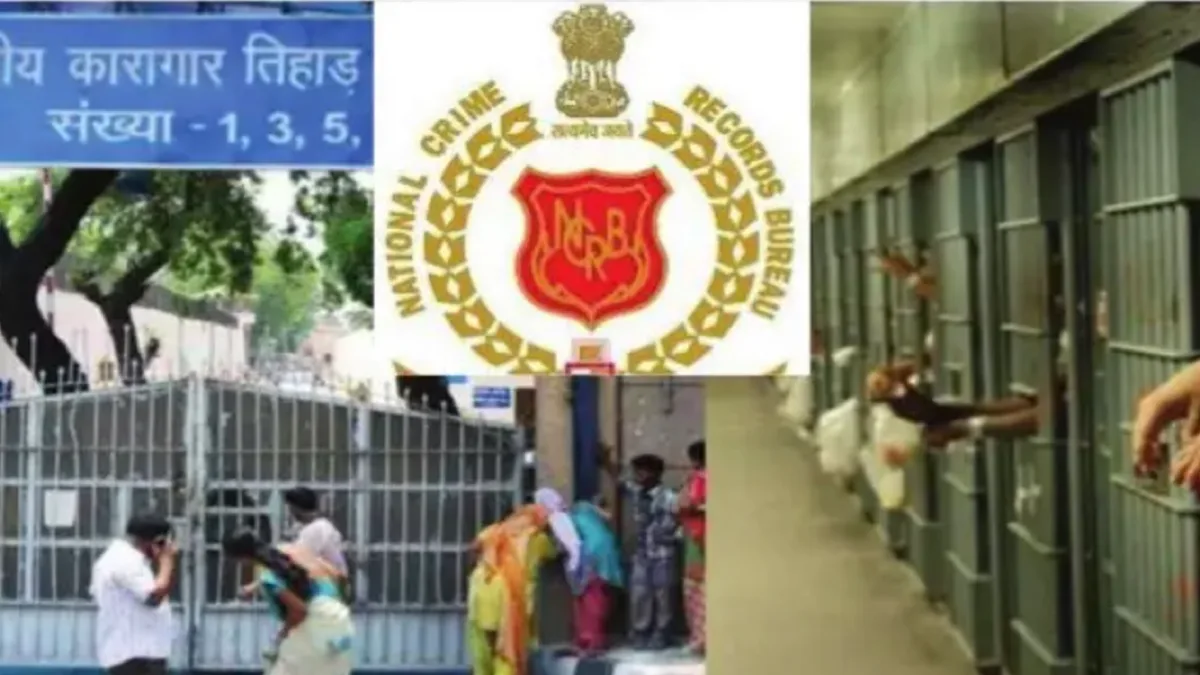
Each year, as India celebrates Constitution Day on 26 November, we reaffirm our collective commitment to liberty, dignity, and justice. The day is meant to remind us of the living spirit of our Constitution, a document that enshrines the rights of citizens and the responsibilities of the State. Yet Rousseau’s timeless observation ~ “Man is born free, but everywhere he is in chains” ~ continues to resonate with painful relevance. While the Constitution guarantees freedom, equality, and protection of rights, the lived reality for thousands of citizens reveals a paradox: liberty celebrated in principle, but denied in practice. Nowhere is this contradiction more glaring than in the plight of undertrial prisoners. India’s prisons today house over 4.3 lakh prisoners, according to the National Crime Records Bureau (NCRB 2023).
Of these, nearly 70 per cent are undertrials ~ individuals not yet convicted of any crime, but confined while awaiting trial. This means that more than three out of every four prisoners are not proven guilty but are trapped in the limbo of delayed justice. In states such as Uttar Pradesh, Bihar, and Madhya Pradesh, the proportion of undertrials exceeds 75 per cent of total inmates, reflecting systemic delays and inefficiencies. Many spend years behind bars without their cases being heard, some even longer than the maximum sentence prescribed for the alleged offence. The marginalized ~ daily wage earners, migrants, Dalits, and minorities ~ form the bulk of this population, their voices silenced by poverty and lack of access to legal aid. Behind these statistics lie human stories that rarely reach the public eye. One young man accused of petty theft spent nearly seven years in prison before being acquitted for lack of evidence, far longer than the maximum sentence for the alleged crime.
Advertisement
A woman charged with abetment remained confined for five years before bail was granted, her children left without care and her dignity shattered. These brief glimpses remind us that the issue is not abstract – it is lived reality, where liberty is eroded not by conviction but by delay. Each case is a reminder that the justice system is not dealing with numbers but with lives, and that every day of confinement without trial is a day stolen from someone’s future. The judiciary, burdened with over five crore pending cases across courts, struggles to deliver timely justice. Trial courts, often overwhelmed, remain mute spectators to delayed hearings. The police system, constrained by inadequate training, political interference, and lack of modern forensic tools, contributes to impulsive arrests and prolonged investigations. The result is a justice delivery mechanism that disproportionately punishes the poor while allowing many offenders with influence or protection to remain outside the purview of law. The Supreme Court itself has repeatedly observed that “bail is the rule, jail is the exception,” yet in practice, bail remains inaccessible to those without resources or connections. The paradox is stark: liberty is celebrated in speeches, but denied in cells.
The problem is not new. As far back as 1979, in the landmark case of Hussainara Khatoon vs. State of Bihar, the Supreme Court highlighted the plight of undertrial prisoners languishing in jails for years without trial. The Court declared that speedy trial is a fundamental right under Article 21 of the Constitution. Yet, more than four decades later, the situation remains largely unchanged. The persistence of this crisis reflects not just administrative inefficiency but a deeper societal indifference. We have normalized the idea that the poor can be confined indefinitely while the wealthy navigate the system with ease. It is here that the ethical dimension becomes unavoidable. India’s population is vast ~ over 1.4 billion citizens ~ and the number of undertrials may appear statistically small in comparison. But justice is not a matter of arithmetic.
Even if a single individual is kept behind bars without conviction for years, the conscience of the nation ought to be stirred. Liberty is not divisible; it cannot be weighed against population size or administrative convenience. The prolonged confinement of even a handful of citizens without trial is a violation of the constitutional promise that should alarm both courts and society. The presumption of innocence, enshrined in law, is not a technicality but a moral foundation. When this presumption is eroded by systemic delay, the State risks transforming itself from protector of rights into a violator. The ethical question is stark: what does it mean for a democracy to accept the indefinite imprisonment of its citizens without proof of guilt? The silence of society in the face of such injustice is equally troubling.
Citizens, often preoccupied with their own struggles, seldom raise their voices for those who cannot speak. The absence of public outrage allows the problem to persist in the shadows, unaddressed and unacknowledged. The plight of undertrials rarely becomes a national issue, rarely finds space in political debates, and seldom features in media campaigns. This silence is not neutral; it is complicity. By failing to acknowledge the injustice, we normalize it, and by normalizing it, we perpetuate it. Reforms must begin with policing. A force trained in law, discipline, humane public dealing, and equipped with modern investigative tools can prevent impulsive arrests and reduce undertrial numbers. Respectable emoluments and family accommodation would strengthen morale, while accountability to local administration and depoliticization ~ though difficult ~ are essential for honest policing. Judicial reforms are equally urgent: investment in infrastructure, digitization of records, and adoption of fast-track courts to reduce pendency.
Bail procedures must be rationalized to prevent indefinite confinement of those accused but not convicted. The Law Commission of India (Report No. 268) has already recommended liberalizing bail provisions, yet implementation remains slow. The gap between recommendation and reality is symptomatic of a system that acknowledges injustice but hesitates to act. Comparative perspectives also reveal the scale of India’s challenge. In countries such as the United Kingdom and Canada, undertrial prisoners constitute less than 20 per cent of the prison population, thanks to robust bail systems and efficient trial procedures. In contrast, India’s figure of nearly 70 per cent underscores the urgency of reform.
The United Nations has repeatedly emphasized that prolonged pre-trial detention violates basic human rights and undermines the principle of presumption of innocence. India, as the world’s largest democracy, cannot afford to ignore these warnings. Technology-driven reforms offer hope. E-filing of cases, video conferencing for hearings, and AI-assisted case management can ease the burden on courts. Legal aid services must be strengthened to ensure that the poor are not left voiceless. Community-based alternatives to incarceration, such as probation and restorative justice, can reduce prison overcrowding. Above all, the system must ensure that constitutional rights are not privileges reserved for the wealthy but protections extended to every citizen. The functioning of police and courts is said to be crumbling under the magnitude of cases, but this is a creation of our own neglect. If crores of rupees can be spent on wayward expenses, surely investment in justice delivery is not beyond reach.
The measure of a nation’s democracy lies not in how it celebrates liberty, but in how it safeguards the liberty of its most vulnerable. To remain silent is to condone injustice; to scrutinize is to reclaim responsibility. The time has come to choose the latter, for only then will the promise of “born free” truly extend beyond the prison walls to every citizen of India. As Haile Selassie once said, “Throughout history, it has been the inaction of those who could have acted; the indifference of those who should have known better; the silence of the voice of justice when it mattered most; that has made it possible for evil to triumph.
(The writer is a retired Air Commodore, VSM, of the Indian Air Force)