PHERAA BEAUTFUL FILM
Father-son relationships are not new in Indian cinema. But few remain etched in our memory as unforgettable slices of life seen through the lens of a movie camera and from the perspective of a director.
Highlighting that all jury-members were “on the same page for whatever films we selected”, Gulati said that they were watching the content, which is more important than anything else.




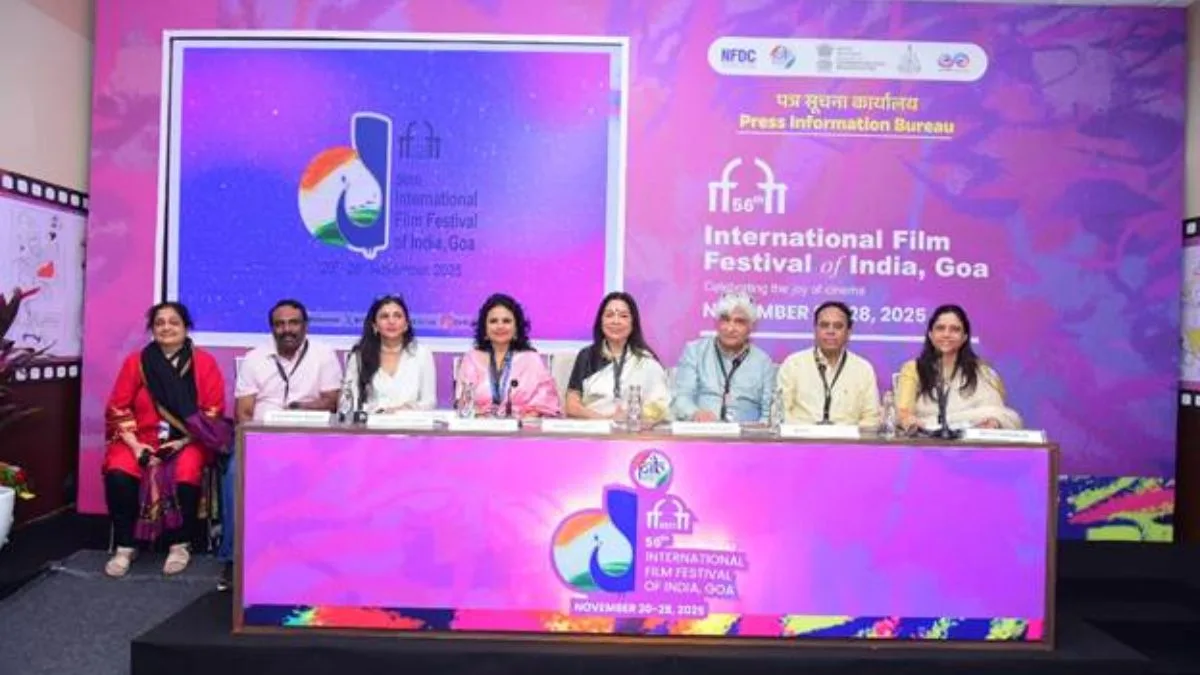
Photo: PIB
The members of the Non-Features Jury made the selections of the films to be showcased at the International Film Festival of India 2025, based on their content. “Selecting 20 films out of 500 submissions was really tough,” stated Dharam Gulati, Chair of the Indian Panorama (IP) Non-Feature Jury.
The Chairperson along with fellow jury members Anjali Panjabi, Ashok Kashyap, Bobby Sarma Baruah, Rekha Gupta, A. Karthik Raaja, and Jyotsana Garg, addressed a press conference in Goa today. They also unanimously stated that they enjoyed watching all the films.
Advertisement
Highlighting that all jury-members were “on the same page for whatever films we selected”, Gulati said that they were watching the content, which is more important than anything else.
Advertisement
He urged the film makers whose films were not selected for IP Non-Features to send their films to other festivals like the Mumbai International Film Festival (MIFF) and others.
While selecting films, the Jury also felt that they should select films from different regions and different languages, he added.
The other Jury Members also expressed their views on their experience in shortlisting the 20 films that are being screened in Non-Features category of IP and also the projects they liked the most.
Gulati made a mention of ‘Battlefield’ – a documentary shot in Manipur, which is based on the Battle of Imphal, one of WWII’s bloodiest battles, that ravaged Manipur in 1944, leaving deep scars on its people.
Panjabi observed that the Indian Panorama Non-Feature section is a remarkable treasure trove of short fictions. She noted, “This year, we were fortunate to witness an incredible diversity of films.”
Highlighting the freedom that short fictions offer, beyond the constraints of feature filmmaking and funding, she added that both veteran filmmakers and emerging student creators had contributed to this rich tapestry of storytelling. Anjali highlighted the Opening
Non-Feature, Kakori, for its unique blending of fiction and non-fiction.
Baruah drew attention to the North-East’s representation, praising projects such as the Sikkimese film Shangrila and the Assamese entry Patralekha for their creativity and cultural depth.
Gupta underscored the significance of Kakori, noting it as the only film among 505 submissions that celebrates India’s Freedom Struggle and the stories of unsung heroes, coinciding with the centenary year of the Kakori Incident.
She also highlighted the film Adi Kailash, which beautifully captures the journey along the route from India to Manosarovar, including the sacred Adi Kailash, reflecting both geographical and spiritual exploration.
Advertisement