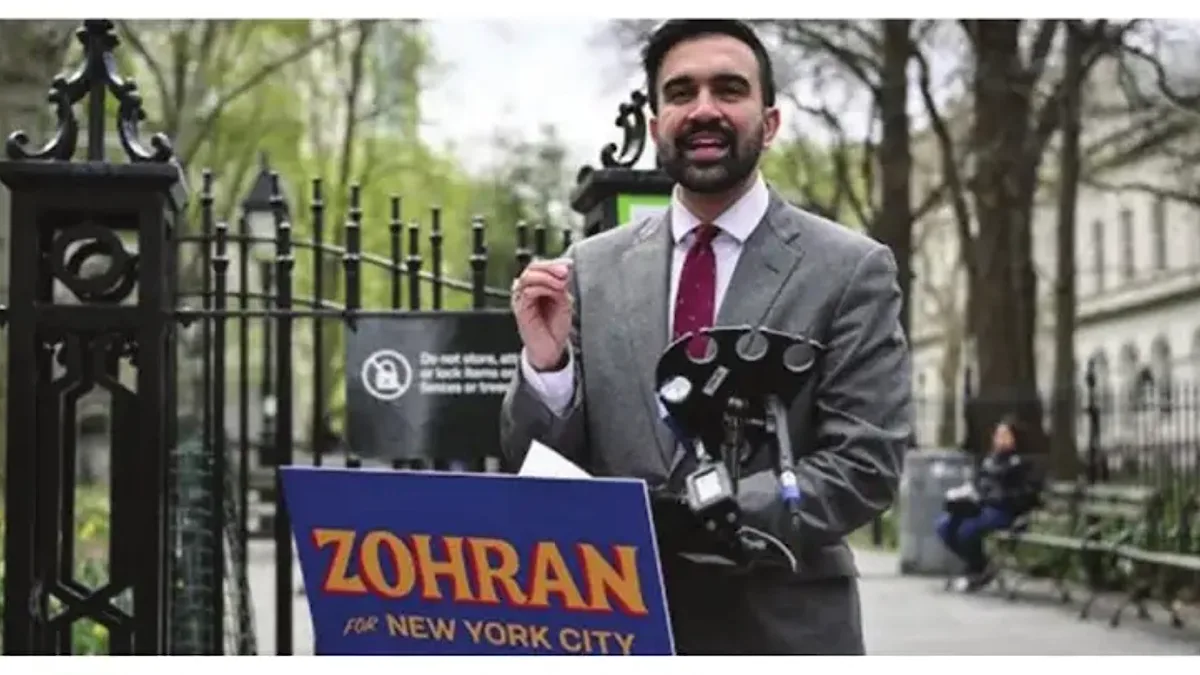
Zohran Mamdani’s remarkable ascent to the mayorship of New York City has already become one of the most significant political stories of the year, not only for its symbolic value but also for what it reveals about the shifting mood of the American electorate. His victory is historic on several fronts: he is the youngest mayor the city has elected in a century, the first Muslim and first Indian-origin leader of America’s largest metropolis, and a politician whose progressive agenda stands in sharp contrast to the right-leaning national climate shaped by Donald Trump.
Yet beyond these symbolic markers, Mamdani’s win signals a deeper transformation underway in American politics ~ an unmistakable reflection of discontent with Trump’s policies, a clear generational shift in urban governance, and a warning that the Republican Party can no longer ignore. What stands out most is that both Mamdani and Trump fought their political battles on the same issue ~ the cost-of-living crisis gripping the United States. Inflation, housing unaffordability, and economic anxiety have reshaped the American political imagination, pushing voters to seek real solutions rather than ideological theatrics. Trump continues to insist that tariff wars and aggressive protectionism will relieve pressure on the American middle class, claiming that foreign competitors and liberal policies are to blame for hardship.
Advertisement
Mamdani, in contrast, proposes a radically different diagnosis: that inequality, corporate concentration, and a governance model skewed toward elites lie at the heart of the crisis. His response is a suite of socialist-leaning measures ~ rent freezes, city-run grocery stores, fare-free buses, universal childcare, and higher taxes on millionaires. Whether these ideas ultimately succeed is an open question, but their electoral appeal is undeniable. Mamdani, just months ago dismissed as a fringe protest candidate, managed to galvanise millions of New Yorkers around a vision of affordability rooted in public service rather than private profit. His victory exposes something Republicans have feared privately but rarely admit publicly: Trump is losing ground.
Off-year elections across New Jersey, Virginia, New York, and California have highlighted an unmistakable pattern of voter rejection of Trump-backed candidates. Exit polls reveal that a meaningful share of Americans cast their ballots not to support a particular candidate but to oppose Trump himself. The poor performance of his endorsed candidates contradicts his claim that he was “not on the ballot,” because in the eyes of many voters, Trumpism was. The defeats reflect widespread dissatisfaction not only with the economic situation but also with the polarised rhetoric and combative governance style that have come to define the Trump presidency. Republican strategists already recognise that the party risks serious setbacks in the 2026 mid-term elections if it continues to follow Trump’s political instincts – particularly on economic issues.
It is equally important to understand that Mamdani’s victory is not merely a rejection of Trump, but a reflection of profound changes taking place in American urban politics. His campaign was unlike anything New York had seen: digital-first, multilingual, humorous, and firmly rooted in working-class struggles. His TikTok and Instagram presence made him a household name among younger voters. Meanwhile, his open embrace of his Shia Muslim identity, his South Asian roots in Gumla, and his family’s pluralistic traditions resonated deeply in a city that thrives on diversity. He spoke about discrimination, Islamophobia, and the experience of being made invisible, and he did so with honesty and vulnerability rather than defensiveness. For many voters across communities ~ Protestant, Catholic, Jewish, Muslim, Hindu ~ his willingness to speak frankly about identity signalled authenticity in an age of political cynicism.
At the same time, Mamdani’s rise has sharpened fissures within New York. Polls show that large sections of the population, especially wealthier residents, are considering leaving the city due to fears of higher taxation and progressive economic policies. Some parts of the police force are witnessing resignations, and conservative commentators already predict an administrative crisis. Trump and his allies have seized on these anxieties, painting Mamdani as an extremist who will drive the nation’s largest city into chaos. Trump has threatened to withhold federal funding from New York ~ move that could spark legal battles and further deepen American polarization.
Republican rhetoric has grown especially charged because Mamdani appointed an all-women transition team led by a Pakistani-origin progressive, Lina Khan, which triggered Islamophobic, xenophobic, and racist reactions from certain corners of the pro-Trump ecosystem. For the MAGA base, the sight of an Indian-origin Muslim mayor and a Pakistani-origin transition team co-chair symbolises a loss of cultural control, fuelling conspiratorial narratives about outsiders taking over traditional American institutions. Yet even this backlash underscores why Mamdani’s victory matters. It demonstrates that in a diverse democracy, identity can be a source of strength rather than limitation.
It also illustrates that younger, multicultural coalitions are increasingly asserting their place in American public life, refusing to remain politically invisible. Mamdani’s win represents not the triumph of a particular community, but the collective assertion of constituencies ~ immigrants, working-class residents, renters, minorities – who have long felt neglected by both parties. His victory speech, invoking Nehru’s “Tryst with Destiny,” was a symbolic reminder that history often turns on the courage of those willing to imagine a new political future. For many New Yorkers, Mamdani embodies that possibility. Of course, the real test begins now. Governing New York is a far more complex challenge than winning an election.
The city’s $116-billion budget, its policing dilemmas, its affordability crisis, and its strained infrastructure will require pragmatic solutions rather than ideological enthusiasm alone. Mamdani has promised to fight for working people every day, but such promises will eventually collide with the realities of municipal finance, federal-state politics, and entrenched interests. Critics warn that his agenda risks triggering an exodus of wealthy taxpayers whose contributions are essential to funding public services.
Supporters argue that the status quo is already untenable, and that bold experimentation is the only path forward. For now, it is too early to judge him; the success or failure of his policies will only become clear in the years ahead. What is undeniably clear, however, is that American politics stands at a threshold. Mamdani’s victory is a signal ~ not just to Trump and the Republican Party, but to America at large ~ that voters are hungry for alternatives, weary of polarization, and increasingly drawn to leaders who speak to their lived realities.
As New York begins this new chapter, the United States remains a deeply divided country, searching for a way forward. Mamdani’s win may not resolve these divisions, but it has certainly illuminated them. Whether New York emerges more united or more fractured will depend on how effectively he can translate his ambitious vision into governance. For now, the message from voters is unmistakable: change is not merely desired ~ it is demanded.
(The writer is Associate Fellow, Manohar Parrikar Institute for Defence Studies and Analyses)